10 Best Dash Cam with Rear Camera: Compared With Buying Guide
Below, I compare ten dash cams by their camera coverage, recording and storage details, connectivity, and parking-mode requirements. The buying guide then explains what to check before purchase, how to install and maintain a system, and how to choose a setup that suits your car and driving habits.
My first choice is 4K Full HD 3 Channel Dash Camera. Choosing the best dash cam with rear camera means balancing useful coverage, image quality, installation effort, and the cost of any extras. Some models record only the road ahead and behind, while others add cabin or side views; the right choice depends on what you want footage to show.
My second choice is 4K+1080P 3 FHD Car Camera 5ghz Wifi and App Control. As my alternative, the 4K+1080P 3 FHD Car Camera 5ghz Wifi and App Control ranks second for drivers who want four-channel coverage of the front, rear, and sides. Its included 64GB card, GPS, and app support make it a versatile option, though its separate hardwire kit is needed for parking monitoring.
My third choice is STARVIS 2 Sensor Free 128GB Card 4K Upscaled Front FHD. It ranks third because it offers built-in GPS, fast phone downloads, and a generous included card, but its front footage is upscaled rather than native 4K.
Below, I compare these options, explain the strengths and trade-offs of each one, and cover the buying factors plus practical setup, use, compatibility, maintenance, longevity, safety, troubleshooting, storage, and common mistakes that matter before choosing.
10 Best Dash Cam with Rear Camera Comparison
I selected these options for their relevance to front-and-rear recording, the practical detail available about their cameras and ownership requirements, and brand diversity where the supplied information made that possible. Customer-feedback evidence and ratings were not provided, so I do not use them to rank these products; the order reflects the supplied relevance scores and product details.
| # | Image | Product | Price on Amazon |
|---|---|---|---|
| 1 |  |
4K Full HD 3 Channel Dash Camera | Price on Amazon |
| 2 |  |
4K+1080P 3 FHD Car Camera 5ghz Wifi and App Control | Price on Amazon |
| 3 |  |
STARVIS 2 Sensor Free 128GB Card 4K Upscaled Front FHD | Price on Amazon |
| 4 |  |
GPS and 5G Band Wifi Night Vision 160 Wide Angle | Price on Amazon |
| 5 |  |
1296P Dash Camera | Price on Amazon |
| 6 |  |
Affver 5-Channel 4K Dash Camera | Price on Amazon |
| 7 |  |
SEEMOPEN D026 4K Dual Dash Camera | Price on Amazon |
| 8 | 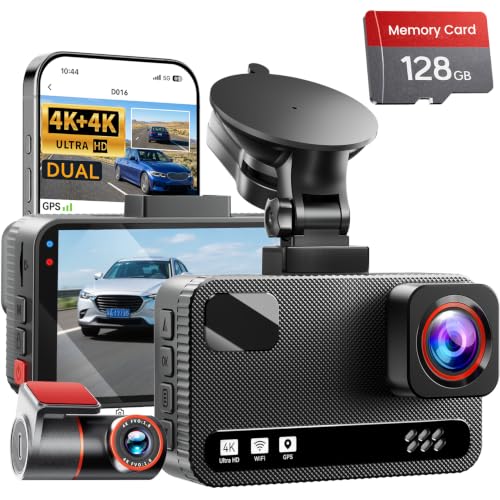 |
4K+4K Dual Dash Cam Front and Rear Free 128GB Card | Price on Amazon |
| 9 |  |
GPS Tracking HDR Night Vision 24H Parking Mode Voice Control | Price on Amazon |
| 10 |  |
5GHz Wifi App Control | Price on Amazon |
4K Full HD 3 Channel Dash Camera
This three-camera system records the road ahead, the cabin, and the area behind the vehicle. The front camera is specified at 4K with a 170-degree field of view; the interior and rear cameras record at 1080p, with 150- and 160-degree views respectively. That mix is useful for rideshare drivers, families, or anyone who wants more context than a forward-facing camera can provide.
The cabin camera combines infrared lights with a wide aperture and WDR, which can help when recording an interior at night. The rear camera must be mounted at the back of the car and connected to the front unit, so expect to route a cable along the vehicle’s interior trim. The front camera uses a straightforward windshield mount and a power connection.
A 32GB card is included, and loop recording replaces older unlocked footage when storage fills. The G-sensor locks a short segment around a detected collision so it is less likely to be overwritten. App access over Wi-Fi lets you view and download clips on iOS or Android. Parking mode is not a self-contained feature: it requires a separately purchased hardwire kit.
Pros
- Records front, cabin, and rear views.
- Includes a 32GB card and app access.
- G-sensor protects detected-event footage from loop overwrite.
Cons
- Parking mode requires an additional hardwire kit.
- The rear camera needs a wired connection to the front unit.
My Opinion
This is a practical pick when cabin footage matters as much as rear coverage. Before buying, confirm that you are comfortable routing the rear-camera cable and purchasing a hardwire kit if you want parked-car monitoring.
4K+1080P 3 FHD Car Camera 5ghz Wifi and App Control
XYGCACO’s four-channel system is aimed at drivers who want to capture more than the forward and rear views. It records the front in 4K and uses three adjustable 1080p lenses for rear, left, and right coverage. The 3-inch IPS screen gives you a way to check the camera views in the car, while the adjustable lenses allow some flexibility in how the extra angles are aimed.
The included 64GB card and loop recording make it ready for basic use after setup. A G-sensor can lock footage when it detects a collision, helping preserve an event clip as the camera continues recording. Built-in GPS records route information, and the Viidure app can be used to view or download clips over dual-band Wi-Fi. Phone connectivity is useful for accessing files without taking out the card, though app access still depends on a nearby connection to the camera.
Parking monitoring is available with a separately purchased hardwire kit. The stated mode watches for approaching objects within a limited area and records after detection, so buyers should not assume it captures every event around the car continuously. The suction-cup mount and included trim tool support installation, but a four-camera system naturally involves more aiming and cable management than a basic two-camera setup.
Pros
- Four channels cover front, rear, and both sides.
- Includes a 64GB card, GPS, and 3-inch screen.
- Adjustable lenses and app connectivity add flexibility.
Cons
- Parking mode requires a separate hardwire kit.
- Four views can take more time to position and wire.
My Opinion
Consider this model if side coverage is a priority, not merely a bonus. Its broad view set is the main reason to accept the extra setup work; drivers seeking a simpler front-and-rear system may not need all four channels.
STARVIS 2 Sensor Free 128GB Card 4K Upscaled Front FHD
The ROVE R2-4K Dual records the road ahead and behind, with a Sony STARVIS 2 IMX675 sensor in the front camera and a 1080p rear camera. One detail to understand before buying is that the front image is captured at 2.5K and intelligently upscaled to 4K; it is not native 4K recording. That distinction does not make it unsuitable, but shoppers comparing resolution labels should account for it.
The front camera’s F1.5 aperture, HDR, and STARVIS 2 sensor are intended to support clearer footage in low light. Built-in GPS can add route, location, and speed information to recordings, while the 3-inch display shows live speed and compass data. A free 128GB card is included, and the camera supports cards up to 1TB. For a driver who wants to retrieve a clip quickly, the ROVE app supports downloads at up to 20MB/s over 5.8GHz Wi-Fi.
Parking mode offers time-lapse, motion-detection, and collision-detection choices, but requires a separately purchased hardwire kit. The package includes mounting and cable-routing accessories, including a trim tool, which can simplify installation. ROVE also specifies a supercapacitor and thermal protection; check the supplied power cable and card for damage before use, and use a compliant 5V USB power source.
Pros
- Includes a 128GB card, GPS, and fast Wi-Fi downloads.
- Front sensor and aperture are suited to low-light recording.
- Offers three parking-mode options with a hardwire kit.
Cons
- Front recording is upscaled from 2.5K, not native 4K.
- Parking-mode hardwire kit is sold separately.
My Opinion
The ROVE is a strong option for drivers who value GPS, app-based file access, and a well-specified front sensor. Read the resolution description carefully and budget for the hardwire kit if parked monitoring is part of your plan.
GPS and 5G Band Wifi Night Vision 160 Wide Angle
This four-channel camera records in 1080p from the front, rear, left, and right. Its adjustable front cameras are described as allowing flexible angles, including interior footage. That can be helpful if you want a broader record of activity around the vehicle, but it is worth noting that the listed resolution is Full HD across the four channels rather than 4K.
Eight infrared lights and WDR are intended to improve visibility in low light and balance bright and dark areas in a scene. These tools can support useful footage in challenging lighting, but they cannot guarantee that every plate or detail will be readable. The system includes a 128GB card and uses loop recording, which replaces older unlocked clips when storage is full. Its incident-lock function is intended to preserve footage associated with an event.
Wi-Fi and a mobile app provide a way to share or retrieve recordings. GPS is optional: the GPS logger is sold separately, so route, location, and speed overlays are not included by default. Parking mode also needs an optional ACC hardwire kit. The product information mentions a supercapacitor, which may appeal to drivers considering operation in varied temperatures, but buyers should check the full package and compatibility details before ordering add-ons.
Pros
- Four 1080p channels provide front, rear, left, and right views.
- Includes a 128GB card and WDR with infrared lighting.
- Offers Wi-Fi app access and loop recording.
Cons
- GPS logger and parking-mode hardwire kit are extra purchases.
- All four cameras are specified at 1080p.
My Opinion
This model suits buyers who value multi-angle coverage and a large included card more than high-resolution front footage. Verify which accessories are in the package, especially if GPS or parked-car recording is essential to your use.
1296P Dash Camera
This three-channel dash camera records the front, cabin, and rear. Its front view is specified at 1296p, while the interior and waterproof rear cameras are listed with 150-degree fields of view. An IPS screen helps make the display easier to view from different angles. For drivers who want evidence of what happened inside the car as well as outside, the cabin camera adds context that a standard dual-channel setup cannot provide.
Four infrared LEDs support the cabin camera in low light, while HDR is intended to balance exposure when a scene includes both bright and dark areas. Those tools can help in night driving or when the cabin is dim, but they are not a substitute for careful camera placement. The included 32GB card can be used immediately, and loop recording lets the camera keep recording by replacing older files once storage fills.
The G-sensor can trigger emergency recording and lock footage after a sudden vibration or impact, including while the car is parked. The product information also lists a 24-hour parking monitor, but does not specify the same hardwire requirement details provided for several other options. Confirm the power method in the manual or with the seller before relying on parked monitoring. Installation is described as plug-and-play: mount the front unit, connect power, and position the rear camera.
Pros
- Three views include the cabin as well as front and rear.
- Includes a 32GB card and loop recording.
- Infrared lighting supports cabin footage in low light.
Cons
- Front resolution is listed as 1296p, not 4K.
- Parking-mode power requirements are not fully detailed in the supplied information.
My Opinion
This is worth considering if you want a straightforward three-camera setup with a cabin view. Clarify how parking mode is powered, and decide whether a 32GB card fits your expected recording needs before settling on it.
Affver 5-Channel 4K Dash Camera
Affver’s system uses five cameras to record the front, rear, cabin, left, and right views. It specifies a 4K front camera and four 1080p cameras, making it the broadest coverage option in this group. That breadth may be valuable in a large vehicle or for rideshare work, where side or cabin context can matter. It also means more lenses to position and more simultaneous video to store.
The included 128GB card is a useful starting point, and the camera supports cards up to 512GB. For five-channel recording, the supplied information recommends a high-endurance, heat-resistant card rated Class 10, U3, and V30 or higher. The adjustable G-sensor can lock footage when it detects a collision; loop recording then continues with unlocked files. Built-in GPS and Wi-Fi 6 support route information and phone-based file access.
Four infrared lights support the cabin view at night. Parking monitoring offers time-lapse or G-sensor recording, but requires the separately sold Affver hardwire kit. Installation is described as plug-and-play and intended for cars, SUVs, and trucks, though routing several cables can still take patience. The listing states a 24-month warranty and customer support, but the hardwire kit and any higher-capacity card should be treated as separate ownership costs unless the package details say otherwise.
Pros
- Five channels record front, rear, sides, and cabin.
- Includes a 128GB card, GPS, and Wi-Fi 6.
- Supports up to 512GB and recommends a high-endurance card.
Cons
- Parking mode requires a separate hardwire kit.
- Five-channel recording makes card quality and cable routing especially important.
My Opinion
Affver is the most coverage-focused choice here and may suit drivers who genuinely need every angle. Its extra cameras are less compelling for a typical commuter, who may prefer a simpler two- or three-channel system.
SEEMOPEN D026 4K Dual Dash Camera
The SEEMOPEN D026 records 4K from both the front and rear cameras, a useful distinction for buyers who want matching high-resolution recording at each end of the vehicle. Dual-channel HDR and night-vision processing are intended to balance bright and dark areas in challenging light. As with any camera, results depend on conditions and positioning; high resolution alone cannot guarantee that a distant plate will be legible.
A 128GB card is included, and the camera supports up to 1TB. Loop recording can be set to one-, three-, or five-minute clips, then replaces the oldest footage when the card is full. Built-in GPS records routes and location data, with an option to turn GPS off in settings. The 3-inch screen provides an in-car display, while Wi-Fi 6 supports app access and downloads at up to 20MB/s.
Parking mode offers time-lapse recording or collision detection and requires a separately sold hardwire kit. The system also has voice guidance, a manual emergency lock, and a driver-fatigue alert. Those extras can be useful, but they do not replace attentive driving or a careful installation. The supplied information states an operating range of -4°F to 158°F and an 18-month warranty. Use the included power cable or a compatible 5V USB source, and check the selected hardwire kit’s connection type before purchase.
Pros
- Records 4K at both the front and rear.
- Includes a 128GB card, GPS, and app-based file access.
- Supports up to 1TB and adjustable clip lengths.
Cons
- Parking mode needs a separate hardwire kit.
- GPS data is recorded unless disabled in settings.
My Opinion
This is a compelling fit for buyers who specifically want 4K rear footage, not just a high-resolution front view. Check card compatibility and the hardwire option before installation, and turn off GPS if you do not want location data in recordings.
4K+4K Dual Dash Cam Front and Rear Free 128GB Card
This dual-channel camera records 4K video from both the front and rear, with stated fields of view of 170 and 160 degrees. That makes it a straightforward match for shoppers who want high-resolution coverage at both ends without adding cabin or side cameras. The front and rear cameras record simultaneously, so placement and cable routing matter: a poorly aimed rear unit can leave a gap even when its resolution is high.
A 128GB card is included. The listing describes an f/1.5 aperture, a five-element lens, and WDR for balancing highlights and shadows, with a starlight-level sensor intended to support low-light capture. Dual-band Wi-Fi gives iPhone and Android users a way to preview or download clips through an app. GPS positioning and video data access are also listed, although the exact GPS playback method is not specified in the supplied details.
Loop recording replaces older files, while the collision sensor can lock an event clip. Parking mode uses time-lapse recording, and a detected collision can trigger a one-minute locked video. This feature requires the specified hardwire kit, ASIN B0H8Y69RQC, so confirm compatibility and availability before ordering. The product information states 18-month coverage and 24/7 support. There is no cabin camera, so rideshare drivers who need interior footage should compare a three-channel model instead.
Pros
- Records 4K from front and rear cameras.
- Includes a 128GB card, Wi-Fi, and GPS positioning.
- Collision-triggered parking clips can be locked.
Cons
- Parking mode requires a specified separate hardwire kit.
- No cabin or side cameras are listed.
My Opinion
This model has a clear purpose: high-resolution front-and-rear recording without extra camera channels. It is a sensible shortlist option if you do not need cabin coverage, provided the required parking-mode kit is compatible with your vehicle.
GPS Tracking HDR Night Vision 24H Parking Mode Voice Control
The 70mai A810 Lite records 4K at the front and 1080p at the rear. Its HDR, F1.55 aperture, and night-vision processing are intended to help balance low-light scenes and headlight glare. That combination may suit commuters who drive after dark, but the rear camera is Full HD rather than 4K, a distinction to weigh if rear detail is your priority.
Built-in GPS supports route, location, and speed data, while voice control offers hands-free operation for supported commands. The camera also uses a supercapacitor rather than a battery, which the supplied information describes as better suited to heat resistance and stable operation in extreme temperatures. A compact form is intended to fit behind the rearview mirror, helping keep the forward view less obstructed.
For parked-car monitoring, the A810 Lite supports impact detection and time-lapse recording, but the necessary UP03, UP05, or UP06 hardwire kit must be purchased separately. The UP05 is also needed for 4G LTE remote access and live viewing; those features are not available from the camera alone. Wi-Fi 6 supports phone downloads at up to 25MB/s, and the app can show GPS data and manage settings. A microSD card capacity is not stated in the supplied information, so check what is included and what the camera supports before buying.
Pros
- 4K front and 1080p rear recording with HDR.
- Built-in GPS, voice control, and fast Wi-Fi 6 downloads.
- Optional LTE remote access and parking modes.
Cons
- Rear camera records at 1080p, not 4K.
- Parking mode and LTE access require separately purchased kits.
- Included card details are not specified here.
My Opinion
The 70mai is a feature-rich choice for buyers who want GPS and the possibility of remote access. Before comparing it with simpler models, add the cost and compatibility of the hardwire kit and verify the memory-card package.
5GHz Wifi App Control
The C5 pairs a 4K front camera with a 1080p rear camera. Its compact design is intended to sit unobtrusively on the windshield, and the F1.8 aperture and night-vision processing are aimed at improving visibility in darkness or rain. It is a basic front-and-rear layout rather than a multi-channel system, so it will not record the cabin or sides of the car.
A 64GB card is included and pre-installed, but the instructions say to format it before first use, either through the camera or app. Loop recording replaces older files when the card fills. A G-sensor locks footage after a collision, and a separate button can manually lock the current recording. These protections are useful, but drivers should still save important clips to another device as soon as practical.
The iOS and Android app connects over 5GHz Wi-Fi for viewing, downloading, and sharing clips. The stated range is about three to five meters, and the camera is not wireless in the sense of operating without power: it must remain connected to a power source while recording. Parking mode supports impact detection or time-lapse, but requires a separately sold three-lead hardwire kit; the supplied details identify kit B0GTT21DLC as the compatible option. An additional USB port can charge another device while driving.
Pros
- 4K front and 1080p rear recording.
- Includes a pre-installed 64GB card.
- Manual and G-sensor event locking are available.
Cons
- Wi-Fi connection range is limited to about three to five meters.
- Parking mode requires a separate compatible hardwire kit.
- Card formatting is required before first use.
My Opinion
The C5 offers useful basics for a driver seeking a compact dual camera with a card included. Follow the initial formatting instruction, and do not mistake phone Wi-Fi connectivity for wireless power or remote access from outside the car.
How I Selected These Best Dash Cams with Rear Cameras
I focused on products that explicitly include rear-camera recording, then considered what the supplied details say about additional views, resolution, storage, incident protection, app access, and parked-car monitoring. The ranking also reflects the provided relevance scores, while emphasizing practical differences such as native versus upscaled resolution and whether key functions require separate accessories.
There were no verified customer ratings or customer-feedback volume in the supplied research. I therefore do not present popularity or owner satisfaction as established facts, and I avoid claiming that I installed or tested these cameras. Several listings also do not identify a brand in the provided data; I have not invented brand names to fill those gaps.
Check what a camera records in each channel, not just the largest resolution printed in its name. A front camera advertised as 4K may be upscaled, and rear-camera resolution can be different from front-camera resolution.
Parking mode often depends on a separately purchased hardwire kit. Verify the exact compatible kit and installation method before treating a dash cam as a 24-hour security system.
How to Choose the Best Dash Cam with Rear Camera
Start with the views you need, then compare recording quality, storage, and power requirements. A reliable, correctly positioned two-camera system may be more useful than a more complex setup that is difficult to install or maintain.
- Choose the number of cameras: front and rear may be enough for everyday driving; add cabin or side views only if they serve a real need.
- Compare resolutions by channel: check front and rear specifications separately, and distinguish native from upscaled resolution.
- Plan for power: confirm whether parking mode needs a compatible hardwire kit and whether professional installation is appropriate for you.
- Check storage: consider the included card, supported capacity, and whether the manufacturer recommends a high-endurance card.
- Think about file access: GPS, Wi-Fi, and an app can make footage easier to retrieve, but do not assume Wi-Fi means remote access.
Decide Between Two, Three, Four, or Five Channels
A two-channel setup records forward and rearward views and is often the simplest arrangement to manage. Three channels add a cabin view, which can matter for rideshare drivers or families who want an interior record. Four-channel systems may add left and right coverage; a five-channel setup can include the front, rear, both sides, and cabin. Each additional camera means more wiring, more positions to check, and more video files to manage.
Match the camera layout to the reason you are buying. If you mainly want evidence of a rear-end collision, extra side and cabin views may add cost and setup without changing your priorities. If you drive passengers or want a broader record around a large vehicle, the extra angles may be worthwhile.
Understand Resolution, Night Features, and Field of View
Read the resolution for every camera rather than relying on the product name. A 4K front camera paired with a 1080p rear camera is common in this list; only some models specify 4K at both ends. Also check whether a stated 4K image is native or upscaled. Aperture, HDR, WDR, and infrared lighting are processing or hardware details that can support recording in difficult light, but they cannot guarantee readable plates in every scene.
A wide field of view can capture more of the scene but may make distant details appear smaller. Proper placement matters as much as a wide-angle specification: aim the camera to include the road and avoid an obstructed view from trim, tint, or a rear wiper path.
Plan Storage Around Recording Channels
Included cards range from 32GB to 128GB among the products here, while some models support larger cards. Multi-channel and high-resolution recording can fill storage more quickly than a single-camera setup. Loop recording helps the camera continue by replacing older unlocked clips, but it does not preserve everything indefinitely.
For models that recommend high-endurance cards, follow that guidance and check the supported capacity and speed class in the manual. Format the card in the camera when instructed, and periodically confirm that the device is still recording. Do not assume a card supplied with one model is suitable for another camera.
Separate Driving Recording from Parking Surveillance
A dash cam powered through the vehicle’s accessory outlet may stop recording when the vehicle is off. Parking modes can use time-lapse, motion, or collision detection, but many products require a hardwire kit. Confirm whether the required kit is included, sold separately, or tied to a specific model. Where the supplied information does not explain the power arrangement, check the manual or ask the seller before relying on the feature.
For LTE remote access, confirm the additional hardware requirement too. For example, the listed 70mai remote-access functions need a suitable 4G hardwire kit; the camera’s ordinary phone Wi-Fi connection is not the same as internet-based remote viewing.
Installing a Front-and-Rear Dash Cam
Installation is easier when you plan the camera positions and cable route before sticking anything in place. Read the model’s instructions first, especially when parking mode or extra camera channels are involved. A rear camera normally connects to the front unit with a cable, so consider how that cable will reach the rear window without interfering with the driver.
Basic Setup Sequence
- Choose a front position that provides a clear road view without obstructing the driver’s sightline.
- Mount the front unit and connect it to the power source specified by the manufacturer.
- Position the rear camera where it can see through the rear window, then route its cable neatly along suitable interior trim.
- For multi-channel systems, aim each additional lens and check that its view is not blocked by seats, headrests, or cargo.
- Power on the camera and verify that every channel records and appears correctly before putting the trim fully back in place.
Use supplied cable clips or trim tools where provided. Avoid routing wires where they could interfere with airbags, pedals, seat adjustment, or the driver’s view. If you are unsure how to work around vehicle safety equipment or connect a hardwire kit, seek qualified installation help.
Using Apps, Wi-Fi, and GPS Wisely
Phone apps can make it more convenient to preview footage, download a clip, or adjust settings. Wi-Fi range is often limited to the area around the vehicle, so connect while parked near the camera rather than assuming you can access files from anywhere. Download important footage to your phone or computer and confirm that the file plays before sharing it.
GPS can add speed, route, or location data to recorded files, depending on the camera. That information may be useful when reconstructing a trip, but some owners may prefer not to record it. Check the settings and playback software for the model you choose; some cameras allow GPS recording to be turned off, while others may display or embed data differently.
Keeping Dash Cam Footage Useful
Event-lock features reduce the chance of an important clip being overwritten, but they are not a substitute for retrieving it. After a collision or other important incident, stop somewhere safe, identify the relevant file, and copy it to another device. Avoid repeatedly recording over the card before you have preserved footage you may need.
Simple Maintenance Routine
- Check that the front and rear lenses remain clean and unobstructed.
- Confirm that the date, time, and recording settings are correct.
- Inspect the power and rear-camera cables for looseness or visible damage.
- Check periodically that every camera channel is recording and that the card is recognized.
- Format the card in the camera when its instructions recommend it, after backing up anything important.
Some listed cameras include a supercapacitor or thermal protection, but that does not mean every component or memory card is immune to heat. Follow the operating guidance for the exact model, and replace a card that produces errors or fails to record reliably.
Common Dash Cam Buying and Setup Mistakes
Many avoidable problems come from assuming that similar-sounding features work the same way across models. Check the product-specific instructions and accessory requirements before installation, particularly if you expect the camera to monitor a parked car.
- Assuming all 4K labels mean the same thing: check whether the resolution is native or upscaled and whether it applies to the rear camera too.
- Forgetting the hardwire kit: parking mode may not work as expected without the compatible separately sold kit.
- Overlooking the cable route: an untidy or unsafe route can interfere with visibility or vehicle equipment.
- Ignoring the memory card instructions: some models require formatting before first use or recommend a particular card type.
- Expecting Wi-Fi to work remotely: local camera-to-phone Wi-Fi and LTE remote access are different capabilities.
- Relying only on automatic event locks: retrieve and back up important footage promptly, since storage and settings affect what remains available.
Before installation, make a short checklist: confirm the card, power cable, rear-camera cable, app, and any required hardwire kit. That simple check can prevent discovering a missing accessory after the camera is mounted.
FAQS About Best Dash Cam with Rear Camera
Do rear-camera dash cams record while the car is parked?
Some support parking monitoring, but the feature may require a separately purchased hardwire kit. Check the specific model’s power requirements and parking modes; a camera that records while driving may stop when the engine is off if it is powered only through an accessory outlet.
Is a 4K front camera with a 1080p rear camera enough?
It can be enough for drivers who prioritize forward footage and want a clear record behind the car. If rear detail is equally important, compare models that specify 4K recording from both cameras. Also check whether any 4K front image is native or upscaled.
Should I choose a dash cam with a cabin camera?
A cabin camera can be useful for rideshare driving or situations where interior activity matters. If you only need to capture the road ahead and behind, a two-channel model is simpler and avoids an extra view to position and manage.
Do I need to buy a memory card separately?
Not always. Several cameras in this roundup include a card, with capacities ranging from 32GB to 128GB. Check the exact package, supported card capacity, and any recommendation for a high-endurance card before purchase.
Can I use a dash cam app when I am away from my car?
Ordinary dash-cam Wi-Fi is generally for a nearby phone connection, not unlimited-distance access. Remote viewing or alerts may require a separate LTE accessory and compatible service; verify those requirements for the exact model.
How should I position the rear camera?
Mount it where it has a clear view through the rear window and is not blocked by cargo or other obstructions. Route its cable neatly to the front unit without interfering with the driver, airbags, or other vehicle equipment, and verify the image before finalizing the installation.
Final Thoughts
The best dash cam with rear camera depends on whether you need straightforward front-and-rear coverage or additional cabin and side views. My leading picks remain the 4K Full HD 3 Channel Dash Camera for three-view coverage, the XYGCACO 4-Channel 360° Dash Camera for broader angles, and the ROVE R2-4K Dual Dash Camera for GPS, app access, and a low-light-focused front sensor. Compare channel resolution, card requirements, and hardwire-kit compatibility before choosing.