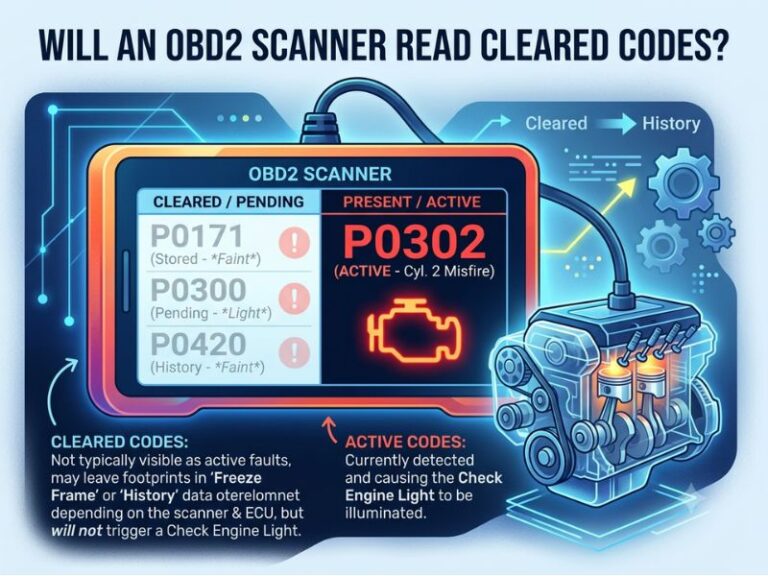
What Is a Car Code Reader and What Does It Do for Your Vehicle?
What is a car code reader? A car code reader is a handheld or wireless diagnostic device that connects to a vehicle’s onboard computer and retrieves stored trouble codes. These codes help identify which system detected a problem, such as the engine, transmission, emissions system, ABS, or airbags.
So, what does a car code reader do? It communicates with the vehicle’s control modules, displays diagnostic trouble codes, and may also show live sensor data, freeze-frame information, and emissions readiness status. However, the exact features depend on the type of reader you use.
The complete details are explained below. You will learn how a car code reader works, what information it can retrieve, which warning lights it can check, how to connect it, and why reading a code is not the same as completing a full diagnosis.
What Is a Car Code Reader?
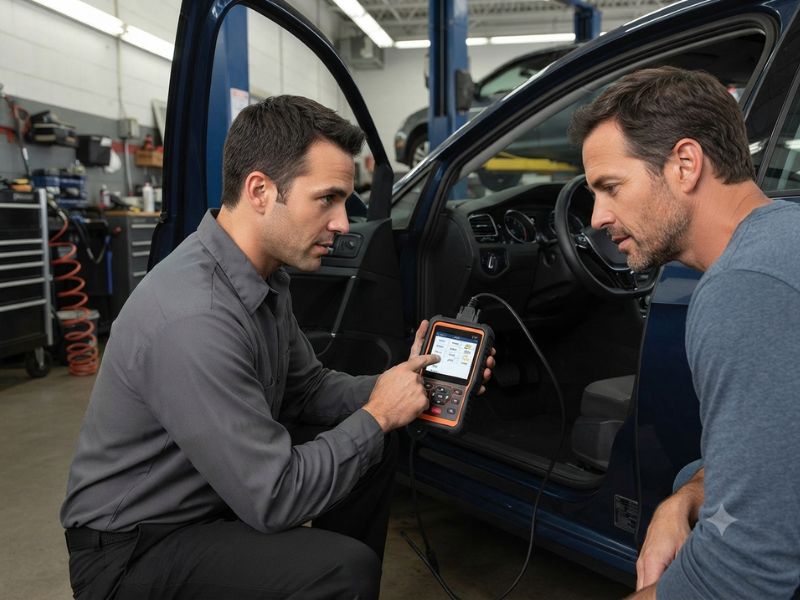
A car code reader is an electronic diagnostic tool used to communicate with a vehicle’s onboard computer system.
Modern vehicles contain multiple computers called control modules. These modules monitor the engine, transmission, braking system, airbags, body electronics, and many other components.
When a module detects an abnormal condition, it may store a Diagnostic Trouble Code, commonly called a DTC.
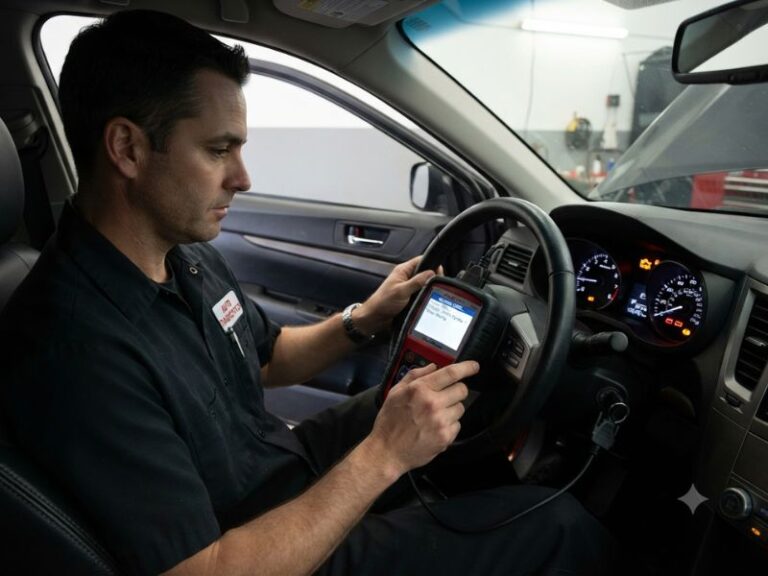
A car code reader accesses these stored codes through the vehicle’s diagnostic port.
Most modern readers connect to the OBD2 port, which is normally located under the driver’s side dashboard near the steering wheel.
The reader can then display a code such as:
- P0300
- P0171
- P0420
- P0700
- C0035
Each code points to a particular system or condition that requires further inspection.
A code reader does not automatically repair the vehicle. It provides information that helps you or a technician decide where to begin testing.
What Does a Car Code Reader Do?
A car code reader retrieves diagnostic information stored inside the vehicle’s computers.
Its most basic function is reading the code responsible for the Check Engine Light.
Depending on the device, it may also:
- Read stored trouble codes
- Display pending codes
- Show permanent emissions codes
- Clear certain warning codes
- Turn off the Check Engine Light after repairs
- Display freeze-frame information
- Check emissions readiness monitors
- Show basic live sensor readings
- Access transmission, ABS, or airbag modules
A simple reader may only provide the code number and a short description.
An advanced scanner may show detailed data, system tests, maintenance functions, and information from nearly every electronic module in the vehicle.
How Does a Car Code Reader Work?
A car code reader works by connecting to the vehicle’s diagnostic network.
On most 1996 and newer vehicles sold in the United States, this connection is made through a standardized 16-pin OBD2 port.
The reader sends a request to the vehicle’s computer. The control module responds with stored diagnostic information.
The basic process is:
- Connect the code reader to the OBD2 port.
- Turn the ignition to the ON position.
- Allow the reader to communicate with the vehicle.
- Select the option to read codes.
- Record the displayed code numbers and descriptions.
Some readers automatically identify the communication protocol. Advanced tools may also identify the vehicle through its Vehicle Identification Number.
Bluetooth readers work in a similar way. The adapter connects to the diagnostic port and sends vehicle information to an app on a phone or tablet.
What Is an OBD2 Code?
An OBD2 code is a combination of letters and numbers that describes a fault detected by a vehicle control module.
A common code format looks like this:
P0301
The first letter identifies the general system.
P means powertrain, including the engine and transmission.
B means body systems.
C means chassis systems.
U means communication or network systems.
The numbers provide additional information about the type and location of the fault.
For example, P0301 generally relates to a misfire detected in cylinder one.
However, the code does not prove which component has failed.
A cylinder misfire may be caused by:
- Worn spark plug
- Failed ignition coil
- Fuel injector problem
- Vacuum leak
- Low compression
- Damaged wiring
- Fuel pressure problem
The code identifies the detected condition. Further testing identifies the actual cause.
What Types of Codes Can a Car Code Reader Find?
The codes a reader can access depend on its software and vehicle coverage.
Stored Codes
A stored code is a confirmed fault that has met the vehicle computer’s requirements for recording a problem.
Stored emissions-related codes commonly turn on the Check Engine Light.
Pending Codes
A pending code means the computer detected a possible problem, but the fault has not happened often enough to become confirmed.
If the condition occurs again, the pending code may become a stored code.
Permanent Codes
Permanent codes are emissions-related faults that cannot normally be erased manually.
The vehicle removes a permanent code after the underlying problem has been repaired and the computer confirms normal operation.
Manufacturer-Specific Codes
Manufacturers use additional codes for systems and components unique to their vehicles.
A basic reader may display the code number but provide limited information.
An advanced scanner with manufacturer-specific coverage can usually provide a more detailed description.
Can a Car Code Reader Diagnose the Check Engine Light?
Yes, checking the Check Engine Light is the main purpose of a basic car code reader.
When the light turns on, the engine or powertrain computer has stored one or more diagnostic trouble codes.
A code reader can retrieve those codes and may provide a basic description.
For example:
P0171 may indicate that the engine is running too lean.
P0300 may indicate random or multiple-cylinder misfires.
P0420 may indicate low catalytic converter efficiency.
P0455 may indicate a large evaporative emissions leak.
Reading the code gives you useful direction, but it does not complete the diagnosis.
For example, P0455 could be caused by a loose fuel cap, cracked vapor hose, leaking valve, damaged charcoal canister, or another EVAP system problem.
Can a Car Code Reader Read Transmission Codes?
Some car code readers can retrieve transmission codes.
Generic transmission-related powertrain codes often begin with P07, P08, or P09.
A basic reader may display codes such as:
- P0700
- P0715
- P0720
- P0730
- P0740
However, many vehicles use a separate Transmission Control Module.
A basic reader may show P0700, which indicates that the transmission module requested the Check Engine Light, but it may not display the detailed code stored inside the TCM.
For complete transmission diagnostics, you usually need an enhanced scanner that specifically supports TCM access.
Can a Car Code Reader Read ABS Codes?
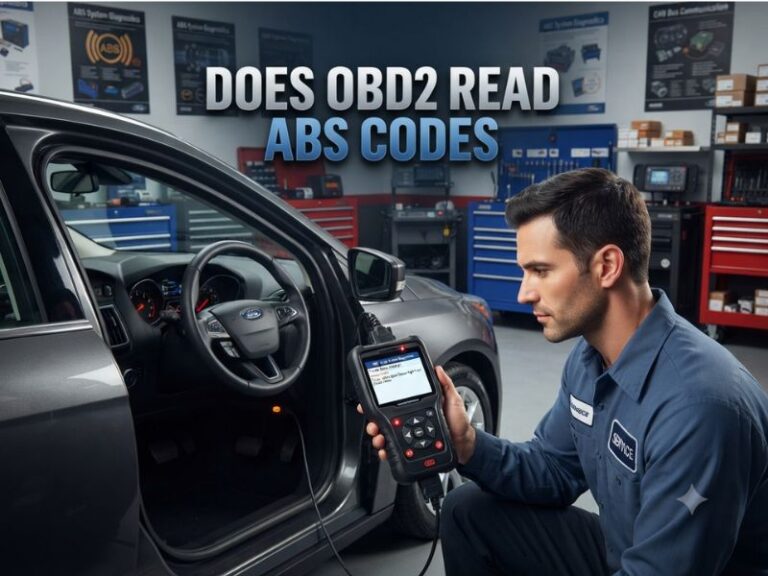
A basic code reader usually cannot read ABS codes.
The Anti-lock Braking System is controlled by a separate brake control module.
ABS faults are commonly stored as chassis codes, often beginning with the letter C.
To retrieve these codes, the scanner must specifically support:
- ABS diagnostics
- Brake control modules
- Chassis codes
- Vehicle-specific communication
A generic engine reader may display “No Codes Found” even when the ABS warning light is illuminated.
An ABS-capable or full-system scanner is required for many brake-related faults.
Can a Car Code Reader Read Airbag Codes?
A basic car code reader normally cannot access airbag or SRS codes.
The Supplemental Restraint System is managed by a separate airbag control module.
An airbag-capable scanner must support:
- SRS diagnostics
- Airbag control module communication
- Seat-belt pretensioner codes
- Occupancy sensor faults
- Impact sensor codes
The scanner may still use the same OBD2 port, but it needs the correct software to communicate with the restraint system.
An illuminated airbag warning light means part of the safety system may not operate correctly during a collision. It should be professionally diagnosed if your reader cannot access the module.
What Is Freeze-Frame Data?
Freeze-frame data is a snapshot of selected vehicle operating conditions recorded when a diagnostic trouble code was set.
It may include:
- Engine speed
- Vehicle speed
- Coolant temperature
- Engine load
- Fuel trim
- Throttle position
- Intake air temperature
This information can help determine when and how the problem occurred.
For example, freeze-frame data may show that a misfire happened during cold startup, highway acceleration, idle, or heavy engine load.
Basic readers may provide limited freeze-frame information. More advanced scanners display a larger number of data values.
Always save freeze-frame data before clearing codes.
What Are Readiness Monitors?
Readiness monitors are self-tests performed by the vehicle’s emissions system.
They check systems such as:
- Catalytic converter
- Oxygen sensors
- Evaporative emissions
- Exhaust gas recirculation
- Misfire detection
- Fuel system
A code reader can show whether each monitor is:
- Ready
- Complete
- Not ready
- Unsupported
This information is important before an emissions inspection.
When codes are cleared or the battery is disconnected, many monitors reset to “not ready.”
The vehicle must then complete specific driving conditions before the monitors become ready again.
Can a Code Reader Clear the Check Engine Light?
Yes, most OBD2 code readers can clear certain stored and pending codes.
Clearing the codes may turn off the Check Engine Light temporarily.
However, clearing a code does not repair the underlying problem.
If the fault is still present, the computer will detect it again and the warning light will return.
Clearing codes may also erase:
- Freeze-frame data
- Pending faults
- Fuel-trim information
- Emissions readiness status
- Useful diagnostic evidence
Always record the codes and available data before selecting the erase function.
Do not clear codes simply to hide a warning light before selling or inspecting a vehicle.
What Is the Difference Between a Code Reader and a Scan Tool?
The terms code reader and scan tool are sometimes used interchangeably, but they can describe different levels of equipment.
A basic code reader usually offers:
- Generic engine code reading
- Code clearing
- Basic code descriptions
- Emissions readiness checks
- Limited freeze-frame data
A more advanced scan tool may provide:
- Full-system scanning
- ABS and airbag access
- Transmission module access
- Live data graphs
- Bidirectional controls
- Service resets
- Battery registration
- Electronic parking brake functions
- Sensor relearning
- Module coding or programming
A basic reader is useful for checking the Check Engine Light.
A full-system scanner is more suitable for professional diagnosis or vehicles with several electronic systems.
Wired, Bluetooth, and Professional Code Readers
Car code readers are available in several formats.
Wired Code Readers
A wired code reader has a built-in cable and display.
It connects directly to the OBD2 port and receives power from the vehicle.
These readers are simple, reliable, and do not require a phone.
Bluetooth Code Readers
A Bluetooth adapter plugs into the OBD2 port and sends data to a smartphone app.
These devices are compact and may provide live gauges, code definitions, and data logging.
However, quality and system coverage vary widely.
Some inexpensive adapters only support generic engine diagnostics.
Professional Scan Tools
Professional scan tools provide broader vehicle coverage and advanced functions.
They may access nearly every control module and perform active tests, calibration, relearning, and programming.
These tools are more expensive and usually require regular software updates.
How to Connect a Car Code Reader
Park the vehicle safely and apply the parking brake.
Turn off the engine and locate the OBD2 port under the driver’s side dashboard.
Insert the reader’s connector firmly into the port.
Turn the ignition to the ON position without starting the engine unless the reader instructs you otherwise.
The dashboard warning lights should illuminate.
Allow the reader to establish communication, then select Read Codes, Scan, or Diagnostics.
Record all code numbers and descriptions before clearing anything.
The engine normally does not need to run to retrieve stored codes.
It may need to run if you want to view live engine data.
Why Is the Code Reader Not Connecting?
A reader may fail to connect because of a power, compatibility, or communication problem.
Common causes include:
- Ignition not in the ON position
- Loose scanner connection
- Blown diagnostic-port fuse
- Weak vehicle battery
- Damaged OBD2 connector
- Bent terminals
- Unsupported vehicle
- Faulty scanner
- Outdated scanner software
- Network communication problem
If the reader does not turn on, check the OBD2 port power and related fuse.
If it powers on but shows “No Link,” confirm the ignition position and scanner compatibility.
Testing the reader on another compatible vehicle can help determine whether the problem is with the tool or the car.
Can You Use a Code Reader on Any Car?
Most standard OBD2 readers work with many 1996 and newer passenger vehicles sold in the United States.
However, compatibility may vary for:
- Older OBD1 vehicles
- Heavy-duty trucks
- Imported vehicles
- Electric vehicles
- Hybrid systems
- Diesel engines
- Manufacturer-specific modules
A basic reader may connect to the engine computer but not support every system.
Before purchasing a scanner, confirm compatibility with the vehicle’s year, make, model, and diagnostic system.
Is a Car Code Reader Worth Buying?
A basic car code reader can be a useful and affordable tool for vehicle owners.
It allows you to:
- Check why the engine light is on
- Record codes before visiting a mechanic
- Check emissions readiness
- Monitor recurring problems
- Confirm whether a repair stopped a code from returning
- Avoid clearing valuable diagnostic information accidentally
However, a code reader should not encourage guessing or unnecessary parts replacement.
The tool is most valuable when combined with reliable repair information and proper testing.
What a Car Code Reader Cannot Do
A car code reader has important limitations.
It cannot always:
- Identify the exact failed component
- Detect every mechanical problem
- Test fuel pressure
- Measure engine compression
- Find every wiring fault
- Confirm internal transmission damage
- Repair the vehicle
- Access unsupported modules
A vehicle can have serious mechanical problems without storing a diagnostic code.
For example, worn brakes, low compression, damaged suspension, fluid leaks, and internal engine noise may not produce an OBD2 fault.
Use the scanner as one part of the diagnostic process.
Final Thoughts
So, what is a car code reader? It is a diagnostic device that connects to a vehicle’s computer and retrieves stored trouble codes, warning information, emissions status, and sometimes live sensor data.
And what does a car code reader do? It helps identify which system detected a problem and gives you a starting point for further inspection.
A basic reader is usually suitable for Check Engine Light codes, while an advanced scanner may access the transmission, ABS, airbags, and other modules. Always record codes before clearing them and remember that a trouble code points toward a system or condition—it does not automatically confirm which part needs replacement.