Will an OBD2 Scanner Read Cleared Codes? Complete Explanation
Will an OBD2 scanner read cleared codes? Usually, no. Once standard diagnostic trouble codes are successfully erased from the vehicle’s computer, a basic OBD2 scanner normally cannot retrieve them as historical codes. However, permanent codes, incomplete readiness monitors, or records stored in other control modules may still reveal that a fault or recent reset occurred.
The complete details are explained below. In this article, you will learn what happens when codes are cleared, which information is deleted, why permanent codes can remain, how quickly a fault can return, and how to check whether a used vehicle’s codes were recently erased.
Will an OBD2 Scanner Read Cleared Codes?
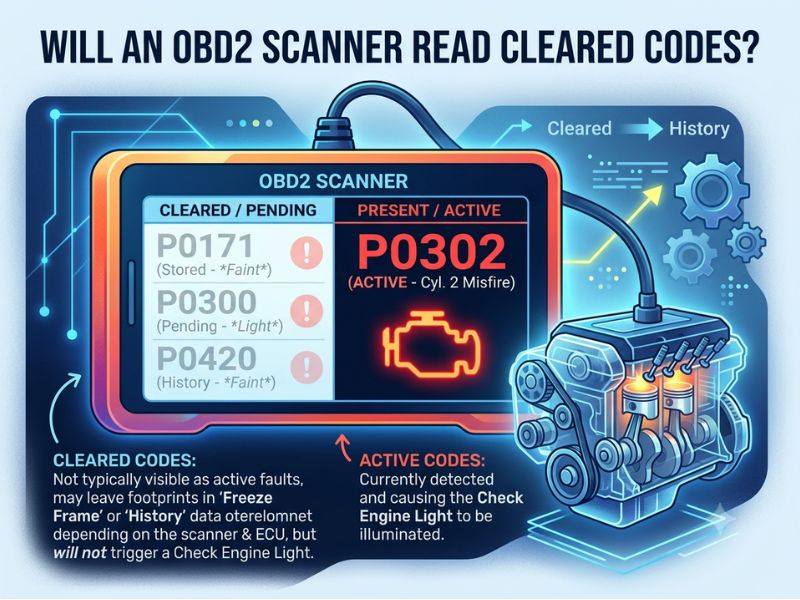
A standard OBD2 scanner generally cannot read stored or pending codes after they have been properly cleared from the engine control module. Clearing the codes deletes the diagnostic information that the scanner would normally display.
However, clearing a code does not necessarily remove every sign of the problem. The vehicle may still show a permanent diagnostic trouble code, reset readiness monitors, or store related faults in another module.
If the underlying mechanical or electrical problem has not been repaired, the code may also return after the vehicle completes the required self-tests.
For example, suppose a vehicle has a P0420 catalyst-efficiency code. Someone clears the code without repairing the exhaust or catalytic converter problem. The check engine light may remain off temporarily, but the computer will continue monitoring the system. When the catalyst monitor runs again and detects the same condition, the code may return.
Therefore, a cleared code is not the same as a repaired problem.
What Happens When You Clear OBD2 Codes?
When you use a scanner’s erase function, it sends a command to the powertrain control module to remove certain diagnostic information.
On most vehicles, this process clears the active check engine light and deletes standard stored or confirmed codes. It may also remove pending codes and reset information used by the emissions-monitoring system.
The exact result varies by vehicle, but clearing engine codes commonly affects:
- Stored and pending trouble codes
- Check engine light status
- Freeze-frame information
- Emissions readiness monitors
- Some adaptive values
A code erase does not physically repair a damaged sensor, vacuum leak, misfire, wiring fault, or emissions problem. It only removes the computer’s current record of the fault.
If the problem is still present, the control module will detect it again when the relevant monitor runs.
Can a Scanner Recover Deleted OBD2 Codes?
A basic code reader cannot normally recover a confirmed code after it has been erased from the engine computer. Once the module accepts the clear command, the code is no longer available through the standard stored-code list.
This is similar to deleting a record rather than hiding it. The scanner can only display the information that the control module currently makes available.
More advanced diagnostic equipment does not automatically restore erased generic OBD2 codes either. A professional scan tool may access additional data, but it cannot recreate a code that has been completely removed from the module’s accessible memory.
However, an advanced scanner may find related evidence elsewhere. Modern vehicles contain multiple computers, including the transmission, body, ABS, airbag, four-wheel-drive, and advanced driver-assistance modules.
A fault erased from the engine computer may still have generated communication codes, event records, or related faults in another module. Whether those records remain depends on the vehicle and the type of problem.
Permanent Codes May Remain After Clearing
A permanent diagnostic trouble code, sometimes called a permanent DTC, is different from a normal stored code.
Permanent codes are mainly associated with emissions-related faults. They were introduced to make it harder to hide an emissions problem by simply disconnecting the battery or clearing the check engine light immediately before an inspection.
A normal scanner generally cannot manually erase a permanent code. The engine computer removes it only after the fault has been repaired and the vehicle successfully completes the required monitoring process.
For example, a driver may repair an oxygen-sensor problem and clear the ordinary stored code. The permanent version may still appear when the vehicle is scanned.
After the vehicle completes the necessary drive cycles and confirms that the fault is no longer present, the computer can remove the permanent code automatically.
This means a scanner may not recover the original cleared stored code, but it may still display a permanent record of the same emissions-related fault.
Stored, Pending, and Permanent Codes Explained
Understanding the main code types makes it easier to determine what a scanner can read after a reset.
A stored or confirmed code means the computer has detected a fault that met the conditions required to register a confirmed problem. This type of code commonly turns on the check engine light.
A pending code means the computer has detected an abnormal condition, but the problem has not yet occurred enough times to become confirmed. Some pending faults disappear when the system passes later tests, while others become stored codes if the problem happens again.
A permanent code records certain confirmed emissions-related failures. It remains until the computer verifies that the repair was successful.
Clearing codes usually removes standard stored and pending codes, but it cannot immediately remove qualifying permanent codes.
Does Clearing Codes Erase Freeze-Frame Data?
In most cases, clearing engine codes also deletes the associated freeze-frame data.
Freeze-frame data is a snapshot of the vehicle’s operating conditions when the computer recorded a fault. It may include engine speed, coolant temperature, vehicle speed, fuel trim, engine load, and other useful information.
This data can help a technician understand when and why the problem occurred.
For example, freeze-frame information may show that a misfire happened during a cold start, under heavy acceleration, or while the engine was idling. That context can make diagnosis much easier.
Once the code and freeze-frame data are cleared, the original snapshot is usually unavailable through a standard scanner.
For this reason, you should read and save all diagnostic information before selecting the erase-codes option.
What Happens to Readiness Monitors?
Clearing OBD2 codes normally resets most readiness monitors to “not ready” or “incomplete.”
Readiness monitors are self-tests performed by the vehicle’s computer. They evaluate systems such as the catalytic converter, oxygen sensors, evaporative emissions system, exhaust gas recirculation, and misfire detection.
Some monitors run continuously, while others require specific driving conditions.
After codes are cleared, the vehicle must complete enough driving and testing before the monitors become ready again. This process is often called a drive cycle, although the exact conditions vary by manufacturer and monitor.
A scanner may therefore show no stored codes while displaying several incomplete monitors. This can indicate that the battery was recently disconnected, codes were cleared, or the computer lost power.
Incomplete monitors do not prove that someone was trying to hide a problem. Recent repairs, battery replacement, cold weather, short trips, and normal service can also reset or delay them.
Can You Tell If Someone Recently Cleared the Codes?
You may not be able to see the deleted code itself, but you can often identify signs of a recent reset.
The most useful clue is the readiness-monitor status. If nearly every non-continuous monitor shows “not ready,” the vehicle’s computer may have been reset recently.
A permanent code is another useful clue. A vehicle may have no active check engine light and no stored code while still displaying a permanent DTC related to a previous emissions fault.
Some advanced scanners can also display information such as distance traveled since codes were cleared, warm-up cycles since reset, or time since the check engine light was cleared. Availability depends on the vehicle.
When inspecting a used car, scan the vehicle before agreeing to purchase it. Check stored, pending, and permanent codes, as well as readiness-monitor status.
A recently cleared system does not automatically mean the vehicle is defective, but it is a reason to ask questions and consider driving the vehicle long enough for its monitors to run.
How Long Does It Take for a Cleared Code to Return?
A code may return almost immediately or take several days of driving. The timing depends on the fault and the conditions required for the relevant monitor to operate.
A severe misfire, disconnected sensor, or major electrical fault may cause the code and check engine light to return within seconds or minutes.
Other systems require more specific conditions. An evaporative emissions monitor may need a particular fuel level, ambient temperature, engine temperature, and period of vehicle rest before it runs.
A catalytic-converter or oxygen-sensor monitor may require the engine to reach operating temperature and the vehicle to maintain certain speeds.
The fault may first return as a pending code. If it occurs again under the required conditions, it may become a confirmed code and turn the check engine light back on.
Because of these requirements, a short test drive does not always prove that a cleared vehicle has no problems.
Will Disconnecting the Battery Remove Codes?
Disconnecting the battery may clear standard codes on some vehicles, but it does not always remove every diagnostic record.
Older vehicles often lose stored engine codes and adaptive information when battery power is removed. Many newer vehicles retain more information in non-volatile memory.
Permanent emissions codes generally cannot be erased simply by disconnecting the battery. They remain until the control module confirms that the fault has been corrected.
Battery disconnection can also reset readiness monitors, clock settings, radio preferences, and learned engine or transmission values.
Using battery disconnection as a repair method is not recommended. The correct approach is to scan the vehicle, diagnose the cause, complete the repair, and then clear the code if appropriate.
Can a Dealer See Cleared Codes?
A dealer-level diagnostic tool may access more modules and manufacturer-specific information than a basic OBD2 scanner.
It may display enhanced data, fault counters, test results, operating history, or codes stored in modules that a generic reader cannot access.
However, a dealer tool cannot always recover a standard engine code after it has been completely erased. The available history depends on how the manufacturer designed the vehicle’s control modules.
Some vehicles retain useful records, while others provide little evidence beyond reset monitors, permanent codes, and current test results.
A dealership may still identify the original problem through live data, component testing, monitor results, symptoms, and related codes stored elsewhere.
Should You Clear a Code Before Repairing the Problem?
You should normally diagnose the fault before clearing it.
A diagnostic trouble code identifies the system or condition detected by the computer. It does not always identify the exact failed part.
For example, a lean-condition code does not automatically mean the oxygen sensor is bad. The real cause could be a vacuum leak, low fuel pressure, a contaminated mass airflow sensor, an exhaust leak, or incorrect sensor data.
Before clearing the code, record the stored, pending, and permanent DTCs. Save the freeze-frame information and review relevant live data.
After completing the repair, clear the codes and drive the vehicle under the conditions required for the monitor to run again. Then scan it once more to confirm that the code has not returned and the readiness monitors are progressing normally.
Why Clearing Codes Can Make Diagnosis Harder
Clearing codes too early can remove some of the most useful evidence available to a mechanic.
The code, freeze-frame snapshot, pending-code status, and monitor results help show how the vehicle behaved when the fault occurred.
Without that information, a technician may need to wait for the problem to happen again before completing an accurate diagnosis.
Intermittent faults are especially difficult. A loose connector, temporary fuel-pressure drop, or occasional misfire may not return during a short inspection.
If you plan to take the vehicle to a repair shop, avoid clearing the codes unless the technician asks you to do so.
How to Scan a Vehicle Before Clearing Codes
Connect the scanner with the ignition in the position recommended by the scanner manufacturer. Allow it to communicate with the vehicle, then perform a complete scan.
Read the stored and pending engine codes first. If the scanner supports permanent codes, review those separately.
Next, examine freeze-frame data and note the vehicle conditions associated with each fault. Review the readiness monitors and relevant live data.
Save a scan report or photograph the results before erasing anything.
After the repair, clear the codes, start the engine, and check whether any fault returns immediately. Complete the required drive cycle, then scan the vehicle again.
This process gives you a clear before-and-after record instead of relying only on whether the check engine light remains off.
Final Thoughts
So, will an OBD2 scanner read cleared codes? A standard scanner usually cannot recover ordinary stored or pending codes after they have been successfully erased. Their freeze-frame information is also commonly deleted during the reset.
However, permanent codes, incomplete readiness monitors, fault counters, and records in other vehicle modules may still provide evidence of an earlier problem or recent reset.
Clearing a code should never be treated as a repair. Read and save all available diagnostic information first, fix the underlying problem, and confirm the repair by completing the appropriate drive cycle and scanning the vehicle again.