What Does Ect Mean on Obd2 Scanner: Clear Answers and Key Facts
ECT on an OBD2 scanner means Engine Coolant Temperature. It is the temperature reading reported by the coolant temperature sensor to the vehicle’s computer, usually shown in degrees Fahrenheit or Celsius.
If you are checking a car with a scanner, the goal is usually to decide whether the engine is warming normally, running too hot, or receiving an inaccurate temperature signal. That decision depends on context: a cold engine should show a temperature close to the surrounding air, while a fully warmed engine commonly reaches roughly 180–220°F, depending on the vehicle, thermostat, load, and operating conditions.
This guide explains how the ECT parameter works, what readings are generally reasonable, how the sensor affects fuel control and cooling fans, and why a code or unusual value does not automatically prove the sensor itself has failed. You will also learn how to compare the reading with actual engine conditions, recognize overheating risks, distinguish common ECT fault patterns, and decide when basic checks are appropriate and when professional diagnosis is safer.
What ECT Means on an OBD2 Scanner
ECT is the abbreviation for engine coolant temperature. The reading comes from the engine coolant temperature sensor, commonly called the ECT sensor, and is transmitted to the engine control module (ECM) or powertrain control module (PCM).
The sensor is usually installed in a coolant passage, thermostat housing, cylinder head, or intake manifold area. Its job is not to measure the temperature of every part of the engine. Instead, it gives the computer an estimate of coolant temperature at a strategically selected location.
Most ECT sensors are thermistors. Their electrical resistance changes as temperature changes, allowing the control module to calculate a temperature value. On many vehicles, resistance decreases as coolant temperature increases, although the scanner displays the converted result rather than the resistance itself.
On a scan tool, ECT may appear under different labels, including “Coolant Temp,” “Engine Coolant Temperature,” or “ECT Sensor.” It is a live-data parameter, separate from a diagnostic trouble code (DTC). A code indicates that the computer detected a problem; the ECT value shows what the system is reporting at that moment.
What a Normal ECT Reading Looks Like
The most useful first check is the reading before the engine is started. After the vehicle has been parked long enough to cool completely, ECT should generally be close to the outdoor air temperature and often close to the intake air temperature (IAT) reading.
A small difference is normal because the sensors are in different locations and may respond at different speeds. However, an ECT value that says ils 180°F on a cold morning, or -40°F after the vehicle has been sitting overnight, deserves attention.
Once the engine starts, the ECT value should usually rise gradually. It may increase slowly during cold weather, while idling, or when the vehicle has a high-efficiency engine. During ordinary driving, many engines stabilize somewhere around 180–220°F, but the correct operating range varies.
The thermostat rating, cooling-system design, ambient temperature, engine load, vehicle speed, and emissions strategy all affect the displayed temperature. A number outside a general range is not enough by itself to condemn a component.
- Cold-soak reading: Usually near ambient temperature before startup.
- Warm-up pattern: A steady increase rather than an immediate jump or a permanently fixed value.
- Operating temperature: Often near the thermostat’s regulated range, but vehicle-specific information is more reliable than a universal number.
- Overheating concern: A rising value accompanied by warning lights, steam, coolant loss, or abnormal engine behavior requires prompt action.
Some scan tools display coolant temperature as a generic value calculated from the vehicle’s data stream. It may not match the dashboard gauge exactly, because the gauge can be deliberately damped so it stays near the middle across a broad range of actual temperatures.
Why the ECT Reading Matters
The ECM uses coolant temperature for much more than displaying information. During a cold start, it may add fuel, adjust ignition timing, control idle speed, and manage emissions-related systems. As the engine warms, those strategies change.
ECT data can influence fuel injection, closed-loop operation, evaporative-emissions functions, transmission behavior, radiator-fan operation, and air-conditioning requests. An incorrect reading can therefore create symptoms that appear unrelated to temperature measurement.
If the computer believes the engine is colder than it really is, it may enrich the mixture and maintain a higher idle for too long. Possible results include poor fuel economy, fuel odor, rough running, black smoke, hard starting when warm, or spark-plug fouling.
If it believes the engine is warmer than it really is, it may reduce cold-start enrichment prematurely. The vehicle might start poorly, hesitate, stall, or run lean during warm-up. A false high reading can also affect cooling-fan decisions, depending on the vehicle’s control strategy.
ECT information is only one input among many. The ECM compares it with data from the intake air temperature sensor, mass airflow sensor or manifold absolute pressure sensor, oxygen sensors, engine speed, and other systems. A diagnosis must consider the complete pattern rather than relying on a single number.
Common ECT-Related Trouble Codes
Several OBD2 codes are associated with coolant temperature sensor circuits. The most common family is P0115 through P0119, although exact code coverage and manufacturer-specific definitions can vary.
- P0115: ECT sensor circuit malfunction.
- P0116: ECT sensor range or performance problem.
- P0117: ECT sensor circuit input is too low.
- P0118: ECT sensor circuit input is too high.
- P0119: ECT sensor circuit is intermittent.
“High” and “low” in these code descriptions usually refer to the electrical signal, not simply whether the engine is physically hot or cold. Depending on the circuit design, an open circuit can make the scanner display an extremely cold value, often around -40°F or -40°C, while a short to ground may produce an implausibly hot reading.
A code does not prove that the ECT sensor is defective. The cause could be a damaged connector, corroded terminals, a broken wire, a short circuit, poor sensor ground, low coolant exposing the sensor, or a computer-side problem.
Symptoms of an Incorrect Coolant Temperature Signal
Symptoms depend on whether the signal is stuck cold, stuck hot, intermittent, or accurate while the engine has a genuine cooling-system problem. Common signs include a check engine light, poor fuel economy, rough idle, difficult starting, stalling, delayed warm-up, or unusual radiator-fan behavior.
A thermostat problem can create similar symptoms. For example, a thermostat stuck open may allow coolant to circulate too freely, causing slow warm-up and a lower-than-expected ECT value while driving. The sensor may be working correctly and simply reporting that the engine is not reaching normal temperature.
Other possible symptoms include:
- Engine cooling fans running immediately after startup or continuing after shutdown.
- A temperature reading that suddenly changes without a corresponding change in operating conditions.
- An engine that runs rich for too long or has a strong fuel smell.
- Heater output that remains weak because the engine is not warming properly.
- Overheating, coolant boiling, or a temperature value that continues climbing.
Do not assume that a normal-looking ECT value rules out every cooling-system problem. A cooling fan, water pump, radiator, thermostat, pressure cap, coolant level, or air pocket can fail while the sensor reports temperature accurately.
How to Check ECT Data With a Scanner
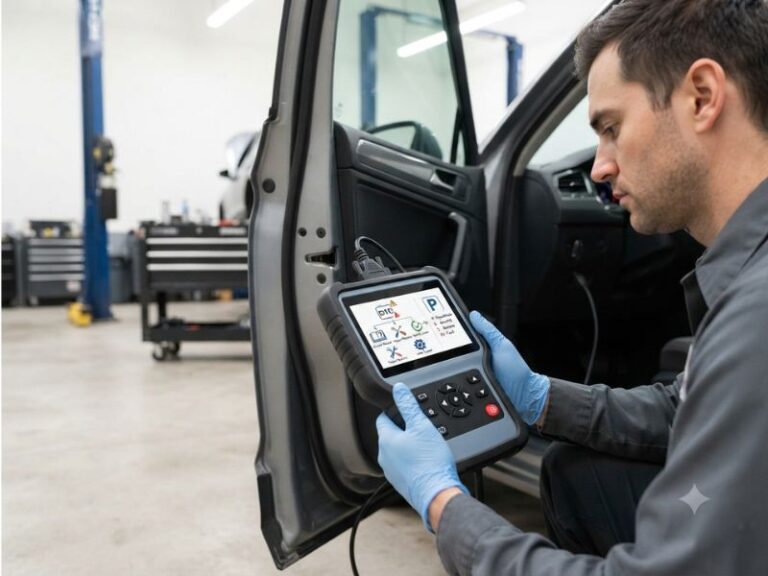
Begin with the vehicle safely parked and the engine completely cold. Turn the ignition on without starting the engine, connect the scanner, and locate the live-data display for ECT. Compare it with the outside temperature and, if available, the IAT reading.
Next, start the engine and watch the value during warm-up. The temperature should generally rise in a believable pattern. It may pause or climb more slowly as the thermostat opens, but it should not leap from a cold value to a fully hot value instantly without a clear reason.
- Record the cold-soak ECT value before starting.
- Check for related trouble codes and freeze-frame data.
- Monitor ECT while idling and during a short, safe drive.
- Note whether the reading changes smoothly and reaches the vehicle’s normal range.
- Compare the scanner data with the dashboard gauge and actual symptoms.
- Inspect the sensor connector and wiring if the value is implausible or intermittent.
Freeze-frame data can show the temperature, engine speed, vehicle speed, and other conditions present when a fault was recorded. This helps determine whether the problem occurred during a cold start, normal driving, heavy load, or an intermittent wiring event.
Do not disconnect the ECT sensor while the engine is hot simply to see what the scanner does. Unplugging components can create additional codes, expose you to hot coolant or moving parts, and make diagnosis less clear.
ECT Sensor, Thermostat, or Cooling-System Problem?
The key diagnostic distinction is whether the temperature value is wrong or the engine temperature is genuinely abnormal. If the scan tool reports 40°F on a cold engine sitting in a 40°F garage, the sensor may be functioning even if the engine later warms slowly.
If the ECT value is implausible immediately after a cold soak, inspect the sensor circuit. A reading near -40°F often points toward an open circuit or disconnected sensor, while an extremely high reading can suggest a shorted circuit. These are useful clues, not universal proof.
If the value rises smoothly but remains unusually low during normal driving, a thermostat stuck open becomes more plausible. If the value rises excessively and the engine shows signs of overheating, investigate coolant level, circulation, airflow, leaks, and fan operation rather than replacing the sensor automatically.
Sensor replacement may be reasonable when testing confirms an inaccurate sensor, but replacing it without checking the connector and wiring can waste time and leave the original fault unresolved. Coolant contamination, damaged insulation, loose terminals, and previous repair work are all worth considering.
Safety When ECT Shows a High Temperature
A high ECT reading can represent a serious overheating condition. If the temperature is rapidly climbing, the dashboard warning appears, steam is visible, coolant is leaking, or the engine is losing power, stop driving as soon as it is safe.
Turn the engine off and allow it to cool. Never remove a radiator cap or pressurized coolant reservoir cap while the engine is hot; escaping coolant and steam can cause severe burns.
After the vehicle has cooled, check for obvious coolant loss without placing hands near fans, belts, or pulleys. Do not continue operating an overheating engine merely because the scanner value later drops or the warning light turns off.
A temperature sensor can report a real overheating condition, but it cannot tell you which cooling-system component caused it. Persistent overheating needs proper testing to prevent head-gasket damage, cylinder-head distortion, or severe engine failure.
Frequently Asked Questions About ECT on an OBD2 Scanner
What does ECT mean on an OBD2 scanner?
ECT means Engine Coolant Temperature. It is the live temperature value supplied by the coolant temperature sensor to the engine computer, usually shown in Fahrenheit or Celsius.
What should ECT read before starting the engine?
It should usually be close to the surrounding air temperature. A large difference between cold-soak ECT and ambient or IAT data may indicate a sensor, connector, wiring, or data-processing problem.
What is a normal warmed-up ECT temperature?
Many engines operate around 180–220°F when fully warmed. The correct range depends on the thermostat and vehicle design, so use the manufacturer’s specifications when a precise judgment is needed.
Does a high ECT reading always mean the sensor is
No; it may indicate genuine overheating. Check coolant level, leaks, fan operation, thermostat function, and circulation before assuming the sensor is the cause.
Why does my ECT reading show -40 degrees?
A -40°F or -40°C reading often suggests an open sensor circuit. A disconnected connector, broken wire, poor terminal contact, or failed sensor can produce this value, but circuit testing is needed to identify the exact fault.
Can a bad ECT sensor cause poor fuel economy?
Yes, an inaccurate cold reading can cause excessive fuel enrichment. The engine computer may behave as though the engine is still warming up, which can increase fuel use and produce rough running or fuel odor.
Can I drive with an ECT sensor code?
Short trips may be possible if the engine temperature is stable and no overheating signs exist. Stop driving immediately if the temperature climbs, coolant is escaping, steam appears, or a temperature warning is displayed.
Practical Takeaway for ECT Scanner Readings
ECT on an OBD2 scanner is the engine coolant temperature reported to the vehicle computer. Compare it with ambient temperature when cold, watch how it changes during warm-up, and interpret it alongside trouble codes and real cooling-system symptoms.
The major limitation is that ECT data alone cannot distinguish a failed sensor from a thermostat, wiring fault, low coolant, or genuine overheating. Record the cold and warmed-up readings, inspect for obvious wiring or coolant problems, and arrange professional testing when the value is implausible, the code returns, or the engine runs hot.