How to Read OBD1 Codes Toyota: Complete Diagnostic Guide
How to read OBD1 codes Toyota vehicles can usually be done without a scanner by using the Toyota diagnostic connector and counting the check engine light flashes. Older Toyota models with OBD1 systems allow you to retrieve stored trouble codes by connecting specific terminals in the diagnostic port and reading the flashing warning light pattern.
The complete details are explained below. In this article, you will learn how Toyota OBD1 systems work, where to find the diagnostic connector, how to retrieve codes step by step, how to read the flash patterns, and what to do after finding the trouble code.
How to Read OBD1 Codes Toyota Vehicles
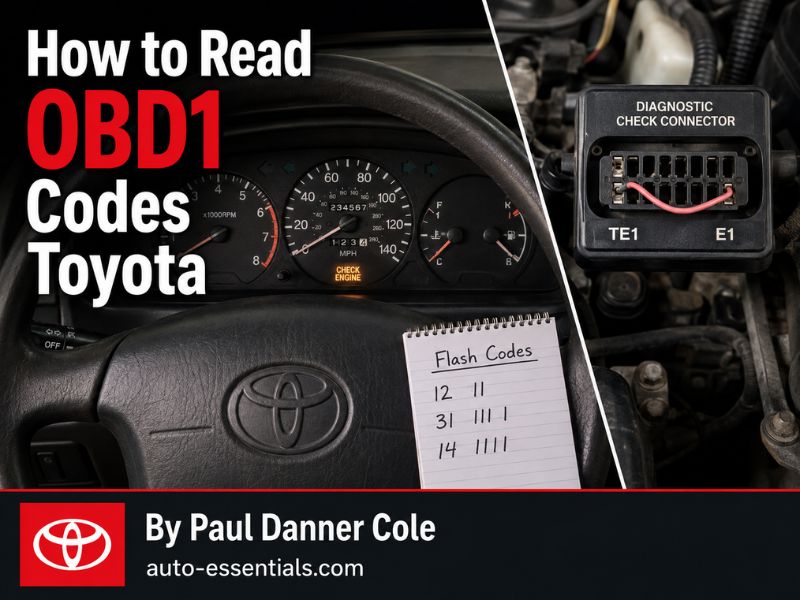
Toyota OBD1 systems use a simple method to display diagnostic trouble codes through the Check Engine Light (CEL).
Unlike modern OBD2 vehicles that require a scan tool connected to a 16-pin diagnostic port, many older Toyota vehicles allow you to manually retrieve codes by connecting diagnostic terminals.
The general process involves:
- Locate the Toyota diagnostic connector.
- Turn the ignition switch ON.
- Connect the correct diagnostic terminals.
- Observe the Check Engine Light flashing pattern.
- Count the flashes to determine the trouble code.
The exact connector type and procedure depend on the Toyota model and year.
Most Toyota vehicles using OBD1 were produced before the widespread adoption of OBD2, which became standard in the mid-1990s.
What Is Toyota OBD1?
Toyota OBD1 is an early onboard diagnostic system used before the standardized OBD2 system.
OBD1 monitors engine operation and emissions-related components but is less standardized than OBD2.
Toyota OBD1 systems can detect problems with components such as:
- Oxygen sensors
- Airflow sensors
- Coolant temperature sensors
- Throttle position sensors
- Ignition systems
- Fuel injection components
When the computer detects a problem, it stores a diagnostic trouble code and turns on the Check Engine Light.
Unlike OBD2 systems, Toyota OBD1 codes are often retrieved manually through a diagnostic connector.
Which Toyota Vehicles Use OBD1?
Toyota used OBD1 systems mainly on vehicles produced before the 1996 OBD2 requirement.
Common Toyota OBD1 models include:
- Toyota Corolla (older generations)
- Toyota Camry (older generations)
- Toyota Celica
- Toyota MR2
- Toyota Supra
- Toyota Pickup
- Toyota 4Runner
- Toyota Land Cruiser
However, the exact diagnostic system depends on the model year and market.
Some late-1990s vehicles may already use OBD2, so always confirm the vehicle’s diagnostic system before attempting an OBD1 procedure.
Where Is the Toyota OBD1 Diagnostic Connector Located?
Toyota OBD1 vehicles usually have a diagnostic connector called DLC1 or DLC2.
The most common location is:
- Under the hood near the engine compartment
- Near the fuse box
- Near the passenger-side strut tower
- Close to the firewall
The connector is usually a small black plastic box with a removable cover.
The cover may have labels showing terminal names such as:
- TE1
- E1
- +B
- FP
- W
Toyota used these labeled diagnostic boxes instead of the standardized OBD2 connector found on newer vehicles.
How to Read Toyota OBD1 Codes Step by Step
Follow these general steps to retrieve Toyota OBD1 codes.
Step 1: Locate the Diagnostic Box
Open the hood and find the Toyota diagnostic connector.
Remove the plastic cover if needed.
Look for the terminals marked:
- TE1
- E1
These are the terminals commonly used for retrieving engine fault codes.
Step 2: Connect TE1 and E1 Terminals
Using a small jumper wire or suitable connector, connect the TE1 terminal to the E1 ground terminal.
This tells the engine computer to enter diagnostic mode.
Be careful not to connect the wrong terminals. Incorrect connections can cause electrical problems.
Step 3: Turn the Ignition ON
Turn the key to the ON position.
Do not start the engine.
The Check Engine Light should begin flashing if the procedure is correct.
Step 4: Count the Flashes
Watch the Check Engine Light carefully.
Toyota OBD1 codes are displayed as two-digit numbers.
The first series of flashes represents the first digit.
A short pause separates the first digit and second digit.
The second series represents the second digit.
For example:
- Two flashes
- Pause
- Three flashes
equals code 23.
A longer pause separates one trouble code from another.
How Toyota OBD1 Flash Codes Work
Toyota uses a simple flashing system.
Example:
Code 12
The light flashes:
- 1 flash
- Short pause
- 2 flashes
This means diagnostic code 12.
Example:
Code 21
The light flashes:
- 2 flashes
- Short pause
- 1 flash
This means diagnostic code 21.
Write down every code displayed before turning off the ignition.
If multiple codes are stored, the computer will display them one after another.
Common Toyota OBD1 Codes
Toyota OBD1 codes vary by model, but some common examples include:
Code 12
Often related to engine speed signal or ignition reference problems.
Code 13
Often associated with engine RPM signal issues.
Code 14
Ignition signal fault.
Code 21
Oxygen sensor signal problem.
Code 22
Coolant temperature sensor problem.
Code 24
Intake air temperature sensor problem.
Code 31
Airflow meter or air measurement issue.
Code 41
Throttle position sensor problem.
Always confirm the exact code meaning using the repair manual for your Toyota model and engine.
How to Clear Toyota OBD1 Codes
After repairing the problem, you may want to clear the stored codes.
The common Toyota OBD1 clearing method is disconnecting battery power.
General steps:
- Turn the ignition off.
- Disconnect the negative battery cable.
- Wait several minutes.
- Reconnect the battery.
- Drive the vehicle and check whether the code returns.
However, disconnecting the battery may also reset:
- Radio settings
- Clock settings
- ECU learning values
Some vehicles may require additional procedures after battery disconnection.
Always confirm the correct process for your specific Toyota model.
Toyota OBD1 vs OBD2 Differences
Toyota OBD1 and OBD2 systems work differently.
Toyota OBD1
- Used mainly on older vehicles
- Diagnostic connector usually under the hood
- Codes displayed through flashing lights
- Less standardized
- Often requires jumper terminals
Toyota OBD2
- Used on most 1996 and newer vehicles
- Uses a 16-pin connector
- Requires a scan tool or compatible app
- Provides more detailed information
- Supports live sensor data
OBD2 scanners generally cannot read Toyota OBD1 systems because the communication protocols are different.
Can You Read Toyota OBD1 Codes Without a Scanner?
Yes, this is one of the advantages of Toyota OBD1 systems.
You typically only need:
- A jumper wire
- Access to the diagnostic connector
- The ability to count Check Engine Light flashes
However, reading the code is only the beginning.
The code identifies the system where the computer detected a problem. It does not always identify the failed part.
For example, an oxygen sensor code does not always mean the oxygen sensor itself is bad. Possible causes may include:
- Wiring problems
- Vacuum leaks
- Exhaust leaks
- Fuel mixture issues
Proper diagnosis still requires testing.
Common Mistakes When Reading Toyota OBD1 Codes
Many people make mistakes during manual code retrieval.
Common errors include:
Jumping the Wrong Terminals
The diagnostic box contains multiple terminals. Connecting the wrong ones can create problems.
Always verify the correct terminals for your exact Toyota model.
Miscounting Flashes
The Check Engine Light pauses between digits and codes.
Write down the flashes carefully.
Replacing Parts Based Only on Codes
A trouble code identifies a monitored condition, not always the failed component.
Test the system before replacing expensive parts.
Assuming All Toyota Models Use the Same Procedure
Toyota changed diagnostic systems over the years.
A Corolla procedure may not apply to a Land Cruiser or 4Runner.
What If the Check Engine Light Does Not Flash?
If the Check Engine Light does not display codes after connecting the terminals, check:
- Correct diagnostic terminals
- Ignition switch position
- Diagnostic fuse
- ECU power supply
- Check engine bulb operation
A burned-out warning bulb can prevent you from seeing the code flashes.
If the vehicle has no communication or response, consult a Toyota service manual for the specific model.
Do You Need a Repair Manual for Toyota OBD1 Codes?
A repair manual is highly recommended.
While the code retrieval process is simple, diagnosing the actual problem requires more information.
A good repair manual provides:
- Code definitions
- Testing procedures
- Wiring diagrams
- Sensor specifications
- Diagnostic flow charts
The trouble code tells you where to start. The repair manual helps you find the real cause.
Final Thoughts
So, how to read OBD1 codes Toyota vehicles is usually a simple process using the diagnostic connector and Check Engine Light flash patterns.
Locate the Toyota diagnostic box, connect the correct terminals, turn the ignition on, and count the flashing light sequence to identify the stored trouble code.
Toyota OBD1 systems are much simpler than modern OBD2 systems, but the diagnostic code is only the first step. Proper testing is still needed to determine whether a sensor, wiring issue, mechanical problem, or another component is causing the fault.