How to Read OBD1 Codes Chevy: Complete Diagnostic Guide
How to read OBD1 codes Chevy vehicles can be done without a modern scanner by using the vehicle’s ALDL diagnostic connector and counting the Check Engine Light flashes. Older Chevrolet vehicles with OBD1 systems allow you to retrieve stored trouble codes by connecting specific terminals and reading the flashing code pattern from the dashboard warning light.
The complete details are explained below. In this article, you will learn how Chevy OBD1 systems work, where to find the diagnostic connector, how to retrieve codes step by step, how to understand flash patterns, and what to do after finding the trouble code.
How to Read OBD1 Codes Chevy Vehicles
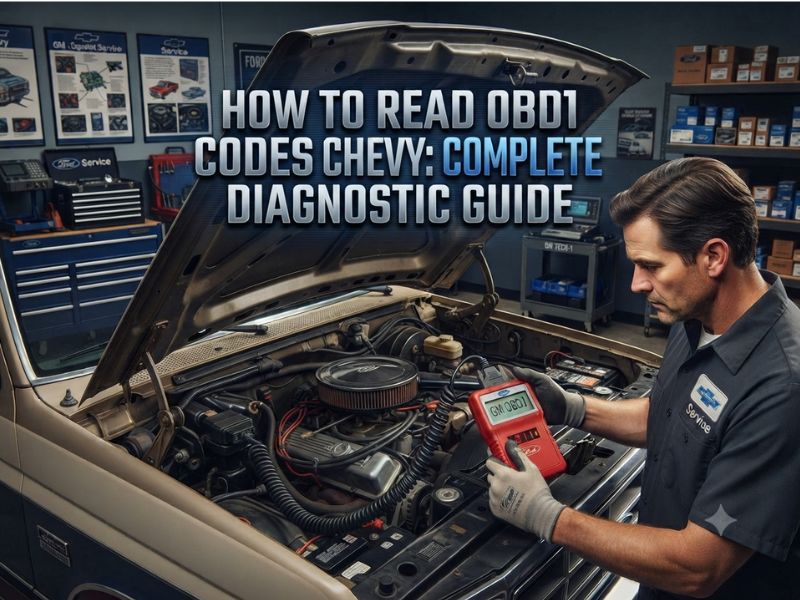
Chevy OBD1 systems use a simple flash-code method to display diagnostic trouble codes through the Check Engine Light.
Unlike modern OBD2 vehicles that require a scan tool connected to a 16-pin diagnostic port, many older Chevrolet vehicles allow you to manually retrieve codes using the factory diagnostic connector.
The general process includes:
- Locate the Chevy ALDL connector.
- Identify the correct diagnostic terminals.
- Connect the terminals using a jumper wire.
- Turn the ignition key ON.
- Watch the Check Engine Light flash.
- Count the flashes and identify the trouble code.
Chevrolet used OBD1 systems mainly before 1996, before the introduction of the standardized OBD2 system.
The exact diagnostic procedure depends on the vehicle year, engine type, and computer system.
What Is Chevy OBD1?
Chevy OBD1 is an early onboard diagnostic system used by General Motors before OBD2 became standard.
The system uses an electronic control module (ECM) to monitor engine operation, fuel delivery, ignition, and emissions-related components.
When the ECM detects a problem, it stores a diagnostic trouble code and turns on the Service Engine Soon or Check Engine Light.
Chevy OBD1 can monitor problems involving:
- Oxygen sensors
- Throttle position sensors
- MAP sensors
- Coolant temperature sensors
- Mass airflow sensors
- Fuel injectors
- EGR systems
- Ignition components
Unlike OBD2 systems, Chevy OBD1 uses a manufacturer-specific diagnostic connector and communication method.
Which Chevy Vehicles Use OBD1?
Chevy used OBD1 systems on many vehicles produced before the 1996 model year.
Common Chevy OBD1 vehicles include:
- Chevrolet Silverado (older models)
- Chevrolet C/K pickup trucks
- Chevrolet Tahoe (early models)
- Chevrolet Suburban
- Chevrolet Blazer
- Chevrolet Camaro
- Chevrolet Corvette
- Chevrolet Caprice
- Chevrolet S10 pickup
However, some vehicles changed diagnostic systems during the transition years.
A 1995 or 1996 Chevy may use either OBD1 or OBD2 depending on the exact production date, engine, and market.
Always verify the diagnostic connector before attempting an OBD1 procedure.
Where Is the Chevy OBD1 Diagnostic Connector Located?
Chevy OBD1 vehicles use a connector called the ALDL (Assembly Line Diagnostic Link).
The connector is usually located:
- Under the driver’s side dashboard
- Near the steering column
- Close to the fuse panel
The ALDL connector typically has:
- A rectangular shape
- 12 pins
- Plastic housing
- Terminal labels molded into the connector
The terminals used for retrieving codes are:
- Terminal A – Ground
- Terminal B – Diagnostic request
These terminals activate the ECM diagnostic mode.
How to Read OBD1 Codes Chevy Step by Step
Follow these steps to retrieve Chevy OBD1 trouble codes.
Step 1: Locate the ALDL Connector
Find the 12-pin diagnostic connector under the dashboard.
Look for the terminal markings on the connector.
Step 2: Connect Terminal A and Terminal B
Use a small jumper wire or suitable connector to connect:
Terminal A → Terminal B
This places the ECM into diagnostic mode.
Only connect the correct terminals. Incorrect connections can cause electrical issues.
Step 3: Turn the Ignition ON
Turn the key to the ON position.
Do not start the engine.
The Check Engine Light should begin flashing.
Step 4: Record the Flash Pattern
Watch the Check Engine Light carefully.
Count the flashes and write down each code.
The ECM will repeat the codes several times, making it easier to confirm the numbers.
How Chevy OBD1 Flash Codes Work
Chevy OBD1 codes are displayed as two-digit numbers.
The Check Engine Light flashes the first digit, pauses, then flashes the second digit.
For example:
Code 12
The light flashes:
- One flash
- Pause
- Two flashes
This indicates code 12.
Code 34
The light flashes:
- Three flashes
- Pause
- Four flashes
This indicates code 34.
A longer pause separates different stored codes.
Always record every code before turning off the ignition.
Why Does Chevy OBD1 Show Code 12 First?
Code 12 is the normal starting code on most GM and Chevy OBD1 systems.
It indicates that:
- The ECM entered diagnostic mode
- The system is ready to display stored codes
Code 12 usually appears three times before other trouble codes are shown.
Example:
Flash
Pause
Flash Flash
The computer repeats this sequence before displaying actual stored faults.
Do not replace parts because you see code 12. It is simply confirming diagnostic mode.
Common Chevy OBD1 Codes
Chevy OBD1 codes vary depending on the engine and ECM, but common examples include:
Code 13
Oxygen sensor circuit problem.
Code 14
Coolant temperature sensor voltage high.
Code 15
Coolant temperature sensor voltage low.
Code 21
Throttle position sensor voltage high.
Code 22
Throttle position sensor voltage low.
Code 32
EGR system problem.
Code 33
MAP sensor signal high.
Code 34
MAP sensor signal low.
Code 42
Electronic spark timing problem.
The exact meaning can vary by engine and computer type, so always confirm using the correct Chevy service information.
Can You Read Chevy OBD1 Codes Without a Scanner?
Yes, one of the advantages of Chevy OBD1 systems is that you can retrieve codes without a professional scan tool.
You only need:
- Access to the ALDL connector
- A jumper wire
- Ability to count flashes
- A Chevy OBD1 code chart
However, retrieving the code is only the first step.
A trouble code does not always mean the listed part has failed.
For example, a MAP sensor code does not automatically mean the MAP sensor is bad.
Possible causes may include:
- Vacuum leaks
- Wiring problems
- Electrical faults
- Poor connections
- ECM issues
Proper testing is still required before replacing components.
How to Clear Chevy OBD1 Codes
After repairing the issue, Chevy OBD1 codes can usually be cleared by disconnecting battery power.
General steps:
- Turn the ignition OFF.
- Disconnect the negative battery cable.
- Wait several minutes.
- Reconnect the battery.
- Start the vehicle and check if the light returns.
Some Chevy vehicles may allow ECM memory clearing through fuse removal.
Resetting the ECM may also erase:
- Fuel adjustment data
- Idle learning
- Stored diagnostic information
The vehicle may need time to relearn normal operating conditions.
Chevy OBD1 vs OBD2 Differences
Chevy OBD1 and OBD2 systems are different diagnostic platforms.
Chevy OBD1
- Used mainly before 1996
- Uses ALDL connector
- Flash-code diagnosis
- Manufacturer-specific
- Limited diagnostic data
Chevy OBD2
- Used mainly from 1996 onward
- Uses 16-pin connector
- Requires OBD2 scanner
- Standardized communication
- Provides live data
A regular OBD2 scanner usually cannot read Chevy OBD1 vehicles without special adapters.
Common Mistakes When Reading Chevy OBD1 Codes
Many people make mistakes during manual code retrieval.
Jumping the Wrong Pins
The ALDL connector contains multiple terminals.
Connecting the wrong pins may cause electrical problems.
Always confirm terminal locations for your exact Chevy model.
Confusing Code 12 With a Fault
Code 12 only indicates diagnostic mode.
It does not mean a component has failed.
Replacing Parts Without Testing
A trouble code points toward a system, not always the exact failed part.
Test wiring, sensors, and related components before replacement.
Using OBD2 Procedures on OBD1 Vehicles
Older Chevy vehicles use different connectors and communication methods.
A modern OBD2 process will not work correctly on an OBD1 vehicle.
What If the Chevy Check Engine Light Does Not Flash?
If the Check Engine Light does not display codes, check:
- Correct ALDL terminals
- Ignition switch position
- Battery voltage
- ECM power supply
- Diagnostic fuse
- Warning light operation
A burned-out Check Engine Light bulb can prevent you from seeing the flash pattern.
If the ECM does not respond, further electrical diagnosis may be required.
Can a Modern Scanner Read Chevy OBD1 Codes?
Some professional scan tools can read Chevy OBD1 systems using special adapters and software.
However, a basic OBD2 scanner normally cannot communicate with Chevy OBD1 vehicles.
The connector type, communication protocol, and diagnostic system are different.
If you own an older Chevy, confirm that the diagnostic tool supports GM OBD1 before purchasing.
Final Thoughts
So, how to read OBD1 codes Chevy vehicles is done by using the ALDL connector, connecting the correct diagnostic terminals, and counting the Check Engine Light flashes.
Locate the 12-pin connector, connect terminals A and B, turn the ignition on, and record the displayed trouble codes.
Chevy OBD1 diagnostics are simple and useful for older vehicles, but the trouble code is only the starting point. Always test the related sensors, wiring, and systems before replacing parts.
A proper diagnosis helps you repair the actual problem instead of replacing unnecessary components.