Does OBD2 Read ABS Codes? Complete Scanner Compatibility Guide
Does OBD2 read ABS codes? A basic OBD2 code reader usually cannot read ABS codes because it is mainly designed for engine and emissions-related diagnostics. To retrieve faults from the Anti-lock Braking System, you generally need an advanced scanner that specifically supports ABS diagnostics for your vehicle.
The complete details are explained below. In this article, you will learn why some OBD2 scanners can read ABS faults while others cannot, how to identify an ABS-compatible scanner, what common ABS codes mean, and whether clearing an ABS code is safe.
Does OBD2 Read ABS Codes on Every Vehicle?
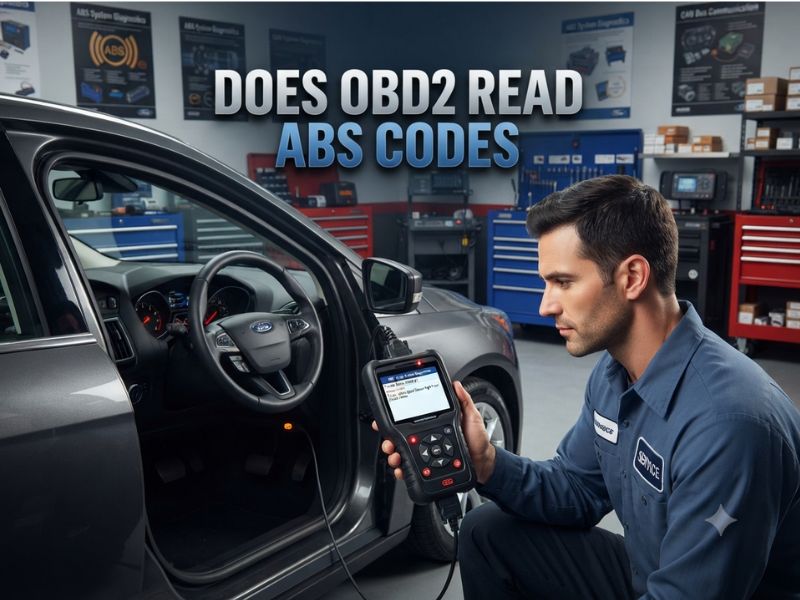
No, standard OBD2 functionality does not guarantee access to ABS codes.
The OBD2 system was standardized mainly to monitor engine performance and emissions-related faults. A basic code reader normally communicates with the engine or powertrain control module.
The ABS is controlled by a separate electronic module, commonly called the:
- ABS control module
- Electronic Brake Control Module
- Brake control unit
- Skid control ECU
Although this module may communicate through the same 16-pin OBD2 diagnostic port, the scanner needs the correct software and manufacturer-specific communication capabilities to access it.
This is why a basic reader may display “No Codes Found” while the ABS warning light remains illuminated.
The scanner may be communicating successfully with the engine computer but not with the ABS module.
Why Basic OBD2 Readers Cannot Read ABS Codes
Most entry-level OBD2 readers are designed to retrieve generic powertrain codes.
These codes commonly begin with the letter P, which refers to the powertrain system.
ABS faults are usually stored as C-codes, where “C” refers to the chassis system. However, manufacturers may use additional proprietary code formats and definitions.
A basic reader may lack:
- ABS diagnostic software
- Manufacturer-specific code definitions
- Chassis-system communication
- Access to the brake control module
- Bidirectional testing capabilities
Because of these limitations, a basic scanner may read the Check Engine Light but not the ABS, traction control, or stability control warning lights.
What Type of Scanner Reads ABS Codes?
To read ABS codes, choose a scanner that clearly states that it supports:
- ABS diagnostics
- Anti-lock braking systems
- Chassis codes
- ABS and SRS
- Four-system diagnostics
- Full-system scanning
- All-module diagnostics
The scanner must also support your exact vehicle.
Check compatibility based on:
- Model year
- Manufacturer
- Model
- Engine
- Market or region
- Brake control system
A scanner may provide ABS coverage for some Ford or Toyota models but have limited access to certain European, diesel, hybrid, or newer vehicles.
Do not rely only on the words “OBD2 scanner” in the product name. Confirm that ABS is listed in the supported systems.
Can the OBD2 Port Access the ABS Module?
Yes, many vehicles allow an ABS-capable scanner to communicate with the brake control module through the normal OBD2 port.
The port is usually located under the driver’s side dashboard near the steering column.
However, using the same connector does not mean all scanners can access every system.
The OBD2 port provides a physical connection to the vehicle’s communication network. The scanner’s software determines which control modules it can access.
A basic code reader may only communicate with:
- Engine control module
- Powertrain control module
- Emissions systems
A more advanced scanner may also communicate with:
- ABS module
- Airbag module
- Transmission module
- Body control module
- Steering module
- Electronic parking brake
- Four-wheel-drive system
The scanner must understand the communication protocol used by each control module.
What Does the ABS Warning Light Mean?
The ABS warning light means the anti-lock braking system has detected a fault.
The light usually appears as the letters ABS inside a circle or warning symbol.
When the ABS light stays on, the vehicle’s normal hydraulic brakes may still work, but the anti-lock function may be disabled.
This means the wheels may lock during hard braking, especially on:
- Wet roads
- Snow or ice
- Loose gravel
- Slippery surfaces
- Emergency stops
The vehicle may also disable related systems such as:
- Traction control
- Electronic stability control
- Hill-start assistance
- Electronic brake-force distribution
The exact effect depends on the vehicle and stored fault.
An illuminated ABS warning should be diagnosed as soon as possible.
Common Causes of ABS Codes
ABS codes can be triggered by several electrical, mechanical, or hydraulic problems.
Common causes include:
- Failed wheel speed sensor
- Damaged sensor wiring
- Dirty or corroded connector
- Cracked tone ring
- Damaged wheel bearing encoder
- Low battery voltage
- Blown ABS fuse
- Faulty brake light switch
- ABS pump motor problem
- Hydraulic control unit fault
- Steering angle sensor issue
- Incorrect tire size
- Mismatched tire pressure
- Communication failure
Wheel speed sensor problems are among the most common causes.
Each wheel usually has a sensor that monitors rotational speed. The ABS module compares the signals to detect whether a wheel is about to lock.
If one sensor reports an incorrect or missing signal, the ABS module may disable the system and turn on the warning light.
How to Check Whether Your Scanner Supports ABS
Read the scanner’s specifications or supported-system list.
Look for terms such as:
- ABS
- Chassis diagnostics
- ABS/SRS scanner
- Brake system diagnostics
- Full-system coverage
A scanner described only as an “engine code reader” or “check engine scanner” probably does not support ABS.
After connecting the scanner, check the diagnostic menu.
An ABS-capable scanner may provide options such as:
Auto Scan: Searches all supported modules and lists stored faults.
Control Units: Allows you to manually select the ABS or brake control module.
Chassis Systems: Contains ABS, steering, suspension, and other chassis-related modules.
ABS Diagnostics: Opens the brake control system directly.
If the ABS option does not appear, the scanner may not support the system, the vehicle information may be incorrect, or the tool may need a software update.
How to Read ABS Codes With a Compatible Scanner
Park the vehicle safely on a level surface and apply the parking brake.
Turn off the engine and connect the scanner to the OBD2 port.
Turn the ignition to the ON position without starting the engine unless the scanner requests otherwise.
Select the correct vehicle details or allow the scanner to identify the vehicle automatically.
Open the ABS, brake, chassis, or electronic brake control module menu.
Choose Read Codes or Diagnostic Trouble Codes.
Record all available information, including:
- Code number
- Code description
- Active or current status
- Stored or history status
- Affected wheel or circuit
- Additional fault information
Do not clear the code before recording it.
The code status can help determine whether the fault is currently present or occurred intermittently.
Why Does My Scanner Show No ABS Codes?
If the ABS warning light is on but the scanner shows no codes, the most likely reason is that the scanner cannot access the ABS module.
Other possible causes include:
- Wrong vehicle selected
- Outdated scanner software
- Limited vehicle coverage
- Communication problem
- Weak battery voltage
- Damaged diagnostic wiring
- Fault stored in another brake-related module
- ABS module power failure
Try performing a complete vehicle scan rather than selecting only the engine menu.
If the scanner successfully reads engine codes but does not display an ABS menu, it probably lacks ABS support.
A generic “No Codes Found” message may only mean that the engine computer has no stored faults. It does not confirm that the ABS module is clear.
Can a Bluetooth OBD2 Scanner Read ABS Codes?
Some Bluetooth OBD2 scanners can read ABS codes, but many inexpensive adapters cannot.
ABS access depends on both the adapter and the diagnostic app.
The adapter must support the required vehicle network, while the app must include:
- ABS module access
- Manufacturer-specific protocols
- Chassis code definitions
- Vehicle-specific coverage
A general smartphone app designed for engine data may only display:
- Engine codes
- Fuel trims
- Sensor values
- Emissions monitors
- Live powertrain data
Before purchasing a Bluetooth adapter, confirm that it supports ABS diagnostics for your exact vehicle.
An app subscription cannot always add ABS access if the adapter hardware does not support the required communication network.
Can You Clear ABS Codes With an OBD2 Scanner?
An ABS-capable scanner may be able to clear ABS codes after the fault has been repaired.
If the problem remains active, the warning light may stay on or return immediately.
For example, clearing a wheel speed sensor code will not solve:
- Broken sensor wiring
- Failed wheel bearing encoder
- Damaged tone ring
- Loose connector
- Defective sensor
The ABS module will detect the fault again as soon as the vehicle begins moving or the next self-test runs.
Some historical codes may clear after repair, while active electrical faults usually return immediately.
Is It Safe to Clear an ABS Code?
Clearing an ABS code is generally safe when the fault has been diagnosed and repaired.
However, clearing the code only to turn off the warning light is not recommended.
The ABS warning indicates that an important braking-assistance system may not work properly.
Erasing the code does not repair:
- Failed wheel speed sensors
- Damaged wiring
- Hydraulic pump faults
- Control module problems
- Steering angle sensor faults
- Brake pressure sensor problems
Always record the code and inspect the system before clearing it.
Never hide an active ABS fault before selling or inspecting a vehicle.
Can an ABS Code Identify the Exact Failed Part?
An ABS code may identify the affected circuit, but it does not always prove that a specific component has failed.
For example, a left front wheel speed sensor code may be caused by:
- Failed sensor
- Damaged wiring
- Corroded connector
- Incorrect sensor gap
- Damaged tone ring
- Failed wheel bearing encoder
- ABS module problem
The code tells you where the fault was detected.
Proper diagnosis may require:
- Visual inspection
- Wiring continuity checks
- Resistance or voltage testing
- Live wheel speed data
- Oscilloscope testing
- Wheel bearing inspection
Live data is particularly useful because it allows you to compare wheel speed readings while the vehicle is moving.
A sensor that drops to zero while the other wheels show normal speed may indicate a problem in that wheel’s sensor circuit.
Can Low Battery Voltage Cause ABS Codes?
Yes, low battery voltage can trigger ABS and stability-control faults.
The ABS module requires stable electrical power. Low voltage during starting or jump-starting may cause:
- Communication codes
- Pump motor voltage codes
- Module reset faults
- Temporary warning lights
Before replacing ABS components, check:
- Battery condition
- Charging system
- Battery terminals
- Ground connections
- ABS fuses
If the code is voltage-related, correct the electrical problem first and then clear the code.
Will Disconnecting the Battery Clear ABS Codes?
Disconnecting the battery does not reliably clear ABS codes.
Many ABS modules store codes in non-volatile memory. This means the code remains even after the battery is disconnected.
A battery disconnect may also create additional issues, such as:
- Lost radio settings
- Reset clock
- Steering angle sensor warnings
- Window relearn requirements
- Low-voltage codes
Use an ABS-capable scanner to read and clear codes after the repair.
Do not disconnect the battery only to hide an ABS warning light.
Can a Basic Code Reader Read Traction Control Codes?
Usually not.
Traction control and electronic stability control often operate through the ABS module.
A basic OBD2 reader may not access these systems.
When the ABS, traction control, and stability-control lights appear together, one ABS fault may be disabling all three systems.
Common causes include:
- Wheel speed sensor fault
- Steering angle sensor problem
- Brake switch fault
- ABS module communication issue
- Low voltage
An ABS-capable or full-system scanner is normally required to identify the stored code.
Basic OBD2 Reader vs ABS Scanner
A basic OBD2 reader is mainly designed for engine and emissions diagnostics.
It may retrieve:
- Check engine codes
- Pending powertrain codes
- Permanent emissions codes
- Freeze-frame data
- Readiness monitor status
An ABS-capable scanner may additionally retrieve:
- Wheel speed sensor codes
- ABS pump faults
- Hydraulic unit codes
- Brake pressure sensor faults
- Steering angle sensor codes
- Stability-control faults
- Traction-control faults
Some advanced scanners can also perform special ABS functions, such as:
- ABS pump activation
- Solenoid testing
- Brake bleeding procedures
- Steering angle calibration
- Sensor relearning
These features are commonly called bidirectional controls or active tests.
Not every ABS scanner supports these functions, so check the tool’s specifications carefully.
When to Seek Professional Diagnosis
Professional diagnosis is recommended when:
- The ABS light remains on
- The red brake warning light is also illuminated
- The scanner cannot access the ABS module
- Braking feels unusual
- The code involves the hydraulic pump
- Multiple wheel speed codes appear
- The fault returns immediately
- Wiring or connectors are damaged
- The vehicle has collision or flood damage
- ABS bleeding or calibration is required
If both the ABS warning and red brake warning lights remain on, stop driving until the braking system has been inspected.
A red brake warning may indicate low brake fluid, hydraulic failure, parking brake problems, or another serious condition.
Final Thoughts
So, does OBD2 read ABS codes? The OBD2 diagnostic port can provide access to the ABS module on many vehicles, but a basic OBD2 reader usually cannot retrieve anti-lock braking faults.
You need a scanner that specifically supports ABS or full-system diagnostics for your vehicle’s year, make, and model.
Record the code before clearing it and remember that the code identifies the affected circuit rather than confirming the exact failed part. Because ABS affects emergency braking and vehicle stability, repair the underlying problem instead of simply erasing the warning light.