Does OBD2 Read Airbag Codes? Full Scanner Compatibility Guide
Does OBD2 read airbag codes? A basic OBD2 code reader usually cannot read airbag codes because it is designed mainly for engine and emissions-related faults. To access airbag or Supplemental Restraint System (SRS) codes, you normally need an advanced scanner that specifically supports the airbag module for your vehicle.
The complete details are explained below. In this article, you will learn why some OBD2 scanners can read airbag faults while others cannot, how to identify an SRS-capable scanner, what airbag codes mean, and whether you can safely clear them.
Does OBD2 Read Airbag Codes on Every Vehicle?
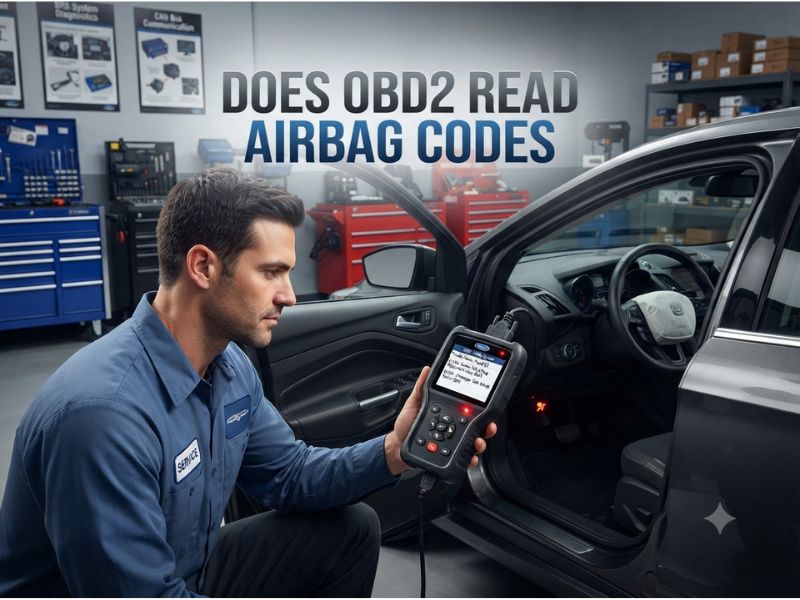
No, standard OBD2 functionality does not guarantee access to airbag codes.
The term OBD2 describes the standardized diagnostic system used mainly for engine performance, fuel control, and emissions monitoring. A basic OBD2 reader normally communicates with the Engine Control Module, also called the ECM or PCM.
The airbag system is controlled by a separate computer, commonly called the:
- SRS control module
- Airbag control module
- Restraint control module
- Supplemental restraint controller
Although the airbag module may communicate through the same 16-pin diagnostic connector, a scanner must understand the correct manufacturer-specific communication protocol to access it.
That is why two scanners can connect to the same OBD2 port but display completely different information.
A cheap code reader may only retrieve powertrain codes, while a full-system diagnostic scanner can access the engine, transmission, ABS, airbags, body electronics, and other control modules.
Why Basic OBD2 Readers Cannot Read Airbag Codes
Basic OBD2 readers are usually designed to retrieve generic emissions-related trouble codes.
These commonly include codes beginning with:
- P0
- P1
- P2
- P3
The letter “P” refers to the powertrain system, including the engine and transmission.
Airbag faults are often stored as B-codes, where “B” refers to the body system. However, manufacturers may also use their own code formats and descriptions.
A basic reader may not have:
- SRS software
- Manufacturer-specific communication protocols
- Airbag code definitions
- Access to body control networks
- Vehicle-specific module coverage
As a result, the reader may show “No Codes Found” even when the airbag warning light is illuminated.
This does not necessarily mean the vehicle has no airbag fault. It may simply mean the scanner cannot access the SRS module.
What Type of Scanner Reads Airbag Codes?
To read airbag codes, look for a scanner that clearly states it supports:
- SRS
- Airbag diagnostics
- Restraint systems
- Full-system scanning
- All-module diagnostics
Do not assume that every expensive scanner includes airbag coverage. Always check the supported systems and vehicle applications before purchasing.
The scanner should support your vehicle’s:
- Year
- Make
- Model
- Engine
- Market or region
Some tools support SRS diagnostics on certain manufacturers but not others.
For example, a scanner may read airbag codes on many Ford, Toyota, and Honda vehicles but have limited coverage for European or newer vehicles.
Vehicle-specific coverage is more important than the word “OBD2” printed on the scanner.
Can an OBD2 Port Access the Airbag Module?
Yes, many vehicles allow an SRS-capable scanner to access the airbag module through the standard OBD2 diagnostic port.
The physical connector is usually the same 16-pin port located under the driver’s side dashboard.
However, using the same connector does not mean every scanner can access every module.
Think of the OBD2 port as a doorway into the vehicle’s computer network. A basic reader may only have permission and software to communicate with the engine computer. A more advanced scanner can communicate with additional modules.
These may include:
- Airbag control module
- ABS control module
- Transmission control module
- Body control module
- Steering control module
- Parking brake module
- Climate control system
The scanner must support the specific communication language used by each module.
What Does an Airbag Warning Light Mean?
The airbag or SRS warning light indicates that the restraint system has detected a problem.
The light may appear as:
- An airbag symbol
- “SRS”
- “Air Bag”
- “Service Airbag”
- “Supplemental Restraint System”
When the light remains on after startup, one or more restraint-system components may not function correctly during a collision.
The system may disable a specific airbag, seat-belt pretensioner, or possibly a larger section of the restraint system depending on the fault.
An illuminated SRS light should not be ignored.
The vehicle may still drive normally, but the affected safety system may not provide proper protection during an accident.
Common Causes of Airbag Codes
Airbag codes can be triggered by many different problems.
Common causes include:
- Loose connector under a seat
- Damaged seat wiring
- Faulty seat occupancy sensor
- Seat-belt buckle switch problem
- Failed seat-belt pretensioner
- Steering wheel clock spring failure
- Low battery voltage
- Impact sensor problem
- Airbag control module fault
- Previous collision damage
- Water entering the SRS module
- Disconnected component with ignition on
Moving a front seat can sometimes pull or disturb wiring underneath it. This may trigger an airbag warning if a connector becomes loose or develops excessive resistance.
A weak battery or jump-starting event can also create voltage-related SRS codes on some vehicles.
However, you should not assume the cause based only on the warning light. The stored diagnostic code is needed to identify the affected circuit.
How to Check Whether Your Scanner Supports Airbag Codes
Read the scanner’s product description, menu options, or coverage list.
Look for terms such as:
- SRS diagnostics
- Airbag code reading
- ABS and SRS
- Four-system scanner
- Full-system scanner
- All-module scan
A scanner advertised only as an “engine code reader” or “check engine light scanner” probably will not read airbag codes.
After connecting the scanner, open the diagnostic menu.
An airbag-capable tool may provide options such as:
Auto Scan: Scans every supported module and lists detected faults.
Control Units: Allows you to select the SRS or airbag module manually.
Body Systems: Contains airbag, seat, restraint, and body-related modules.
SRS/Airbag: Opens the restraint-system diagnostic menu directly.
If no SRS option appears, the scanner may not support the system, the wrong vehicle profile may have been selected, or the tool may require a software update.
How to Read Airbag Codes With a Compatible Scanner
Park the vehicle safely, apply the parking brake, and turn the ignition off.
Locate the OBD2 port beneath the driver’s side dashboard and connect the scanner firmly.
Turn the ignition to the ON position without starting the engine unless the scanner requests otherwise.
Select the correct vehicle information or allow the tool to identify the vehicle automatically.
Open the SRS, airbag, or restraint control module.
Choose Read Codes or Diagnostic Trouble Codes.
Record all displayed information, including:
- Code number
- Code description
- Current or active status
- Stored or history status
- Module name
- Additional fault details
Do not immediately erase the code.
The code and status information help determine whether the fault is currently present or occurred in the past.
Why Does My Scanner Say No Airbag Codes?
If the airbag light is on but the scanner displays no codes, the most likely reason is that the scanner cannot access the SRS module.
Other possible causes include:
- Incorrect vehicle selection
- Outdated scanner software
- Limited manufacturer coverage
- Communication failure
- Low battery voltage
- Damaged diagnostic wiring
- Fault stored in another restraint-related module
- Airbag warning caused by a non-standard system fault
Try performing a full-system scan rather than selecting only the engine menu.
Also verify that the scanner specifically supports SRS diagnostics for your exact vehicle.
A generic OBD2 scan showing “no codes” only confirms that no supported engine codes were found. It does not prove that the airbag module has no faults.
Can a Bluetooth OBD2 Scanner Read Airbag Codes?
Some Bluetooth OBD2 scanners can read airbag codes, but many cannot.
Low-cost Bluetooth adapters are often designed only for generic engine diagnostics and live data.
Airbag access depends on both the adapter and the mobile application.
The adapter must support the required communication protocol, while the app must include SRS access and vehicle-specific code definitions.
Before purchasing a Bluetooth device, confirm that the manufacturer lists:
- SRS support
- Your exact vehicle
- Required app or subscription
- Supported control modules
- Software update availability
An app cannot always add airbag access if the adapter hardware does not support the required vehicle network.
Can You Clear Airbag Codes With an OBD2 Scanner?
An SRS-capable scanner may be able to clear airbag codes, but only after the fault has been repaired.
If the problem is still present, the warning light may remain on or return immediately.
Some codes are stored as active faults, while others are stored as historical or intermittent faults.
A loose connector that has been repaired may leave a stored code that can be cleared normally. A damaged sensor, open circuit, or failed clock spring will usually cause the code to return until the actual problem is fixed.
Some crash-related information cannot be erased with an ordinary scan tool.
After an airbag deployment, the control module may store permanent crash data. Depending on the vehicle, the module may need professional resetting or replacement.
Deployed airbags, seat-belt pretensioners, impact sensors, damaged wiring, and other components may also require replacement.
Is It Safe to Clear an Airbag Code?
Clearing an airbag code without diagnosing the cause is not recommended.
The warning light is telling you that the restraint system may not operate correctly.
Erasing the code may temporarily switch off the light, but it does not repair:
- Broken wiring
- Loose connections
- Failed sensors
- Damaged seat-belt pretensioners
- Faulty airbags
- Clock spring problems
- Crash damage
Record the code before clearing anything.
If the code returns, the fault remains active and requires further testing.
Never clear an SRS light only to hide a safety problem before selling or inspecting a vehicle.
Important Airbag System Safety Precautions
Airbag systems contain pyrotechnic devices that can deploy with significant force.
Do not probe airbag connectors with a test light, jumper wire, or ordinary multimeter unless the manufacturer’s service procedure specifically allows it.
Many airbag connectors and wiring harnesses are yellow, but color coding varies.
Avoid disconnecting SRS components with the ignition on.
Before repairing an airbag circuit, technicians commonly disconnect the battery and wait the manufacturer-specified time for backup power to discharge.
The exact waiting time and disabling procedure vary by vehicle.
Incorrect testing can:
- Trigger accidental deployment
- Damage the control module
- Set additional fault codes
- Cause personal injury
- Disable part of the restraint system
Reading codes through the diagnostic port is generally safe. Physically testing or repairing SRS circuits should be performed using proper service information and safety procedures.
Does a Code Tell You Which Airbag Is Bad?
Sometimes the code identifies a specific airbag circuit, but it does not always prove that the airbag itself has failed.
A code may refer to:
- Driver airbag circuit
- Passenger airbag circuit
- Side airbag circuit
- Curtain airbag circuit
- Seat-belt pretensioner
- Occupancy sensor
- Impact sensor
- Clock spring
- Resistance too high or low
- Communication failure
For example, a driver airbag circuit code may be caused by the steering wheel airbag, clock spring, connector, wiring, or SRS module.
A passenger occupancy code may involve the seat sensor, wiring, calibration, seat replacement, or an object interfering with the system.
The code provides the starting point. Proper circuit testing identifies the actual cause.
Will Disconnecting the Battery Clear Airbag Codes?
Disconnecting the battery does not reliably clear SRS codes.
The airbag control module often stores codes in non-volatile memory, meaning the information remains even when battery power is removed.
A battery disconnect may also create additional problems, including lost settings or low-voltage codes.
Some intermittent SRS faults may disappear after the connection is repaired and the vehicle completes a self-check. However, many stored codes require an SRS-capable scanner to clear them.
Do not disconnect the battery solely as a substitute for diagnosis.
Basic OBD2 Reader vs SRS Scanner
A basic OBD2 reader is useful for checking the Check Engine Light and emissions-related problems.
It commonly reads:
- Engine codes
- Pending powertrain codes
- Permanent emissions codes
- Freeze-frame data
- Readiness monitors
An SRS-capable or full-system scanner may additionally read:
- Airbag codes
- Seat-belt pretensioner faults
- Occupancy sensor faults
- Crash sensor faults
- ABS codes
- Transmission codes
- Body module codes
The correct choice depends on the warning light you are diagnosing.
For a Check Engine Light, a basic reader may be sufficient. For an airbag warning light, verify SRS support before purchasing or connecting the tool.
When to Seek Professional Diagnosis
Professional diagnosis is recommended when:
- The airbag light remains on
- The scanner cannot access the SRS module
- Airbags have deployed
- The vehicle has collision damage
- Water has entered the cabin
- Wiring under the seat is damaged
- The code involves resistance or deployment circuits
- The code returns immediately after clearing
- The restraint system requires calibration
Some repairs require manufacturer-specific equipment.
Seat occupancy sensors, airbag modules, or replacement seats may need calibration, initialization, coding, or programming before the warning light can be cleared.
Final Thoughts
So, does OBD2 read airbag codes? The OBD2 diagnostic port can provide access to the airbag system on many vehicles, but a basic OBD2 code reader usually cannot retrieve SRS faults.
You need a scanner that specifically supports airbag or SRS diagnostics for your vehicle’s year, make, and model.
Record the codes before clearing them, diagnose the complete circuit, and avoid working directly on airbag wiring without proper service information. An airbag warning light indicates a potential safety-system problem, so the underlying fault should be repaired rather than simply erased.