What Can a Car Code Reader Tell You? Complete Diagnostic Guide
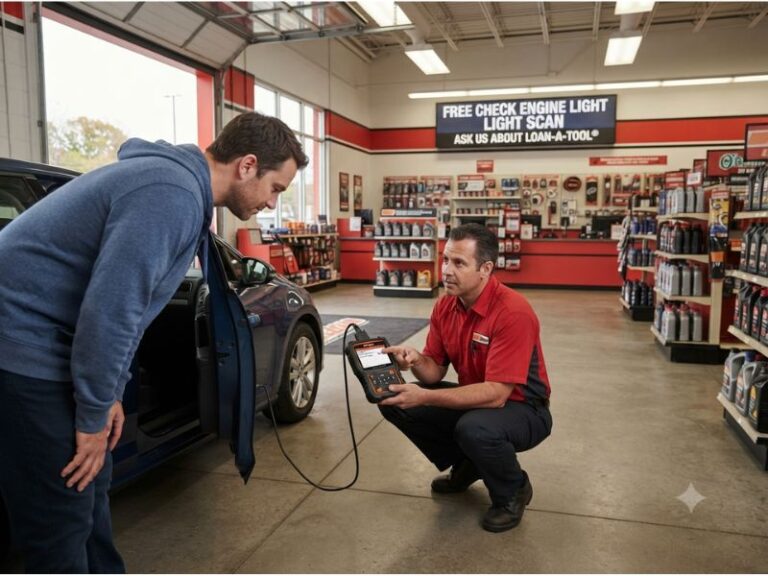
What can a car code reader tell you? A car code reader can tell you which vehicle system has detected a problem, display diagnostic trouble codes, show basic sensor information, check emissions readiness, and provide clues about possible repairs. However, it does not always identify the exact failed part or replace a professional diagnosis.
The complete details are explained below. You will learn what information a car code reader provides, which problems it can detect, what different codes mean, how accurate the results are, and what a scanner cannot tell you about your vehicle.
What Can a Car Code Reader Tell You?
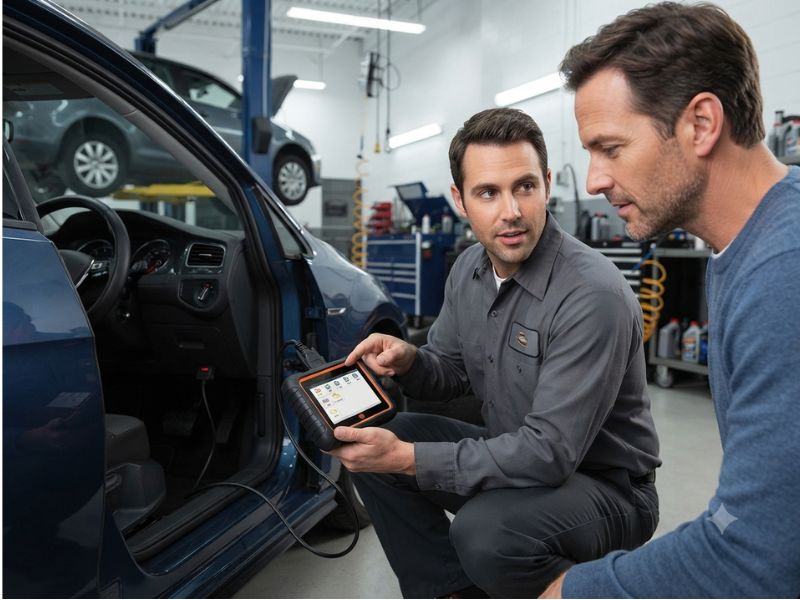
A car code reader tells you information stored inside your vehicle’s onboard computer system.
Modern vehicles use multiple electronic control modules to monitor engine performance, emissions, transmission operation, safety systems, and other functions.
When the computer detects an abnormal condition, it stores a Diagnostic Trouble Code (DTC).
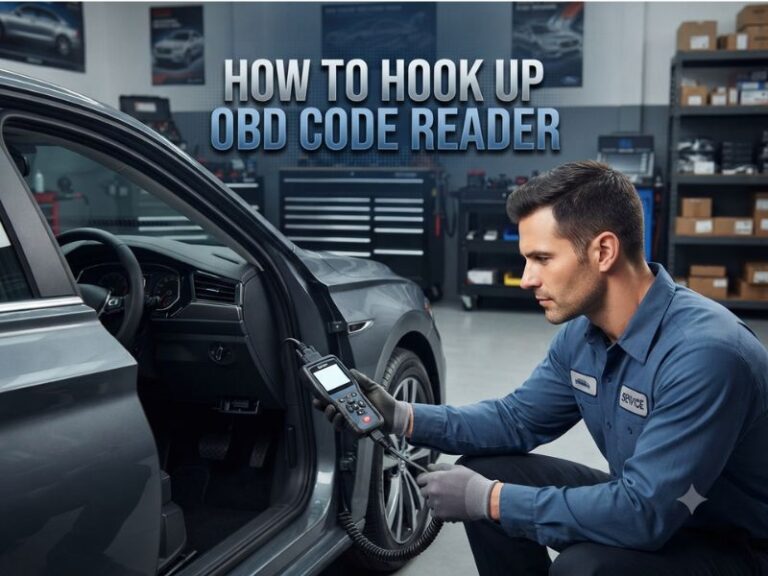
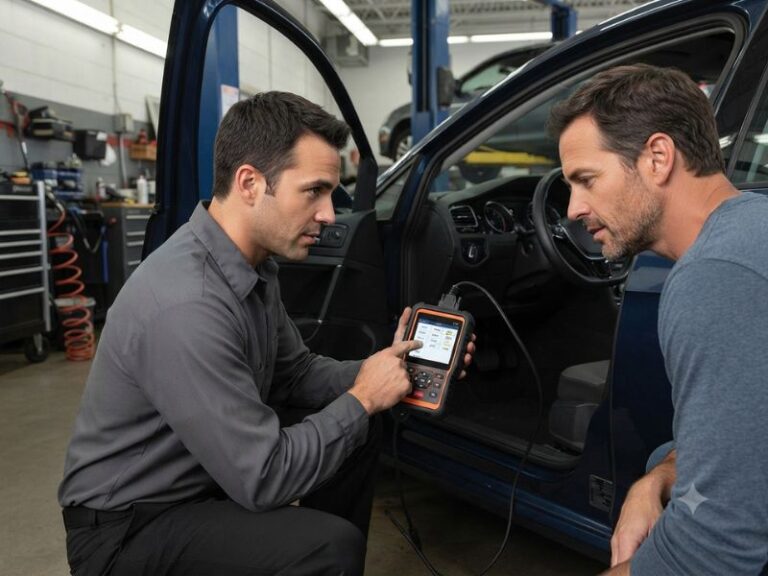
A car code reader connects to the vehicle’s diagnostic port and retrieves these stored codes.
Depending on the scanner type and vehicle compatibility, it can tell you:
- Which system detected a problem
- The diagnostic trouble code number
- Basic code descriptions
- Whether a problem is current or stored
- Freeze-frame information
- Emissions readiness status
- Basic live sensor readings
- Possible areas requiring inspection
For example, a code reader may display:
P0301 – Cylinder 1 Misfire Detected
This tells you that the engine computer detected a misfire condition involving cylinder one.
However, it does not prove the exact cause. The problem could be:
- Bad spark plug
- Failed ignition coil
- Fuel injector issue
- Vacuum leak
- Low compression
- Wiring problem
The code provides a starting point for diagnosis, not a guaranteed repair solution.
It Can Tell You Why the Check Engine Light Is On
The most common reason people use a car code reader is to find out why the Check Engine Light appeared.
The Check Engine Light can turn on for hundreds of reasons, ranging from simple issues to serious engine problems.
A code reader can retrieve the stored fault that caused the warning.
Common Check Engine Light codes include:
P0300 – Random or Multiple Cylinder Misfire
This indicates that the engine computer detected misfires occurring across multiple cylinders.
Possible causes include:
- Ignition problems
- Fuel delivery issues
- Vacuum leaks
- Engine mechanical problems
P0420 – Catalyst System Efficiency Below Threshold
This code relates to catalytic converter efficiency.
Possible causes include:
- Weak catalytic converter
- Faulty oxygen sensor
- Exhaust leak
- Engine running problems
P0171 – System Too Lean
This means the engine is receiving too much air or not enough fuel.
Possible causes include:
- Vacuum leak
- Dirty airflow sensor
- Fuel pressure problem
- Intake leak
P0455 – Evaporative Emissions Leak
This relates to the fuel vapor control system.
Possible causes include:
- Loose gas cap
- Damaged EVAP hose
- Faulty purge valve
- Leaking fuel vapor component
The code helps narrow the search area but does not confirm the failed component.
It Can Show Diagnostic Trouble Codes (DTCs)
A car code reader’s main job is retrieving Diagnostic Trouble Codes.
These codes follow a standardized format.
Example:
P0420
The first letter identifies the system:
- P = Powertrain
- B = Body
- C = Chassis
- U = Network Communication
The numbers provide more specific information about the detected fault.
Common categories include:
Powertrain Codes (P-Codes)
These are related to:
- Engine
- Transmission
- Fuel system
- Emissions
- Ignition
Body Codes (B-Codes)
These may involve:
- Air conditioning
- Door systems
- Airbags
- Interior electronics
Chassis Codes (C-Codes)
These relate to:
- ABS
- Steering
- Suspension
- Brake systems
Network Codes (U-Codes)
These indicate communication problems between vehicle computers.
For example, a U-code may indicate that two control modules cannot exchange information properly.
It Can Tell You Whether a Code Is Current or Historical
Many scanners show different types of fault status.
Stored Codes
A stored code means the vehicle computer confirmed a problem and saved it in memory.
Stored codes often activate warning lights.
Pending Codes
A pending code means the computer noticed a possible issue but has not confirmed it enough times to turn it into a stored fault.
A pending code may disappear if the condition does not happen again.
Permanent Codes
Permanent codes are mainly emissions-related faults that remain stored until the vehicle verifies that the issue has been repaired.
They cannot always be removed manually.
The vehicle automatically clears them after successful self-testing.
Understanding code status helps determine whether a problem is active, intermittent, or already repaired.
It Can Show Freeze-Frame Data
Many car code readers can display freeze-frame data.
Freeze-frame data is a snapshot of vehicle conditions when the computer detected a fault.
It may show:
- Engine speed
- Vehicle speed
- Coolant temperature
- Fuel trim values
- Engine load
- Throttle position
- Intake air temperature
This information is useful because it shows what was happening when the problem occurred.
For example:
A misfire code occurring during heavy acceleration may point toward ignition or fuel delivery issues.
A misfire code occurring only during cold startup may suggest different causes.
Without freeze-frame data, diagnosing intermittent problems can be much more difficult.
It Can Tell You If Emissions Monitors Are Ready
A car code reader can check emissions readiness monitors.
These are self-tests performed by the vehicle computer to verify that emissions systems are working correctly.
Common monitors include:
- Catalytic converter
- Oxygen sensors
- EVAP system
- EGR system
- Fuel system
- Misfire monitoring
The scanner may show:
- Ready
- Complete
- Not ready
- Unsupported
This information is especially useful before an emissions inspection.
When someone clears trouble codes or disconnects the battery, these monitors often reset.
The vehicle must then complete specific driving cycles before the monitors become ready again.
It Can Show Basic Live Sensor Data
More advanced car code readers can display live data while the engine is operating.
Examples include:
- Engine RPM
- Coolant temperature
- Vehicle speed
- Throttle position
- Oxygen sensor readings
- Fuel trims
- Airflow measurements
- Intake temperature
- Engine load
Live data helps compare what the vehicle computer sees in real time.
For example:
If a coolant temperature sensor shows an unrealistic reading, such as a freezing temperature after the engine has warmed up, the sensor or wiring may have a problem.
If fuel trims are extremely positive, the engine may be compensating for a lean condition.
Live data turns a code reader from a simple code finder into a more useful diagnostic tool.
It Can Tell You About Fuel System Problems
A car code reader can provide clues about fuel-related issues.
Fuel system information may include:
- Short-term fuel trim
- Long-term fuel trim
- Oxygen sensor activity
- Airflow readings
- Fuel pressure-related codes
Fuel trim shows how much the engine computer adjusts fuel delivery.
Positive fuel trim means the computer is adding fuel because it believes the engine is running lean.
Negative fuel trim means it is reducing fuel because it believes there is too much fuel.
A scanner may identify a fuel-related condition, but additional testing is usually needed to determine the exact cause.
It Can Tell You About Misfire Problems
A code reader can identify many ignition and combustion problems.
Common misfire codes include:
- P0300 – Random misfire
- P0301 – Cylinder 1 misfire
- P0302 – Cylinder 2 misfire
- P0303 – Cylinder 3 misfire
Misfire causes may include:
- Spark plugs
- Ignition coils
- Fuel injectors
- Vacuum leaks
- Compression problems
- Timing issues
Some advanced scanners can display misfire counters showing which cylinders are experiencing problems.
This information helps technicians quickly identify the affected area.
It Can Tell You About Transmission Problems
Some car code readers can access transmission-related information.
Transmission codes commonly include:
- P0700
- P0715
- P0720
- P0730
- P0740
A scanner may identify issues involving:
- Transmission sensors
- Shift solenoids
- Torque converter operation
- Gear ratio problems
- Communication faults
However, basic code readers may only show general transmission warnings.
For example, P0700 indicates that the transmission control system has detected a problem, but a more advanced scanner may be needed to access the detailed TCM code.
Transmission diagnosis often requires additional testing beyond reading codes.
It Can Tell You About ABS Problems (With Compatible Scanners)
Not every car code reader can access ABS systems.
An ABS-capable scanner may retrieve chassis codes related to:
- Wheel speed sensors
- ABS modules
- Brake pressure sensors
- Stability control systems
- Steering angle sensors
Common ABS-related problems include:
- Damaged wheel speed sensor
- Wiring problems
- Low battery voltage
- Faulty ABS module
A basic engine code reader may show no problems even when the ABS warning light is on because it cannot communicate with the brake control module.
It Can Tell You About Airbag Problems (With Compatible Scanners)
Airbag systems require specialized scanning capability.
An advanced scanner may access:
- SRS module
- Airbag faults
- Seat-belt pretensioners
- Occupancy sensors
- Impact sensors
A basic OBD2 reader usually cannot read airbag codes.
If the airbag warning light is illuminated, you need a scanner with SRS support.
Because airbags are safety devices, do not attempt repairs based only on a code without proper testing procedures.
It Can Tell You If Codes Were Recently Cleared
A code reader can check readiness monitors and stored information that may reveal whether someone recently cleared the computer memory.
When codes are cleared:
- Trouble codes disappear
- Readiness monitors reset
- Vehicle self-tests restart
A vehicle with many “not ready” monitors may indicate that codes were recently erased.
This information can be useful when inspecting a used vehicle before purchase.
However, readiness status alone does not prove that someone intentionally cleared codes.
What a Car Code Reader Cannot Tell You
A car code reader is useful, but it has limitations.
It cannot always tell you:
- The exact failed component
- The repair cost
- Whether a part should be replaced
- Mechanical damage inside the engine
- Internal transmission wear
- Brake pad condition
- Suspension problems
- Fluid quality
- The complete cause of a fault
For example, a P0420 catalytic converter code does not automatically mean the catalytic converter needs replacement.
A complete diagnosis may require:
- Visual inspection
- Electrical testing
- Mechanical testing
- Pressure testing
- Manufacturer repair procedures
A scanner provides information, but experience and testing are still required.
Can a Code Reader Tell You If Your Car Is Safe to Drive?
Not always.
A code reader can identify problems, but it cannot determine overall vehicle safety.
Some warning lights require immediate attention, including:
- Oil pressure warning
- Overheating warning
- Red brake warning
- Flashing Check Engine Light
- Airbag warning
- Severe transmission problems
For example, a flashing Check Engine Light often indicates an active misfire that can damage the catalytic converter.
A scanner can tell you the code, but you must determine whether driving is safe based on the symptoms and severity.
Is Buying a Car Code Reader Worth It?
For many vehicle owners, a car code reader is a useful investment.
It can help you:
- Understand warning lights
- Avoid unnecessary repairs
- Monitor vehicle problems
- Prepare for mechanic visits
- Check used vehicles
- Verify repairs
A basic reader is affordable and useful for common engine problems.
A more advanced scanner is better for enthusiasts, technicians, and owners of vehicles with many electronic systems.
The value depends on how much diagnostic information you want.
Final Thoughts
So, what can a car code reader tell you? It can tell you which vehicle system detected a problem, retrieve diagnostic trouble codes, display basic data, check emissions readiness, and provide valuable clues about possible faults.
However, a car code reader does not magically diagnose every problem or identify the exact failed part.
The best way to use a scanner is as the first step in diagnosis. Read the code, understand what system is involved, perform proper testing, and confirm the actual cause before replacing parts.