How to Read Obd2 Codes Without Scanner Gm: Overview and Key Facts
That dreaded Check Engine Light (CEL) illuminating on your dashboard can be a source of immediate anxiety for any car owner, especially when you’re far from a repair shop or simply trying to understand the issue yourself. For many GM vehicle owners, the first thought might be to rush to an auto parts store for a free scan or invest in an OBD2 scanner. But what if you could get a preliminary idea of the problem without any special tools?
While modern vehicles are complex, there are indeed some clever, albeit limited, methods to glean information about your car’s diagnostic trouble codes (DTCs) even without a dedicated scanner. These techniques won’t replace a professional diagnosis, but they can empower you with knowledge, help you decide if a trip to the mechanic is urgent, or even pinpoint a simple fix.
My aim in this article is to explore the practicalities of how to read OBD2 codes without scanner GM vehicles might offer, focusing on methods that have historically been available or are still applicable to certain models. I’ll cover the limitations, the potential pitfalls, and what information you can realistically expect to retrieve.
Understanding these alternative approaches can save you time, money, and a good deal of stress, providing a stepping stone toward resolving your vehicle’s issues.
Understanding OBD2 and GM Vehicles
Before diving into scanner-free methods, it’s crucial to grasp what OBD2 is and how it relates specifically to General Motors vehicles. OBD2, or On-Board Diagnostics II, is a standardized system implemented in all cars and light trucks sold in the United States since 1996. It monitors various vehicle systems, from engine performance to emissions, and stores diagnostic trouble codes (DTCs) when a problem is detected.
The Role of the Check Engine Light (CEL)
The Check Engine Light is your primary indicator that the OBD2 system has detected an issue. It can illuminate steadily or flash. A steady light usually indicates a non-critical issue, while a flashing light often signals a severe problem, such as a misfire that could damage the catalytic converter, requiring immediate attention.
GM’s Specifics and OBD2
While the OBD2 standard dictates the connector type and basic communication protocols, manufacturers like GM often have their own proprietary enhanced codes and data streams. However, the generic P0xxx codes (e.g., P0301 for a cylinder 1 misfire) are consistent across all OBD2-compliant vehicles, including GM models. The methods I’ll discuss primarily focus on accessing these generic codes or historical indicators that might precede them.
Why Scanner-Free Methods Have Limitations
It’s important to set realistic expectations. Scanner-free methods are generally limited to retrieving basic codes or observing symptoms. They typically cannot access live data, pending codes, or manufacturer-specific enhanced codes, which are often crucial for a precise diagnosis. Think of them as a first-aid kit, not a full diagnostic lab.
Historical Methods for Retrieving Codes (Older GM Vehicles)
For GM vehicles from the OBD1 era (pre-1996) and some early OBD2 models, there were often built-in methods to flash codes without a scanner. While these are less common on modern vehicles, understanding them provides context and might still be applicable to older GM cars you encounter.
The “Paperclip Trick” (OBD1 and Early OBD2)
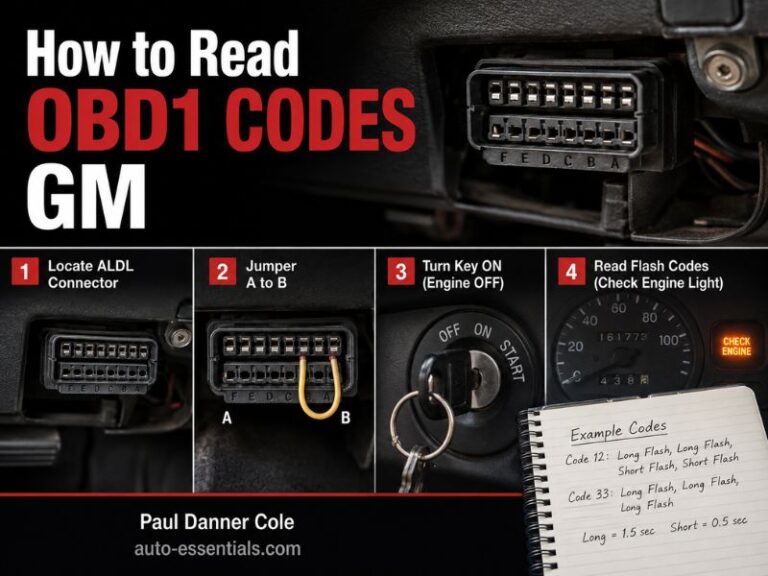
This method, famously known as the “paperclip trick,” was prevalent for GM vehicles equipped with OBD1 systems and some very early OBD2 cars (typically 1996-1998, though it varied by model). It involved shorting two specific pins on the diagnostic connector to make the Check Engine Light flash out the codes.
How it Worked (General Steps):
- Locate the ALDL/OBD1 Connector: For OBD1, this was often a 12-pin connector, usually under the dash near the steering column or sometimes under the hood. For early OBD2, it would still be the standard 16-pin connector.
- Identify the Pins: For OBD1 GM vehicles, you’d typically short pins A and B. For early OBD2, the specific pins varied greatly by model and were less reliably documented for this method.
- Turn Key to ON: With the paperclip (or a small wire) bridging the pins, turn the ignition key to the “ON” position (don’t start the engine).
- Observe the CEL Flashes: The Check Engine Light would then flash a sequence. For example, three flashes, a pause, two flashes, another pause, and then three flashes would indicate code 32. This sequence would repeat for all stored codes, often starting with code 12 (which signifies the system is working).
Important Caveats:
- Safety First: Incorrectly shorting pins can damage the vehicle’s computer. I strongly advise against attempting this on any vehicle unless you are absolutely certain of the correct pins and procedure for your specific year and model, and understand the risks.
- Model Specificity: This method was highly model and year-specific. What worked for a 1995 Camaro might not work for a 1997 Tahoe.
- Rarity on Modern OBD2: This method is almost entirely obsolete for GM vehicles from the late 1990s onward. Modern OBD2 systems are designed for digital communication via a scanner.
Dashboard Display Diagnostics (Limited Models)
Some premium GM vehicles, particularly those from the late 1990s and early 2000s (e.g., certain Cadillac, Pontiac, and Buick models), had a feature where you could access diagnostic codes directly through the instrument cluster or climate control display. This was often done by pressing a specific sequence of buttons.
How it Worked (Example – Cadillac):
- Key ON, Engine OFF: Ensure the ignition is on but the engine is not running.
- Button Sequence: A common sequence might involve holding down the “OFF” and “PASSENGER WARMER” buttons on the climate control for a few seconds.
- Display Codes: The digital display (e.g., climate control or driver information center) would then cycle through various diagnostic parameters and DTCs. Codes would often be displayed as “P0XXX,” “C0XXX,” “B0XXX,” or “U0XXX” for powertrain, chassis, body, and network codes, respectively.
- Navigating Menus: You might use other buttons (like “FAN UP/DOWN”) to scroll through the codes or clear them.
Important Caveats:
- Extremely Model-Specific: This feature was not universal across GM and was typically found on higher-trim models.
- Consult Your Owner’s Manual: If your GM vehicle is from this era and you suspect it might have this feature, your owner’s manual is the definitive source for instructions. I cannot provide a universal procedure here due to the vast differences.
- Limited Information: While more informative than the paperclip trick, it still wouldn’t offer the depth of data a dedicated scanner provides.
I emphasize that these methods are largely historical. For most GM vehicles built after 2000, and certainly after 2005, the expectation is that you will use an OBD2 scanner for code retrieval. However, it’s good to know the legacy of diagnostic access.
Observing Symptoms and Dash Indicators (All GM Vehicles)
Even without a scanner, your GM vehicle is constantly communicating with you through its behavior and dashboard warning lights. While this doesn’t give you specific OBD2 codes, it provides crucial clues that can help you narrow down potential issues.
Understanding Dashboard Warning Lights
Beyond the Check Engine Light, other warning lights can point to specific systems. While they don’t directly display OBD2 codes, they indicate a problem within a particular area that might trigger a related DTC.
- Battery Light: Indicates a charging system issue (alternator, battery, wiring).
- Oil Pressure Light: Low oil pressure – stop driving immediately!
- Temperature Light: Engine overheating.
- ABS Light: Problem with the Anti-lock Braking System.
- Traction Control/StabiliTrak Light: Issues with traction control or stability control systems.
- Airbag Light: Problem with the Supplemental Restraint System (airbags).
- TPMS Light: Tire Pressure Monitoring System issue (often low tire pressure).
Each of these lights, when illuminated, suggests a specific area of concern. While an OBD2 scanner might show a P0500 (Vehicle Speed Sensor Malfunction) alongside an ABS light, the ABS light itself tells you which system is affected.
Listening to Your Vehicle: Sounds and Vibrations
Your ears and the “feel” of your car are powerful diagnostic tools. Unusual noises or vibrations often accompany underlying issues that trigger DTCs.
- Misfires: A rough idle, shaking, or loss of power can indicate a misfire (P030x codes).
- Hissing Sounds: Often points to a vacuum leak, which can cause lean conditions (P0171/P0174) or rough idle.
- Whining/Grinding: Could be power steering, wheel bearings, or other rotating components.
- Squealing: Often a belt issue.
- Rattling: Could be loose exhaust components, heat shields, or internal engine issues.
- Clicking: Often related to valvetrain issues or fuel injectors.
Observing Performance Changes
How your GM vehicle drives is a direct reflection of its health.
- Reduced Fuel Economy: Can be caused by many issues, including O2 sensor failures (P013x, P014x), rich/lean conditions (P017x), or misfires.
- Loss of Power/Acceleration: Could be misfires, clogged catalytic converter (P0420/P0430), fuel delivery issues, or turbocharger problems.
- Rough Idle: Common with vacuum leaks, misfires, or dirty throttle bodies.
- Stalling: Can be due to a faulty Crankshaft Position Sensor (P0335), Camshaft Position Sensor (P0340), or idle air control valve.
- Difficulty Starting: Could point to battery, starter, fuel pump, or ignition system issues.
Smells
Unusual odors are strong indicators of problems.
- Sweet Smell: Often coolant leak (antifreeze).
- Burning Oil Smell: Oil leaking onto hot engine components.
- Burning Rubber Smell: Slipping belt or tire rubbing.
- Rotten Egg Smell: Usually indicates a failing catalytic converter (often accompanied by P0420/P0430).
- Fuel Smell: Fuel leak, potentially dangerous.
By paying close attention to these sensory inputs, you can often get a very good idea of the system affected, even if you don’t have the specific OBD2 code. This information is invaluable when describing the problem to a mechanic or researching potential fixes.
The Free Scan at Auto Parts Stores
While this isn’t a “without a scanner” method in the strictest sense, it’s a widely available and free option for GM owners (and all OBD2 vehicle owners) that bypasses the need to purchase your own tool. Many major auto parts retailers offer free OBD2 code scanning services.
How it Works:
- Drive to the Store: Simply drive your GM vehicle to a participating auto parts store (e.g., AutoZone, Advance Auto Parts, O’Reilly Auto Parts, Pep Boys in the me).
- Request a Scan: Inform a store associate that your Check Engine Light is on and you’d like a free code scan.
- Technician Scans: A store employee will typically come out to your vehicle with their OBD2 scanner, plug it into your car’s diagnostic port (usually under the dashboard on the driver’s side), and retrieve the codes.
- Receive Printout/Information: They will often provide you with a printout or verbally tell you the codes and a brief description of what they mean, along with suggestions for common parts that might resolve the issue.
Advantages of Free Scans:
- It’s Free: The most obvious benefit. You get the specific codes without any personal investment in a scanner.
- Specific Codes: Unlike symptom observation, this gives you the actual P0xxx codes.
- Quick and Convenient: Usually takes only a few minutes.
- Parts Suggestions: Store employees can often point you to relevant parts in their inventory.
Limitations of Free Scans:
- Basic Scanners: The scanners used are typically basic code readers. They will retrieve generic P0xxx codes but usually won’t access manufacturer-specific codes (like GM’s enhanced codes), live data, pending codes, or allow for advanced diagnostics.
- No Diagnosis: The store employees are not certified mechanics and cannot diagnose the problem. They can only tell you the code and suggest parts. A code merely points to a system; it doesn’t always tell you the exact faulty component. For example, a P0420 (Catalyst System Efficiency Below Threshold) doesn’t automatically mean you need a new catalytic converter; it could be an O2 sensor or an exhaust leak.
- Clearing Codes: Some stores may not clear codes for liability reasons, or their scanners might not have that functionality.
- Inconvenience: You still have to drive to the store, which might be an issue if your car is running poorly or if the store is far away.
For most GM owners looking for a quick and free way to get their Check Engine Light codes, this is my top recommendation. It provides concrete information that you can then research further or take to a trusted mechanic.
Leveraging Online Resources and GM Forums
Once you have a code (either from a historical method, symptoms, or a free scan), the internet becomes your most powerful tool for understanding what it means and what steps to take next. GM-specific forums and online communities are particularly valuable.
Decoding OBD2 Codes
The first step is to understand what your code means. There are numerous websites dedicated to listing and explaining OBD2 codes. A quick search for “P0XXX GM code” (replacing XXX with your specific numbers) will yield plenty of results.
- P-Codes (Powertrain): These are the most common and relate to the engine, transmission, and associated emissions systems.
- B-Codes (Body): Relate to body functions like airbags, power windows, central locking, etc.
- C-Codes (Chassis): Relate to chassis systems like ABS, traction control, and steering.
- U-Codes (Network): Relate to communication issues between different modules in the vehicle.
While generic code definitions are a start, remember that the exact cause can vary. For instance, a P0420 (Catalyst System Efficiency Below Threshold) could be a bad catalytic converter, but it could also be a failing oxygen sensor, an exhaust leak, or even a misfire causing unburnt fuel to enter the exhaust.
GM-Specific Forums and Communities
This is where the power of collective experience shines. Websites like:
- GM-Trucks.com
- LS1Tech.com (for LS-powered vehicles)
- CadillacForums.com
- ChevyForum.com
- PontiacG8.org (and other model-specific forums)
…are goldmines of information. I highly recommend searching these forums for your specific GM model, year, and the DTC you’ve found. Often, other owners have experienced the exact same issue and have documented their diagnostic process, common fixes, and even part numbers.
What to Look For in Forums:
- Common Causes: Are there known issues for your specific GM model that trigger this code?
- Diagnostic Steps: What steps did others take to confirm the problem?
- DIY Fixes: Are there relatively simple fixes you can attempt yourself?
- Cost Estimates: What did repairs cost others?
- Parts Recommendations: Which brands or types of parts worked best?
YouTube Tutorials
Visual learners will find YouTube invaluable. Search for your specific GM model and the code (e.g., “P0420 Chevy Silverado fix”). You can often find step-by-step guides on how to diagnose and even replace components related to common codes.
Limitations of Online Research:
- Information Overload: You might find conflicting advice.
- Misdiagnosis Risk: Without proper diagnostic tools, it’s easy to misinterpret information or replace the wrong part.
- Outdated Information: Ensure the information you’re reading is relevant to your vehicle’s year and model.
Online resources are fantastic for guiding your next steps, but always cross-reference information and consider the source. They empower you to be an informed consumer, whether you’re tackling the repair yourself or discussing it with a mechanic.
When a Scanner is Truly Necessary
While the methods I’ve discussed can provide valuable insights, there are definite limitations to reading OBD2 codes without a dedicated scanner, especially for GM vehicles. Understanding these limitations helps you know when it’s time to invest in a tool or seek professional help.
Accessing Manufacturer-Specific Codes
GM, like other manufacturers, uses enhanced or proprietary codes that go beyond the generic P0xxx codes. These codes often provide much more specific information about a fault within a GM-specific system. Basic code readers (like those used for free scans) typically cannot read these, but a more advanced scanner (often called a “bi-directional” or “enhanced” scanner) can.
Live Data Monitoring
This is perhaps the biggest advantage of a scanner. Live data allows you to see real-time sensor readings (e.g., O2 sensor voltage, engine RPM, coolant temperature, fuel trim, MAF sensor readings). Observing these values while the engine is running can be critical for diagnosing intermittent problems or confirming a sensor’s failure. For example, if you have a P0171 (System Too Lean Bank 1), monitoring fuel trims and O2 sensor data can help pinpoint if it’s a vacuum leak, a faulty MAF sensor, or a weak fuel pump.
Pending Codes
The OBD2 system stores “pending codes” when a fault is detected but hasn’t yet occurred enough times to trigger the Check Engine Light. A scanner can read these pending codes, giving you a heads-up about potential issues before they become a full-blown problem.
Clearing Codes and Resetting Monitors
After a repair, you’ll want to clear the codes and turn off the Check Engine Light. A scanner allows you to do this. Additionally, clearing codes resets the vehicle’s readiness monitors, which are crucial for emissions testing. Driving cycles are then required to set these monitors to “ready.”
Bi-Directional Control and Special Functions
More advanced scanners offer bi-directional control, meaning they can send commands to vehicle components (e.g., activate the fuel pump, cycle the ABS pump, perform an idle relearn). They can also perform special functions like programming new keys, bleeding ABS brakes, or calibrating sensors. These capabilities are far beyond what any scanner-free method can offer.
When to Consider Buying a Scanner:
- Frequent Issues: If your GM vehicle frequently has CEL issues, a scanner pays for itself quickly.
- DIY Enthusiast: If you enjoy working on your own car, a scanner is an essential tool.
- Multiple Vehicles: If you own several OBD2-compliant vehicles, a scanner is a smart investment.
- Want More Detail: If you’re frustrated by the limited information from free scans or symptoms, a scanner provides deeper insight.
Basic OBD2 scanners are relatively inexpensive, starting from around $20-$30 for Bluetooth dongles that pair with smartphone apps, up to $100-$200 for handheld units with more features. For serious DIYers or those with specific GM models, investing in a scanner with enhanced GM capabilities might be worthwhile.
Conclusion: How to Read OBD2 Codes Without Scanner GM Vehicles (The Reality)
While the allure of diagnosing your GM vehicle without any tools is strong, the reality is that truly “reading” OBD2 codes without a scanner is largely a historical concept for older models. For most modern GM vehicles (post-2000), direct code retrieval without a scanner is not a standard feature. The “paperclip trick” and dashboard diagnostics were specific to certain eras and models, and attempting them on newer vehicles can be risky or simply ineffective. My advice is to focus on practical, safe, and effective alternatives.
The most reliable and accessible method to read OBD2 codes without scanner GM owners needing to buy a tool is to utilize the free diagnostic services offered by many auto parts stores. This provides you with the actual P0xxx codes, which you can then research extensively using online resources and GM-specific forums. Coupled with careful observation of your vehicle’s symptoms and dashboard warning lights, you can gather a significant amount of information to understand the problem, decide on urgency, or prepare for a conversation with a mechanic. While these methods won’t replace the comprehensive diagnostic capabilities of a dedicated OBD2 scanner, they empower you to be an informed and proactive GM vehicle owner. A reliable answer to “how to read obd2 codes without scanner gm” comes from applying these points to the specific situation rather than relying on one rule.