How to Read Engine Codes Without a Reader: Key Facts and Guidance
Yes, some vehicles let you retrieve engine or diagnostic trouble codes without owning a code reader, but the method depends on the vehicle’s year, make, model, and diagnostic system. Newer cars usually require a scan tool, while certain older vehicles can display codes through a flashing check-engine light, an ignition-key sequence, or a built-in information screen.
The stakes are practical: a quick code check can prevent unnecessary parts replacement, but a misleading interpretation can waste money or leave a serious fault untreated. A steady check-engine light may allow limited driving, whereas a flashing light can indicate a condition capable of damaging the catalytic converter or engine. The code identifies a system or fault area, not automatically the failed part.
This guide explains the workable no-reader methods, how to recognize whether a vehicle supports them, and why many modern cars cannot provide a complete answer from the dashboard alone. You will learn how to record a flash code, use a key-cycle or vehicle-information display when available, avoid unsafe connector shortcuts, interpret the result alongside symptoms, and decide when borrowing a scan tool or seeking professional diagnosis is the sensible next step.
What an engine code actually tells you
An engine code is usually a diagnostic trouble code (DTC) stored by one of the vehicle’s control modules. The powertrain control module monitors sensors, actuators, emissions equipment, ignition, fuel delivery, and communication circuits. When measured behavior falls outside an expected range, it may turn on the malfunction indicator lamp, commonly called the check-engine light, and store a code.
Codes typically identify a system, circuit, or operating condition. For example, a code related to an oxygen-sensor circuit does not prove that the oxygen sensor itself is defective. Wiring, a connector, an exhaust leak, a power-supply problem, or an engine condition that creates unusual readings could be responsible.
Common code families begin with a letter:
- P codes concern the powertrain, including the engine, transmission, and emissions systems.
- B codes concern body systems such as airbags, climate controls, or power accessories.
- C codes concern chassis systems such as braking, steering, or suspension controls.
- U codes concern communication between electronic modules.
A no-reader method may reveal only a basic engine code, a flash count, or a warning message. It may not show pending codes, manufacturer-specific details, freeze-frame data, live sensor readings, or codes stored in other modules. That limitation matters because a complete diagnosis often depends on knowing when the fault occurred and what the vehicle was doing at that moment.
Check for a built-in code display first
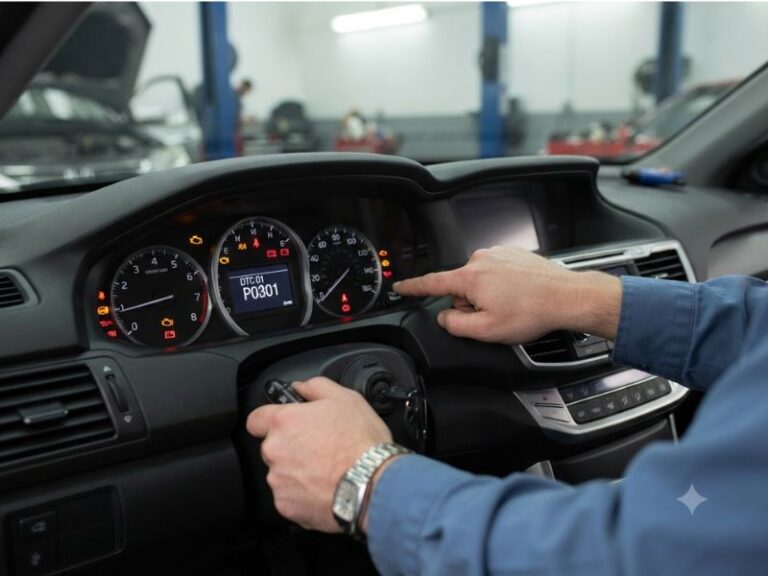
Before trying a workaround, inspect the vehicle’s instrument cluster and driver-information menu. Some vehicles can display diagnostic messages, stored faults, or text descriptions after a specific button sequence. This is more common on vehicles with advanced information displays, although the available data varies considerably.
Turn the ignition on without starting the engine and look through the information screens. Search for menus labeled vehicle status, diagnostics, warnings, or service information. Some systems show only “check engine” or “service engine soon,” while others display a numerical code or a short description.
Use the owner’s manual to confirm the correct sequence. A display that shows maintenance reminders is not necessarily capable of reading DTCs. Resetting a reminder may also erase useful service information without addressing the fault, so avoid selecting a reset option unless the maintenance work has actually been completed.
Use the ignition-key cycle method on compatible vehicles
Some older vehicles can enter a diagnostic mode when the ignition is switched between the off and run positions in a particular pattern. A commonly used sequence involves turning the key from off to run several times without cranking, then leaving it in the run position. The exact pattern differs by manufacturer and model year, so a generic sequence is not guaranteed to work.
If the method is supported, the check-engine light may flash a two-digit or three-digit code, or the instrument cluster may show a code. Count each flash carefully and write down the numbers in order. Long pauses often separate individual digits or separate codes, but the timing convention is vehicle-specific.
Do not assume that a successful key sequence proves the vehicle has no fault. Some cars show only stored emissions-related codes, some show a “done” or “end” message, and some provide no useful display at all. If the lamp remains on but no code appears, the vehicle may require a scan tool or the procedure may simply be incompatible.
Look for a flashing check-engine light on older systems
Vehicles built before modern OBD-II requirements may use a flash-code system. When placed in diagnostic mode, the malfunction indicator lamp can blink a pattern that corresponds to a numerical trouble code. This approach is associated mainly with older OBD-I vehicles and certain manufacturer-specific systems.
To read a flash code, sit where the warning lamp is easy to see, switch the ignition to the specified position, and observe the pattern without starting the engine unless the manual explicitly requires it. Record the flashes as they occur rather than relying on memory. A phone’s video camera can help document the sequence, but the phone does not decode the vehicle by itself.
Flash-code interpretation must match the correct manufacturer and system. The same number can mean different things on different vehicles, and some systems use pauses, groups, or repeated end codes. A code list from another model can lead to an incorrect repair.
Can the gas-pedal or button method reveal codes?
On certain vehicles, pressing the accelerator pedal in a specified pattern with the ignition on can trigger a diagnostic display. Others use steering-wheel buttons, trip-meter controls, or a combination of pedals and ignition positions. These procedures are not universal and can vary even between two models from the same brand.
Use only a procedure documented for the exact vehicle. A pedal sequence that works on one model may do nothing on another, and an incorrect sequence could change a setting or enter a service mode unrelated to engine diagnostics. Keep the transmission in Park, apply the parking brake, and do not attempt a procedure while the vehicle is moving.
If a code appears, photograph the display and record whether the light was steady or flashing. The warning-light behavior, driving symptoms, and recent repairs provide important context that the number alone cannot supply.
Why improvised connector methods are risky
Older diagnostic connectors sometimes allowed a test light or jumper wire to retrieve flash codes. This is the origin of many paperclip-based instructions found online. The danger is that connectors can look similar while having different pin assignments, voltage levels, and module functions.
Bridging the wrong terminals can short a power circuit, damage a control module, deploy a restraint system, or create a new fault. Modern vehicles may have several networks and modules connected through the diagnostic connector, so guessing based on connector shape is unsafe. Never insert a wire, test probe, or metal object unless a verified vehicle-specific procedure identifies the exact terminals and the manufacturer’s instructions permit it.
Airbag, hybrid, and electric-vehicle systems deserve particular caution. Their warning codes may not be accessible through the engine-light procedure, and high-voltage components should not be probed by an untrained person. A dashboard warning involving brakes, steering, airbags, or high voltage is a reason to stop experimenting and obtain qualified help.
Read the warning light before interpreting the code
A steady check-engine light generally indicates that the computer detected a fault that may not require immediate shutdown, although the vehicle should be checked promptly. Reduced power, rough running, unusual smells, overheating, or poor braking changes the risk even when the lamp is steady.
A flashing check-engine light commonly signals an active misfire severe enough to threaten the catalytic converter. Reduce load, avoid hard acceleration, and pull over safely if the engine is shaking, losing power, overheating, or producing smoke. Continuing to drive can turn an ignition or fuel problem into expensive emissions or engine damage.
If several warning lamps appear together, do not focus only on the engine code. A weak battery, charging fault, network problem, or low system voltage can trigger multiple unrelated-looking warnings. Note when each lamp appeared and whether the vehicle had recently been jump-started, serviced, flooded, or exposed to extreme weather.
Match the code with symptoms and recent events
After recording a code, inspect the simplest relevant causes before replacing parts. A loose fuel cap, disconnected intake hose, damaged wiring, low battery voltage, blown fuse, or recently disturbed connector can produce a warning. Visual inspection should be done with the engine off and cool enough to touch safely.
Ask what changed before the light appeared. Did the vehicle receive a tune-up, battery replacement, oil service, exhaust repair, or fuel-system work? Did the symptom begin after heavy rain or a very cold start?
Timing does not prove causation, but it helps narrow the diagnostic path.
Do not clear the code merely to turn the light off. Clearing erases stored evidence and resets emissions monitors, which can make the vehicle temporarily appear normal while the fault remains. It can also complicate an emissions inspection because the monitors may show as incomplete.
Codes should be treated as starting points. A fuel-trim code may result from an intake leak, low fuel pressure, a sensor issue, or an exhaust leak. A misfire code may point to a spark plug, ignition coil, injector, compression problem, or wiring fault.
Testing is needed before choosing a replacement part.
When a scan tool is still necessary
Most vehicles sold in the United States from the mid-1990s onward use OBD-II, but the dashboard generally cannot display all OBD-II data without a compatible scan tool. Even when a key or pedal trick works, it may expose only a narrow set of powertrain codes.
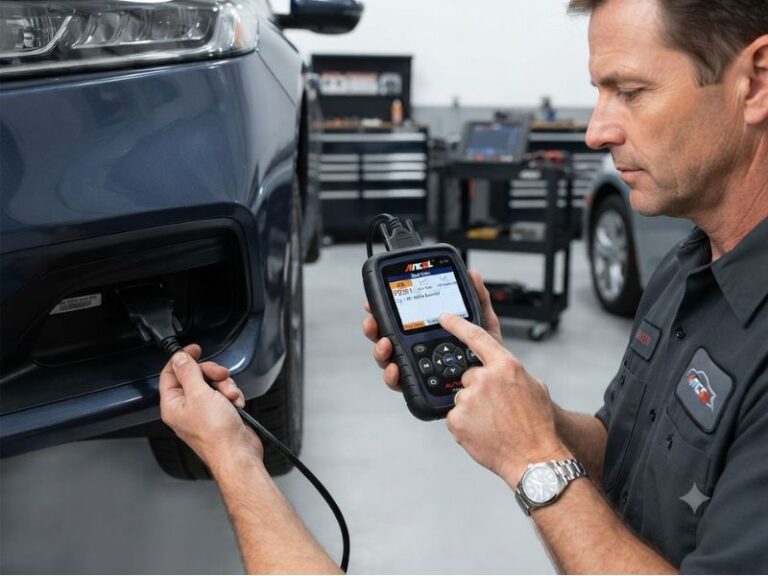
A scan tool becomes especially important when the vehicle has intermittent symptoms, multiple codes, a no-start condition, reduced-power mode, transmission problems, or a warning from a system other than the engine. A capable tool can show pending codes, freeze-frame information, monitor readiness, and live data that help distinguish a failed component from a wiring or operating problem.
If buying a tool is not worthwhile for a single diagnosis, consider borrowing one, using a repair facility, or asking whether a local parts retailer provides a code scan. Confirm what information the service includes and remember that reading codes is not the same as diagnosing the vehicle. Keep the printed or photographed results, including code status and any freeze-frame details.
Safe no-reader checklist
The following process keeps a basic code check useful without turning it into guesswork:
- Park safely, apply the parking brake, and switch off the engine before inspecting anything.
- Record the warning lights, visible messages, mileage, weather, and driving symptoms.
- Check the owner’s manual for a supported display, key-cycle, pedal, or flash-code procedure.
- Use only instructions for the exact year, make, model, engine, and diagnostic system.
- Record every flash or displayed code in sequence; photograph the display when possible.
- Inspect obvious, safe items such as the fuel cap, accessible connectors, hoses, and battery terminals.
- Do not jump diagnostic terminals or probe unknown pins.
- Do not clear codes until the information has been saved and the cause has been investigated.
- Arrange professional diagnosis for a flashing light, severe running problem, safety-system warning, or repeated fault.
Frequently asked questions about reading engine codes without a reader
Can I read engine codes without a reader on any
No, not on every car. Some older vehicles and a limited number of newer vehicles offer a flash-code, ignition, pedal, or information-display method. Many modern OBD-II vehicles require a scan tool to retrieve complete diagnostic information.
How do I read engine codes without a reader using
Use the vehicle-specific ignition-cycle procedure if the manufacturer supports it. The sequence usually switches the key between off and run without starting the engine, after which the light or display may report codes. Check the exact owner’s manual instructions because the sequence and flash interpretation vary.
Can a phone read engine codes by itself?
No, a phone needs compatible hardware to communicate with the vehicle. A phone camera can record a flashing light, but an app requires an adapter connected to the diagnostic port. Without that adapter, the phone cannot retrieve electronic codes.
Will turning the key on and off reset the check-engine
It usually will not repair or reliably reset the underlying fault. Some key sequences retrieve codes, while others may temporarily change what is displayed. Disconnecting the battery or clearing codes can erase useful diagnostic information and reset emissions monitors.
What does a flashing check-engine light mean without a code?
It should be treated as an urgent running problem, often an active misfire. Avoid hard acceleration and stop safely if the engine runs roughly, loses power, overheats, or smells strongly of fuel. Arrange diagnosis promptly to reduce the risk of catalytic-converter or engine damage.
Can I use a paperclip to read an engine code?
Do not use a paperclip unless a verified, vehicle-specific procedure explicitly identifies the safe terminals. Connecting the wrong pins can damage electronics or create a serious safety hazard. Connector shape alone is not enough to identify the correct circuit.
Does an engine code identify the bad part?
No, an engine code identifies a detected fault area or condition rather than proving which part failed. Wiring, connectors, vacuum leaks, voltage problems, and related mechanical faults can produce the same code as a defective sensor or actuator.
Use the no-reader method as a first check
Reading engine codes without a reader is possible when the vehicle provides a supported flash, ignition, pedal, or display procedure, but it is not a universal substitute for scanning. Record the code and symptoms, interpret them together, and never treat a code as automatic proof that a particular part needs replacement.
The major limitations are incomplete data and safety risk, especially with flashing warning lights, unknown diagnostic terminals, airbags, hybrids, and electric vehicles. Use the owner’s manual to verify the method, avoid improvised electrical connections, and obtain a proper scan or professional diagnosis when the vehicle runs poorly or the warning returns.