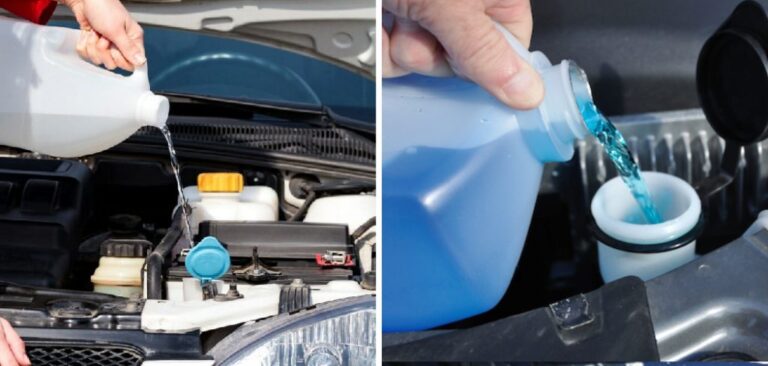
To mix windshield washer concentrate, read the dilution instructions on the bottle, measure the required concentrate and water separately, combine them in a clean container, mix thoroughly, and then pour the finished solution into the windshield washer reservoir.
For drivers in the United States, the correct windshield washer concentrate mixture depends heavily on the product and the climate where the vehicle is used. A summer mixture that works well in Florida, southern Texas, or coastal California may not provide enough freeze protection for winter driving in Minnesota, North Dakota, Colorado, or other cold regions. There is no universal concentrate-to-water ratio that is correct for every brand, so the dilution chart on your specific bottle should always take priority.
The basic process is simple, but accurate measurement matters. Too much water can weaken cleaning performance and, with winter formulas, reduce freeze protection. Using more concentrate than the manufacturer specifies may waste product and can increase odor, chemical exposure, or residue without providing a useful advantage. This guide explains how to mix windshield washer concentrate correctly, calculate common dilution ratios, choose water, prepare a winter mixture, fill the reservoir safely, and correct a mixture that was made too strong or too weak.
How to Mix Windshield Washer Concentrate Step by Step
The safest way to mix windshield washer concentrate is to prepare the solution outside the vehicle. You need the concentrate, the water specified or permitted by its instructions, a clean measuring container, a clean mixing jug, and a funnel if the washer reservoir opening is difficult to reach.
Before measuring anything, read the entire product label. Look for wording such as concentrate to water, water to concentrate, summer dilution, winter dilution, or freeze protection. Pay close attention to which ingredient is listed first. A 1:3 concentrate-to-water ratio is very different from a 3:1 concentrate-to-water ratio.
Once you know the required ratio, calculate how much finished fluid you need. You do not have to fill the reservoir completely if it already contains compatible washer fluid. Making only the amount you need reduces waste and makes accurate measurement easier.
Source: storage.googleapis.com
Step 1: Read the concentrate label
Find the manufacturer’s dilution ratio and any temperature-specific mixing chart. Do not substitute a generic ratio if the bottle provides its own instructions.
Step 2: Determine how much fluid you need
Estimate the empty space in the washer reservoir or prepare a convenient batch size such as one gallon.
Step 3: Measure the water
Use clean water of the type allowed by the manufacturer. Distilled or demineralized water can be useful where tap water is especially hard.
Step 4: Measure the concentrate
Measure it separately so the dilution remains accurate instead of estimating by eye.
Step 5: Combine the liquids
Pour the measured ingredients into a clean, chemical-compatible container and gently mix them.
Step 6: Fill the washer reservoir
Locate the reservoir cap marked with the windshield washer symbol and add the premixed fluid without overfilling.
Step 7: Test the system
Operate the washers briefly and confirm that both the fluid spray and wipers work normally.
Why Premixing Is Better Than Mixing in the Reservoir
Premixing gives you better control over the ratio. If concentrate and water are poured into the reservoir separately, the actual mixture can be difficult to judge, especially when some old fluid remains in the tank. Vehicle manufacturers may also specifically instruct owners to premix concentrate before filling.
A separate container also makes it easier to correct a measuring error before the solution enters the car. Use a clean container intended for automotive chemicals, label any leftover mixture, and never store washer fluid in beverage bottles or food containers.
A dilution ratio tells you how many equal parts of concentrate and water should be combined. If the instructions say 1 part concentrate to 3 parts water, the finished mixture contains four total parts. One quarter of the final volume is concentrate and three quarters is water.
Do not assume that a particular ratio provides the same freeze protection across different brands. Formulas vary in alcohol content, detergents, solvents, and other ingredients. For example, manufacturers of different concentrates publish substantially different dilution charts even when the numerical ratios look similar.
Source: prosupply.com
1:1 concentrate to water
Two total parts. Half of the finished mixture is concentrate and half is water.
1:2 concentrate to water
Three total parts. One third is concentrate and two thirds are water.
1:3 concentrate to water
Four total parts. One quarter is concentrate and three quarters are water.
1:5 concentrate to water
Six total parts. One sixth is concentrate and five sixths are water.
Example: Making One Gallon at a 1:3 Ratio
One U.S. gallon contains 128 fluid ounces. A 1:3 concentrate-to-water mixture has four total parts. Divide 128 ounces by four to get 32 ounces per part. You would therefore use 32 fluid ounces of concentrate and 96 fluid ounces of water.
This calculation explains the mathematics only. Use a 1:3 mixture for your vehicle only when the concentrate manufacturer specifies that ratio for the conditions in which you will drive.
Quick One-Gallon Mixing Examples
For a hypothetical one-gallon batch, a 1:1 ratio requires 64 fluid ounces of concentrate and 64 fluid ounces of water. A 1:2 ratio requires about 42.7 fluid ounces of concentrate and 85.3 fluid ounces of water. A 1:3 ratio requires 32 fluid ounces of concentrate and 96 fluid ounces of water.
When practical, follow the quantities provided directly by the product manufacturer rather than relying on rounded calculations.
How to Mix Windshield Washer Concentrate for Winter
Winter mixing requires more attention because the finished washer fluid must remain usable at the temperatures the vehicle will encounter. The manufacturer’s freeze-protection chart is the deciding reference. Select a dilution that is rated for temperatures at least as cold as the conditions reasonably expected where you drive and park.
This is especially important for U.S. drivers who travel between climate zones. A vehicle prepared for a mild southern winter may later be driven into below-freezing conditions in the Midwest, Mountain West, or Northeast. The fluid already in the reservoir must be considered before adding a stronger winter mixture because leftover summer fluid will dilute what you add.
Commercial concentrate formulas differ dramatically. Some products call for relatively strong concentrate ratios in cold weather, while others achieve their stated protection at different proportions. That variation is why a generic winter recipe cannot replace the specific dilution chart on your bottle.
Source: snapklik.com
Check the expected low temperature
Consider nighttime lows and travel destinations rather than only the daytime temperature when you prepare the mixture.
Use the product’s freeze rating
Choose the manufacturer’s stated dilution for the desired temperature protection.
Account for fluid already in the tank
A reservoir containing weak summer fluid can dilute a newly added winter mixture.
Do not add engine antifreeze
Engine coolant is not a substitute for windshield washer antifreeze and can cause visibility or vehicle-finish problems.
What If Summer Washer Fluid Is Already in the Reservoir?
If a major freeze is approaching and the reservoir contains a weak summer mixture, simply topping it off with winter concentrate does not guarantee the final blend will reach the desired freeze rating. The result depends on how much old fluid remains and the strength of both fluids.
When practical and permitted by the vehicle instructions, use the existing washer fluid before severe cold arrives and refill with properly premixed winter fluid. Avoid intentionally running the washer pump dry for an extended period because washer pumps depend on fluid for normal operation.
Should You Use Tap Water or Distilled Water?
Use the type of water specified by the concentrate manufacturer. If the instructions simply call for water, clean tap water is often practical, but distilled or demineralized water can be a useful choice in areas with very hard water.
Hard water contains dissolved minerals. Repeated use can contribute to mineral spotting on glass and deposits around washer nozzles, particularly where water hardness is high. Distilled water contains far fewer dissolved minerals and removes that variable from the mixture.
Using distilled water does not improve the concentrate’s freeze protection beyond what the manufacturer states. Freeze protection comes from the complete formula and its dilution ratio, not from distilled water itself.
Source: storage.googleapis.com
Tap water
Convenient and often acceptable when the product instructions permit it and local water is not excessively hard.
Distilled water
A practical option for minimizing mineral content, especially where tap water leaves visible scale or spots.
Well water
Quality varies considerably, so water with noticeable sediment or high mineral content is better avoided for a washer system.
Can You Use Only Water in the Washer Reservoir?
Plain water may rinse light dust in warm weather, but it lacks the detergency and temperature protection provided by properly formulated washer fluid. More importantly, water can freeze at 32 degrees Fahrenheit, creating problems in the reservoir, hoses, pump, and spray nozzles when temperatures fall below freezing.
For year-round reliability, use an automotive windshield washer product mixed according to its instructions rather than treating plain water as an all-season substitute.
Common Mistakes When Mixing Windshield Washer Concentrate
Most mixing problems come from guessing the ratio, misreading which component comes first, or failing to consider temperature. Correcting those issues before filling the reservoir is easier than trying to adjust an unknown mixture afterward.
Another common mistake is assuming that more concentrate is automatically better. A stronger blend may cost more, produce stronger solvent odors, or fall outside the manufacturer’s intended dilution without giving the vehicle a meaningful benefit.
Source: storage.googleapis.com
Guessing the dilution
Eyeballing the amount can produce a mixture that is much stronger or weaker than intended.
Reversing the ratio
Confirm whether the label means concentrate-to-water or water-to-concentrate before measuring.
Ignoring winter temperature
A heavily diluted summer mixture may freeze when exposed to subfreezing weather.
Mixing unrelated automotive fluids
Do not add engine coolant, brake fluid, fuel additives, or other chemicals to the washer reservoir.
Combining unknown washer products
Avoid mixing different concentrates unless their manufacturers indicate compatibility because their formulas and required dilution can differ.
Using an unlabeled storage container
Store leftover fluid only in a suitable, clearly labeled container and keep it away from children and pets.
What If You Added Too Much Water?
If you know exactly what you added, you can calculate how much concentrate is needed to restore the manufacturer’s ratio. For example, if the target is 1 part concentrate to 3 parts water and you accidentally used 4 parts water, additional concentrate may correct the batch.
When the amounts are unknown, especially before freezing weather, guessing at a correction is unreliable. Replacing the questionable mixture with a correctly measured batch is the more dependable approach.
What If You Added Too Much Concentrate?
If the product is designed to be diluted and you know the quantity used, add the calculated amount of water required to bring the batch back to the labeled ratio. Make the correction in a separate container when possible so you can measure accurately.
Do not assume full-strength concentrate is automatically safe merely because it provides stronger freeze protection. Some vehicle and product instructions specifically require dilution or premixing.
Safety Tips for Handling Washer Fluid Concentrate
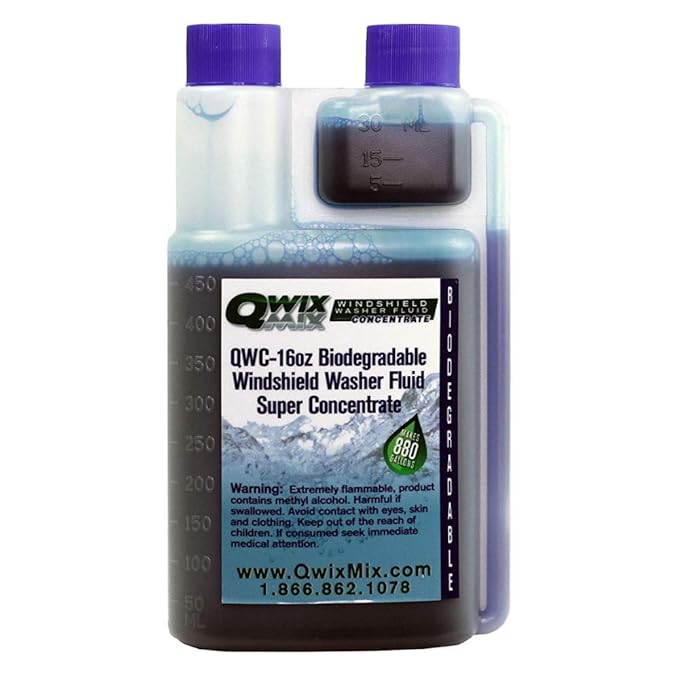
Windshield washer concentrates are automotive chemicals, and their ingredients vary. Some formulas contain alcohols such as methanol or other solvents that can be toxic, irritating, or flammable. Read the hazard statements on your specific container and follow its storage, ventilation, protective-equipment, and first-aid directions.
Work in a well-ventilated area, avoid splashing the liquid into your eyes, and wash exposed skin as directed by the label. Keep concentrates and mixed washer fluid away from children and pets. Never transfer them into a beverage bottle, cup, or food container because the liquid can be mistaken for something safe to drink.
If the product is labeled flammable, keep it away from flames, sparks, smoking materials, hot surfaces, and other ignition sources. Dispose of unwanted concentrate according to the label and applicable local household hazardous-waste rules rather than pouring an unknown chemical onto the ground or into a storm drain.
Read the hazard label
Ingredients and precautions vary between washer concentrate formulas.
Avoid ingestion
Some washer fluids contain highly toxic alcohols or solvents and must never be consumed.
Protect your eyes
Pour carefully and follow the product’s eye-protection guidance, particularly when handling concentrated fluid.
Use ventilation
Avoid deliberately breathing concentrated vapors, particularly in enclosed garages.
Store securely
Keep the original label intact and place the product where children and animals cannot reach it.
U.S. Regional and Regulatory Considerations
Some windshield washer formulations and dilution recommendations differ by U.S. jurisdiction because volatile organic compound requirements can restrict the concentration of certain ingredients. California is a notable example where product directions may vary by region or temperature conditions.
For that reason, a dilution chart intended for one product or jurisdiction should not automatically be applied to another. Use a concentrate sold for your market and follow its current U.S. label instructions.
How to Know the Mixture Is Working Correctly
After filling the reservoir, activate the washer system for a short period. A properly functioning system should deliver a consistent spray onto the windshield, and the wipers should clear the fluid without leaving an unusual oily film or persistent heavy residue.
If the pump runs but little or no liquid reaches the glass, stop repeatedly operating it and investigate the system. The reservoir may be empty, the nozzles may be obstructed, a hose may be disconnected, the fluid may be frozen, or the washer pump may have a fault. Mixing stronger concentrate will not repair a mechanical problem.
During freezing weather, fluid that turns to slush, freezes on the windshield, or stops spraying after cold exposure suggests that the existing mixture may not provide adequate low-temperature protection. Check the actual product rating and replace or correct the mixture rather than relying on an assumed ratio.
Normal spray pattern
Fluid reaches the intended windshield area without obviously restricted flow.
Good wiping
The solution helps remove road film, dirt, and light debris without persistent smearing.
Cold-weather operation
A correctly selected winter mixture remains usable within the temperature range stated by its manufacturer.
What to Do If the Washer Fluid Freezes
Do not pour boiling water onto a frozen reservoir or windshield. Rapid temperature changes can damage materials, and attempting to operate a frozen washer system can place unnecessary load on the pump.
Move the vehicle to a warmer environment when practical and allow the system to thaw naturally. Once thawed, replace or adjust the fluid using a winter-rated mixture appropriate for the expected temperature. If the reservoir, hoses, nozzles, or pump were damaged, repair may be needed before the system works normally.
Frequently Asked Questions
Q
What is the correct windshield washer concentrate to water ratio?
There is no single correct ratio for every concentrate. Depending on the formula and intended temperature range, manufacturers may specify ratios such as 1:1, 1:2, 1:3, or much more dilute summer mixtures. Use the dilution chart on your exact product.
Q
Can I pour windshield washer concentrate directly into the reservoir?
Premixing is generally the better method when the product requires dilution, and some vehicle manufacturers specifically instruct owners to premix the concentrate and water before filling the reservoir. Follow both the vehicle owner’s manual and concentrate label.
Q
Does adding more concentrate give better freeze protection?
A higher concentration can change freeze protection when the product is formulated for that purpose, but the relationship is product-specific. Do not assume that adding an arbitrary extra amount is beneficial. Use the manufacturer’s temperature and dilution chart.
Q
Can I mix blue and orange windshield washer fluid?
Color alone does not establish compatibility. Washer fluids can use color simply as an identifier, while their chemical formulations and intended functions may differ. If compatibility is not stated, avoid combining unknown products and use one correctly diluted formula.
Q
Can I mix windshield washer concentrate with regular washer fluid?
It may be possible with some compatible products, but doing so makes the final concentration and freeze rating harder to determine. If winter protection matters, starting with a known mixture made according to one manufacturer’s instructions gives a more predictable result.
Q
How much concentrate do I need for a one-gallon batch?
The amount depends on the labeled ratio. At 1:1 concentrate to water, a one-gallon batch uses 64 fluid ounces of each. At 1:3, it uses 32 fluid ounces of concentrate and 96 fluid ounces of water. These are mathematical examples, not universal mixing recommendations.
✦ Wrapping Up
Conclusion
Learning how to mix windshield washer concentrate is mainly about following the product’s dilution instructions accurately. Check the label first, choose the ratio appropriate for your U.S. climate and expected temperature, measure both ingredients, mix them in a clean separate container, and then fill the washer reservoir.
Avoid guessing at winter protection or assuming that all concentrates use the same formula. Accurate dilution gives you predictable cleaning performance while helping protect the washer system during cold weather. If you are preparing a vehicle for a U.S. winter, pay particular attention to the manufacturer’s freeze-protection chart and to any weaker fluid already remaining in the reservoir.
💡 Key Takeaway
Before mixing, photograph or read the concentrate’s dilution chart, choose the ratio for your expected temperature, calculate the total parts, measure the concentrate and water separately, premix them thoroughly, and only then add the finished fluid to the vehicle.
Learn how to fold a collapsible windshield sun shade using the simple figure-eight method, plus tips for storage, troubleshooting, and different shade designs.
Learn how to install a windshield sun shade correctly in your car. Follow simple steps for folding, roll-up, and umbrella-style shades, plus fit, safety, storage, and troubleshooting tips.