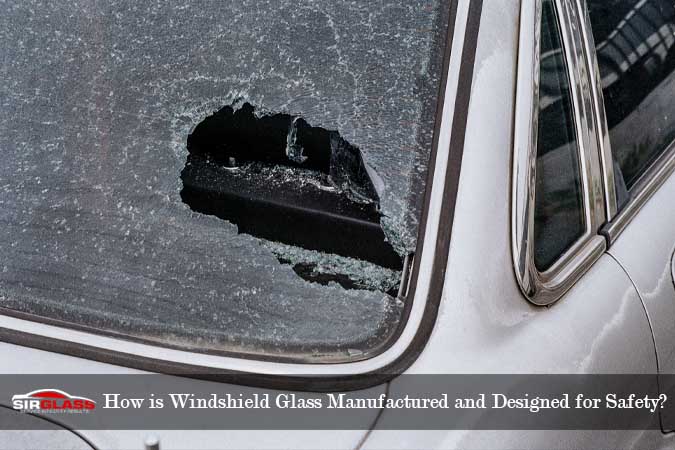
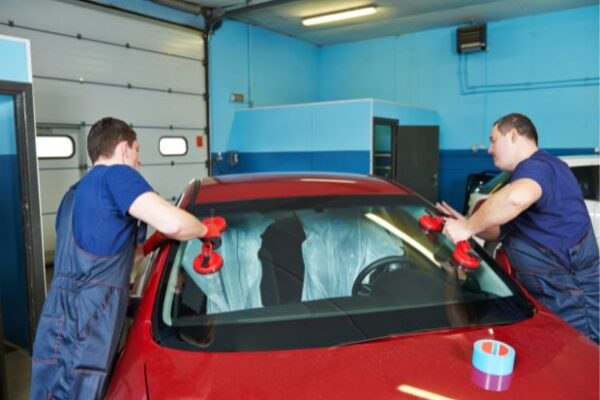
Windshields are made by shaping two thin sheets of automotive glass, placing a transparent plastic interlayer between them, removing trapped air, and bonding the three layers together with heat and pressure.
In the United States, the windshield in a typical passenger vehicle is much more than a curved piece of glass. It is safety glazing designed to give drivers a clear view of the road while helping the windshield remain together after an impact. U.S. motor vehicle glazing is subject to Federal Motor Vehicle Safety Standard No. 205, which establishes performance and location requirements for automotive glazing. That is one reason the windshield is constructed differently from many side and rear windows.
The basic structure is surprisingly straightforward: two carefully formed glass plies surround a plastic interlayer, usually polyvinyl butyral, or PVB. The manufacturing process is anything but simple, however. The glass must be cut accurately, shaped to the vehicle body, cleaned to extremely high standards, paired with the interlayer, de-aired, bonded under controlled heat and pressure, and inspected for optical or physical defects.
Understanding how are windshields made also explains several things drivers notice in everyday life, including why a cracked windshield often stays in one piece, why windshields have a distinctive curved shape, and why replacing a modern windshield may involve more than installing glass. Many current U.S. vehicles place cameras, sensors, antennas, heating elements, or other equipment around or within the windshield assembly.
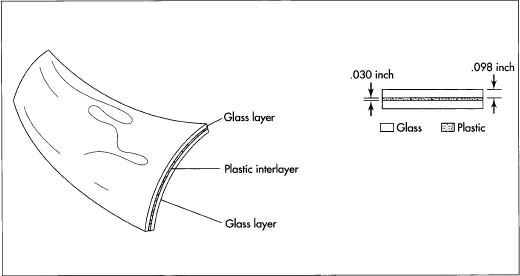
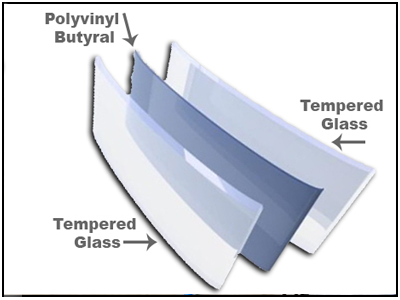
A modern windshield is normally a laminated assembly rather than one solid sheet of glass. Its basic construction consists of an outer glass ply, a plastic interlayer, and an inner glass ply. After manufacturing, the three components behave as a single windshield.
The glass itself is generally based on soda-lime glass, a widely used type of glass containing ingredients derived from silica sand, soda ash, limestone, and other materials. Automotive glass begins as high-quality flat glass with tightly controlled thickness and optical properties before it is cut and shaped for a particular vehicle.
The middle layer is commonly polyvinyl butyral, usually called PVB. This transparent polymer is important because it adheres strongly to the glass. If the windshield cracks, the PVB helps retain fragments instead of allowing large pieces to separate freely from the assembly.
Laminated construction should not be confused with ordinary tempered automotive glass. Tempered glass is commonly used in many side and rear window applications and is designed to break into relatively small pieces. Laminated windshield glass behaves differently because the plastic layer continues to support the fractured glass.
Source: glassfixitauto.com
Outer glass ply
Provides the exterior surface exposed to rain, road debris, wiper blades, temperature changes, and environmental contamination.
PVB interlayer
Bonds the glass layers together and helps retain broken fragments after an impact.
Inner glass ply
Forms the cabin-facing surface and completes the laminated safety-glass structure.
Why Is PVB Used Between the Glass Layers?
PVB combines transparency, flexibility, adhesion, and impact-related safety benefits. During lamination, it bonds to both glass surfaces and becomes an integral part of the windshield.
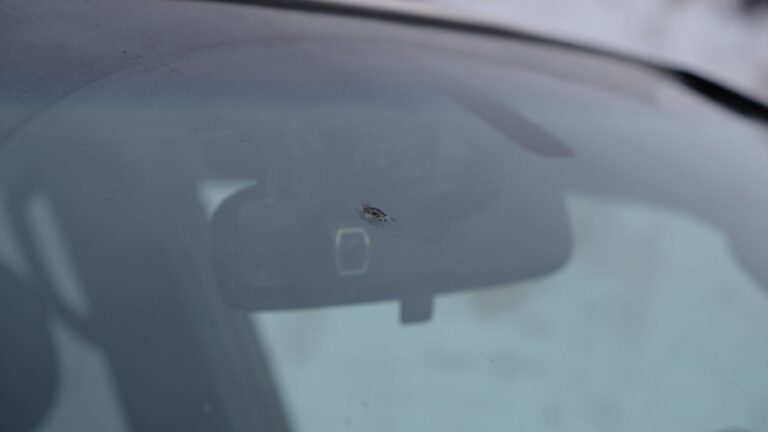
When a stone or another object damages the glass, the windshield can develop chips and cracks while much of the fractured material remains attached to the interlayer. This behavior is one of the main practical differences between laminated glass and a single untreated sheet of glass.
Are All Automotive Windows Laminated?
No. The windshield is normally laminated, while many vehicles use tempered glass for at least some side and rear windows. Laminated side glazing is also found on certain vehicles, especially where manufacturers want additional acoustic, security, or comfort characteristics.
How Are Windshields Made Step by Step?
Windshield manufacturing follows a controlled sequence because the two glass sheets must match each other, fit the vehicle body accurately, provide a clear view, and form a reliable bond with the interlayer. Exact equipment differs among manufacturers, but the core process is similar.
A typical production route moves from flat automotive glass through cutting, edge preparation, printing, bending, washing, PVB assembly, de-airing, autoclaving, inspection, and final preparation for installation.
Source: windshieldstore.in
Step 1: Cut the flat glass
Large flat sheets are cut to the outline required for the specific windshield design.
Step 2: Finish the edges
The edges are processed to remove sharp irregularities and prepare the pieces for later handling and forming.
Step 3: Add printed details
Ceramic markings, black perimeter areas, identification marks, and other required printed features may be applied before bending.
Step 4: Bend the glass
The matched sheets are heated until they can take the precise curvature required by the vehicle.
Step 5: Cool and clean the glass
After shaping, the glass is cooled and thoroughly washed so contaminants do not become trapped inside the laminate.
Step 6: Insert the PVB
A PVB sheet is positioned between the two matching glass plies in a clean production environment.
Step 7: Remove trapped air
Rollers, vacuum equipment, or another de-airing method removes air from between the layers and begins the bonding process.
Step 8: Autoclave the assembly
The windshield is exposed to controlled heat and pressure so the PVB permanently bonds to the glass.
Step 9: Inspect and finish
The completed windshield is examined for optical distortion, contamination, bubbles, edge problems, scratches, and other defects before shipment.
Why Are Two Glass Sheets Shaped Together?
The glass layers must have closely matching curvature. If one ply differs from the other, the finished laminate may develop stress, optical distortion, poor edge alignment, or bonding problems.
During a common bending process, paired glass sheets are heated to roughly 620 degrees Celsius, or about 1,148 degrees Fahrenheit. The softened glass can sag over a form under gravity or be press-bent when a more complex or tightly controlled shape is required.
How Is a Windshield Curved to Fit a Vehicle?
Windshield curvature is created by heating the cut glass until it becomes soft enough to form without cracking. Precise temperature control matters because the glass must achieve the intended three-dimensional shape without introducing unacceptable optical distortion.
One method is gravity sag bending. The glass rests on or over a shaped support and gradually settles into the desired curvature as it heats. Another method uses pressing equipment to shape the softened glass more directly. Press bending can be useful for windshields with complex contours or strict dimensional requirements.
The windshield’s geometry affects far more than appearance. Its shape must align with the vehicle body, provide the intended field of view, allow the wiper system to contact the glass properly, work with weather seals and adhesive systems, and maintain the designed position of cameras or sensors that look through the glass.
Optical quality is especially important in the driver’s viewing area. A windshield can have the correct physical dimensions yet still be unsuitable if the shaping process creates visible waves, double images, or distortion that interferes with the view ahead.
Source: claritycarwashing.com
Vehicle fit
The finished curvature must correspond closely to the body opening and bonding surface.
Driver visibility
Forming must preserve clear optical performance through areas used for driving.
Wiper performance
The surface contour must allow the wiper blades to sweep the designed area effectively.
Sensor alignment
On equipped vehicles, the glass geometry around forward-facing cameras and sensors must meet the vehicle manufacturer’s requirements.
Why Is Windshield Glass Not Completely Flat?
Curvature allows the windshield to follow the vehicle’s body design and aerodynamic profile while giving occupants a suitable field of view. It can also contribute to structural packaging, wiper geometry, interior space, and exterior styling.
How Are the Windshield Layers Bonded Together?
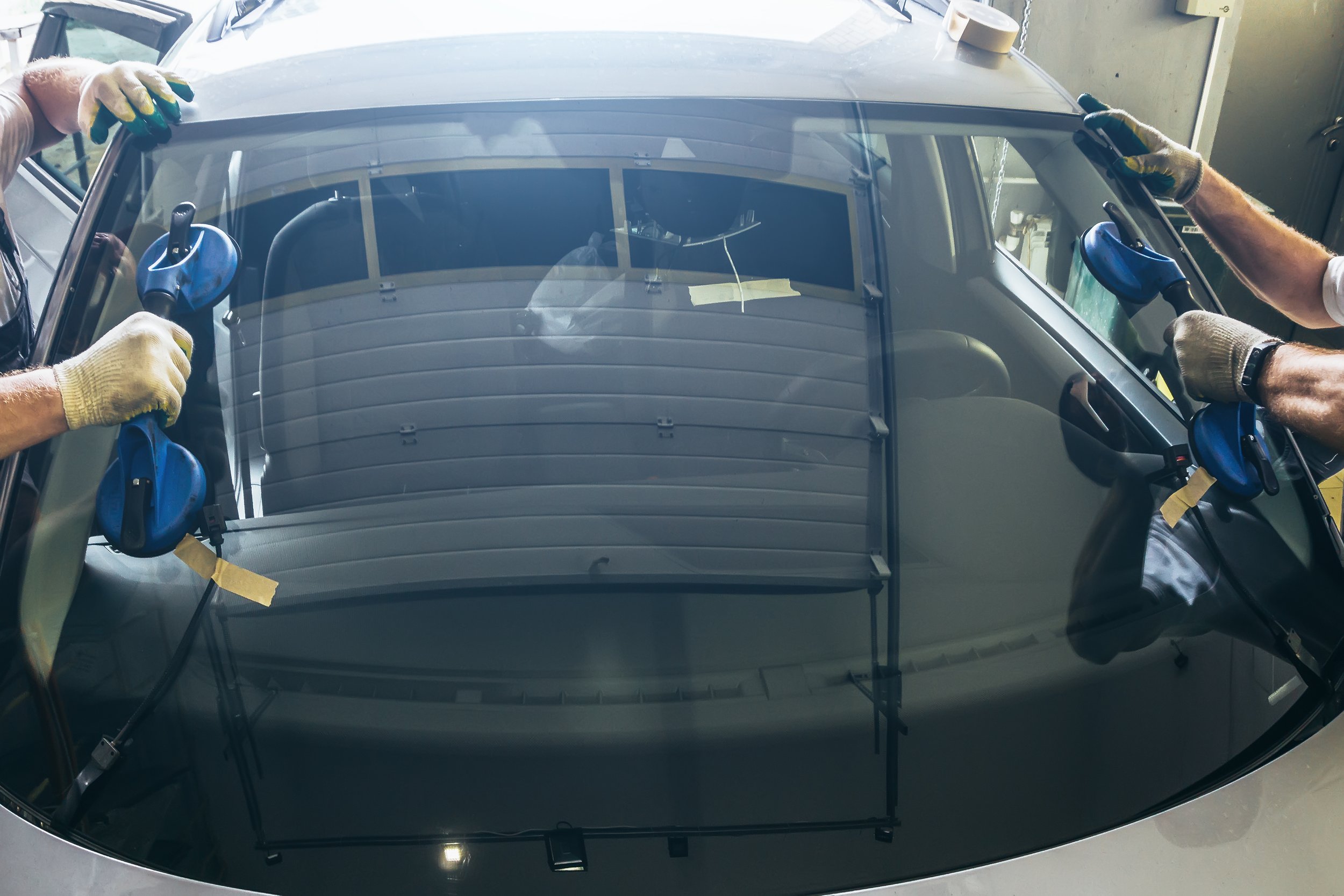
After bending and cooling, the two glass plies are cleaned thoroughly before the PVB sheet is placed between them. Cleanliness is critical because a speck of dirt, hair, fiber, or other contamination trapped between the layers could remain visible for the life of the windshield.
The assembled glass and PVB sandwich initially contains air between the surfaces. Manufacturers therefore use a de-airing stage, which may involve rollers, vacuum equipment, or related techniques. Removing air allows the layers to make close contact and reduces the risk of bubbles in the finished laminate.
The windshield then enters an autoclave, which is a pressure vessel capable of maintaining controlled temperature and pressure. A representative automotive lamination process heats the assembly to around 140 degrees Celsius, or about 284 degrees Fahrenheit, while applying substantial pressure.
The combined heat and pressure finish the bond between the glass and PVB. Once properly processed, the interlayer becomes optically clear and firmly adheres to both glass surfaces.
Source: tsautoglass.com
Cleaning
Removes particles and residues that could produce visible defects or interfere with bonding.
PVB placement
Positions the plastic safety interlayer between the two matched glass plies.
De-airing
Pushes or draws air out of the laminate before final bonding.
Autoclaving
Uses controlled heat and pressure to create the permanent laminated structure.
What Happens If Air Is Left Between the Layers?
Trapped air can appear as bubbles or interfere with uniform bonding. That is why de-airing and contamination control are major parts of laminated-glass manufacturing rather than minor finishing steps.
Why Does the PVB Become Clear?
Before final lamination, the assembled interlayer may not look fully transparent. Heat, pressure, and close contact between the materials transform the assembly into the clear laminate expected in a finished windshield.
What Features Can Be Built Into a Modern Windshield?
The glass and PVB layers are only the foundation of a modern windshield. Depending on the vehicle, manufacturers can add functional areas, coatings, embedded components, brackets, or printed features during or after the core glass-production process.
The black band around the perimeter is commonly a ceramic frit. It provides an opaque border and can support the windshield bonding system by shielding areas around the adhesive from sunlight while also hiding the bonding interface from view.
Some windshields use acoustic interlayers designed to reduce certain types of road, wind, or exterior noise entering the cabin. Others may use solar-control materials or coatings intended to influence how much solar energy enters the vehicle.
Heating elements can be incorporated around the wiper area or across selected portions of the glass. Antennas and other electrical functions may also be integrated into some windshield designs.
Advanced driver-assistance systems have made the windshield especially important on many newer U.S. vehicles. A forward-facing camera may look through a precisely defined area of the windshield. The glass, bracket position, optical characteristics, and installation angle can therefore affect the camera system.
Source: sirautoglass.com
Ceramic frit
Creates the familiar dark perimeter and supports the design of the bonded installation area.
Acoustic layer
May help reduce transmission of certain exterior sounds into the passenger compartment.
Solar-control treatment
Can alter the amount of solar energy transmitted through the windshield.
Heating elements
May assist with clearing ice, fog, or the area where the windshield wipers rest.
Camera and sensor zones
Provide controlled optical areas and mounting provisions for equipped driver-assistance systems.
Why Can Windshield Replacement Require ADAS Calibration?
On vehicles with a camera or other driver-assistance equipment associated with the windshield, replacement can change the relationship between the sensor, glass, and road view. Depending on the vehicle manufacturer’s procedure, calibration may be required after the windshield is replaced.
This is one reason a replacement windshield should be selected and installed according to the requirements for the specific vehicle rather than simply by overall width and height.
How Are Finished Windshields Inspected?
A finished windshield must satisfy more than dimensional requirements. Manufacturers inspect the laminate for defects that could affect visibility, appearance, durability, fit, or compliance with applicable glazing requirements.
Inspection can include checks for scratches, contamination, bubbles, inclusions, edge defects, improper curvature, dimensional errors, printing problems, and optical distortion. Automated inspection equipment may be combined with visual inspection depending on the production line.
For the U.S. market, automotive glazing must meet applicable requirements under Federal Motor Vehicle Safety Standard No. 205. The standard addresses glazing performance and location and incorporates requirements covering characteristics such as light transmission and other safety-related properties.
Windshields and replacement glazing also carry permanent markings that identify information associated with the glazing and its manufacturer. Those markings should not be confused with ordinary branding or decoration.
Source: glassfixitauto.com
Optical inspection
Checks whether the driver’s view through the glass is acceptably clear and free from problematic distortion.
Laminate inspection
Looks for bubbles, separation, contamination, or other problems between the layers.
Dimensional inspection
Confirms that the outline and curvature match the required windshield design.
Surface inspection
Identifies scratches, chips, printing defects, or other visible damage.
What Does AS1 on a Windshield Mean?
AS1 is a safety-glazing designation associated with material suitable for areas requiring driving visibility when the applicable requirements are met. On U.S. vehicles, markings on the windshield can also include manufacturer identification and other certification-related information.
The presence of a marking should be evaluated as part of the complete glazing certification information rather than treated as a stand-alone measure of overall windshield quality.
Frequently Asked Questions
Q
Why do windshields crack instead of shattering into pieces?
A windshield can fracture extensively, but the PVB interlayer remains bonded to much of the broken glass. As a result, the cracked fragments tend to stay attached to the laminate instead of separating the way pieces from some non-laminated glass may.
Q
Are windshields tempered or laminated?
Passenger-vehicle windshields are normally laminated safety glass. Many side and rear vehicle windows are made from tempered glass, although laminated side glass is also used on some vehicles.
Q
How many layers does a windshield have?
A conventional laminated windshield has three primary layers: an outer glass ply, a PVB interlayer, and an inner glass ply. Additional functional films, coatings, printed areas, electrical components, or specialized interlayer technologies may be included depending on the windshield design.
Q
Why is there a black border around a windshield?
The black perimeter is commonly a ceramic frit applied to the glass. It creates an opaque finished border and is associated with the bonded installation area. The pattern also helps conceal adhesive and related components from view.
Q
Can a windshield be made from one thick sheet of glass?
A conventional automotive windshield uses laminated construction rather than relying on one thick monolithic sheet. The plastic interlayer is a key part of the windshield’s breakage behavior because it helps retain glass fragments after cracking.
✦ Wrapping Up
How Windshield Manufacturing Comes Together
The answer to how are windshields made starts with two precisely cut sheets of automotive glass and a thin plastic interlayer, but producing a usable windshield requires much more. The glass must be shaped as a matched pair, cleaned, combined with PVB, de-aired, bonded with heat and pressure, and inspected carefully before it can be installed in a vehicle.
That laminated structure explains why a windshield behaves differently from many other vehicle windows. When damage occurs, the plastic interlayer helps keep fractured glass together, preserving a physical barrier and reducing the tendency for large loose pieces to enter the cabin.
For U.S. drivers, windshield construction is becoming even more important as cameras, heating systems, antennas, acoustic layers, solar-control technology, and other components become integrated into the glazing. A windshield is therefore best understood as an engineered vehicle component rather than simply a transparent panel.
💡 Key Takeaway
If your windshield needs replacement, match the replacement glass to the exact vehicle and its installed features, and follow the vehicle manufacturer’s procedures for installation and any required camera or driver-assistance-system calibration.