Can a Code Reader Turn Off Check Engine Light: Explained Clearly
Yes, a code reader can turn off a check engine light on many vehicles, but clearing the light does not repair the problem that caused it. The light may return as soon as the vehicle’s computer detects the same fault again.
It is easy to assume that erasing a diagnostic trouble code means the engine is fixed. In reality, a code reader mainly communicates with the onboard diagnostic system, commonly called OBD-II, and tells the vehicle computer to erase stored information. The result depends on why the light came on, whether the fault is still present, and what type of scanner is being used.
This article explains what happens when a code reader clears a warning, when clearing it is reasonable, and why disconnecting the battery is usually a poor substitute. You will learn how to read the code before erasing it, understand permanent and pending codes, recognize situations that require immediate attention, and decide when professional diagnosis is safer than repeatedly resetting the light.
What happens when a code reader clears
When a code reader is connected to the vehicle’s OBD-II diagnostic port, it can retrieve fault information from one or more control modules. A basic reader may display a generic code such as P0301, while a more capable scan tool can show manufacturer-specific data, freeze-frame information, live sensor readings, and system readiness monitors.
Using the tool’s “Clear Codes,” “Erase Codes,” or similar command deletes stored diagnostic trouble codes from the module’s memory. On many vehicles, this also turns off the malfunction indicator lamp, which is the technical name for the check engine light.
That action is best understood as resetting the warning, not correcting the defect. If the faulty condition remains, the computer will run its tests again and usually switch the light back on after the problem is detected.
Some vehicles may turn the light off on their own after several successful trips if the fault no longer occurs. A code reader can make the warning disappear sooner, but it cannot confirm that the repair was successful unless the vehicle is driven and the relevant diagnostic tests complete.
Why the check engine light may come back
The engine computer continuously checks systems related to emissions, fuel delivery, ignition, air intake, and other powertrain functions. It compares sensor readings and operating conditions with programmed limits. When a reading is outside those limits, the computer can store a code and illuminate the warning.
Clearing the code does not change the defective component, wiring, vacuum leak, fuel cap, software issue, or mechanical condition behind that test result. The warning returns when the same monitor runs and fails again.
A light may come back immediately when the fault is easy to reproduce. For example, a disconnected sensor, shorted wire, or severe ignition problem may be detected as soon as the engine starts. Other problems require specific conditions, such as highway speed, a cold start, a fuel-tank pressure test, or several drive cycles.
This delay can create a false impression that the vehicle is fixed. The underlying issue may still exist even if the dashboard stays clear for a day or two.
Read the code before clearing it
Always record the diagnostic trouble code and any supporting information before selecting the erase function. Write down the exact code, description, mileage, driving conditions, and symptoms. If available, save the freeze-frame data, which captures engine conditions at the moment the computer recognized the fault.
Freeze-frame information can include engine speed, coolant temperature, vehicle speed, fuel-trim readings, and load. It may help identify whether the fault happened during a cold start, acceleration, cruising, or idling.
Do not assume that the first code automatically identifies the failed part. A code for a lean air-fuel mixture, for example, may result from an intake leak, weak fuel delivery, a contaminated airflow sensor, an exhaust leak, or another problem. The code describes a detected condition or circuit, not always the component that must be replaced.
Clearing the memory too early can remove useful evidence. A repair shop may need the original code and freeze-frame information to reproduce the concern, especially when the light is intermittent.
When clearing the light can be useful
There are legitimate reasons to clear a code after it has been documented and the situation is understood. A loose fuel-filler cap is a common example. If the cap was not tightened properly and the vehicle has no other symptoms, tightening or replacing it may solve the issue.
Clearing the code can then confirm whether the evaporative-emissions fault returns.
Clearing codes can also be appropriate after a verified repair. For example, a damaged oxygen-sensor wire may be repaired, or a failed ignition coil may be replaced. Erasing the old code allows the computer to begin a fresh monitoring period rather than leaving a historical warning on the dashboard.
A code reader can also clear a light that was triggered by a temporary event, such as a low battery during starting or a connector that was briefly unplugged during service. However, the code should still be recorded first, and the vehicle should be monitored afterward.
Some tools offer a separate option to clear enhanced or manufacturer-specific codes. A basic reader may not communicate with every module, so the absence of a code on one scanner does not prove that no fault is stored anywhere in the vehicle.
When you should not simply erase the warning
Repeatedly clearing the light without diagnosis can hide an active problem and delay necessary repairs. This is particularly risky when the vehicle runs poorly, loses power, stalls, overheats, smells strongly of fuel, or produces unusual smoke or noises.
A flashing check engine light deserves special attention. It commonly indicates an active misfire severe enough to damage the catalytic converter. Reduce engine load and avoid continued driving until the cause is assessed.
If the engine is shaking badly or the vehicle is unsafe to operate, stop in a safe location and arrange professional help.
A steady light is generally less urgent than a flashing one, but it should not be ignored indefinitely. An emissions fault may increase fuel consumption or emissions, while a drivability problem can worsen and damage other components.
Do not erase a code merely to pass an emissions inspection. Clearing codes resets the vehicle’s readiness monitors, and many inspection programs can identify that the system has not completed its self-tests. The vehicle may fail or be rejected until it has completed enough normal driving cycles.
Clearing codes versus fixing the cause
A useful diagnostic process separates three different tasks: identifying the fault, repairing the cause, and verifying the repair. A code reader can assist with the first and third tasks, but it does not replace testing.
- Connect the scanner with the ignition off or according to the tool’s instructions.
- Read and record stored, pending, and permanent codes.
- Review freeze-frame data and note the vehicle’s symptoms.
- Inspect obvious causes, such as a loose fuel cap, damaged wiring, disconnected hoses, or low fluid levels where relevant.
- Perform the appropriate electrical, mechanical, fuel, or emissions tests before replacing parts.
- Repair the confirmed cause, then clear the code if the tool or service procedure calls for it.
- Drive under varied normal conditions and rescan the vehicle.
The final step matters because a light that stays off immediately after clearing does not prove the repair worked. Check whether the original code returns, whether new pending codes appear, and whether the monitors have completed.
Permanent and pending codes matter
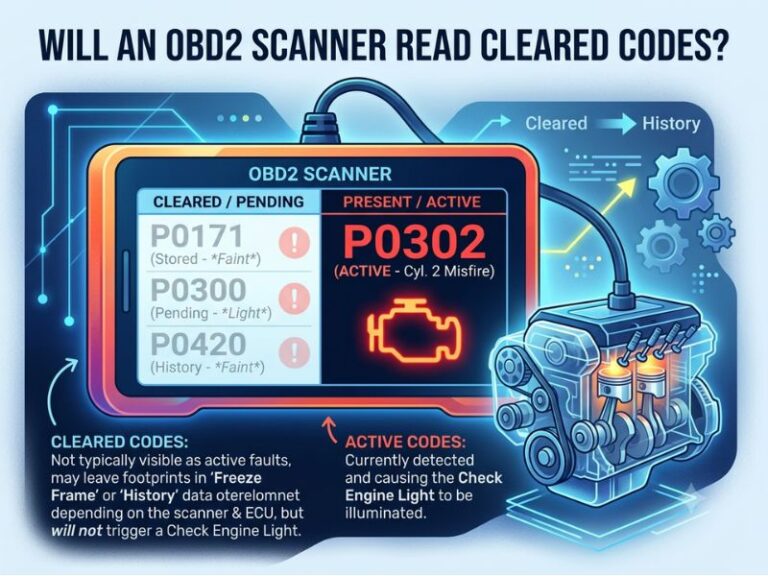
A pending code means the computer noticed a condition but may not yet have failed the full criteria needed to turn on the warning. Pending information can provide an early clue, even when the dashboard light is still off.
A permanent code is different. It is stored in a way that usually cannot be erased with a normal scanner command. The vehicle must verify that the problem has been repaired through its own diagnostic tests before the permanent code disappears.
Because of this design, a code reader may report that stored codes were cleared while a permanent code remains. That is not necessarily a scanner failure. It is a safeguard intended to prevent someone from hiding an emissions-related fault before the vehicle computer confirms the repair.
After clearing codes, the readiness monitors may show a “not ready” status. The exact drive cycle varies by vehicle and system, so normal driving may be required under several conditions before a complete evaluation is available.
Can disconnecting the battery do the same thing?
Disconnecting the battery may erase some stored codes on older vehicles, but it is not a dependable or preferred method. Many newer vehicles retain information in modules that are not fully reset by removing battery power, and some faults will remain stored.
Battery disconnection can also erase radio presets, clock settings, adaptive transmission values, idle-learn information, and other personalized settings. Certain vehicles may require an anti-theft code or a relearn procedure after power is interrupted.
A code reader is more useful because it can identify the stored fault before clearing it and show whether codes are pending or permanent. It also reduces the chance of creating unrelated electrical or calibration issues.
What a code reader cannot tell you by itself
A generic scanner is a communication and information tool, not a complete repair system. It may tell you that a sensor circuit is out of range, but it cannot always determine whether the sensor, wiring, power supply, ground, or a related mechanical problem is responsible.
Some repairs require a digital multimeter, test light, fuel-pressure gauge, smoke machine, compression tester, oscilloscope, or bidirectional scan tool. A bidirectional tool can command certain components on and off, which may help confirm whether a component responds correctly.
Vehicle-specific service information may also be necessary. The same general code can have different diagnostic steps depending on the engine, model year, software version, and installed emissions equipment.
Beware of replacing parts based only on a code description. “Oxygen sensor slow response” does not automatically mean the sensor is bad, and “catalyst efficiency below threshold” does not automatically justify installing a catalytic converter. Testing prevents unnecessary repairs.
Signs professional diagnosis is the safer choice
Professional help is appropriate when the code returns immediately, multiple modules report faults, or the vehicle has serious drivability symptoms. It is also wise when the code involves airbags, anti-lock brakes, electronic throttle control, high-voltage hybrid systems, or other systems a basic reader cannot fully access.
Seek assistance if you cannot identify the code, do not have the equipment to test the suspected circuit, or need the vehicle for an emissions inspection soon. Clearing the light without completing the required monitors can make the inspection process more difficult.
- Flashing light: Treat it as a potentially damaging misfire and limit driving.
- Loss of power or stalling: Avoid relying on a reset to make the vehicle dependable.
- Overheating or severe noises: Stop and address the mechanical risk before further driving.
- Fuel smell or visible leaks: Do not continue operating the vehicle until the hazard is evaluated.
- Repeated returns: Diagnose the cause instead of erasing the same code again.
Frequently asked questions
Can a code reader turn off check engine light without
Yes, it can often switch the light off temporarily without repairing the vehicle. The warning usually returns when the computer reruns the failed test, although the timing may range from immediately to several drive cycles.
Will clearing a code permanently remove the check engine light?
No, clearing a code only removes the current stored warning information. If the original fault remains, the engine computer can store the code again and illuminate the light. Permanent codes may require successful self-tests before they clear.
Can a code reader turn off check engine light after
Yes, it can clear the old code after a confirmed repair. The vehicle should still be driven and rescanned to verify that the original fault does not return and that no new pending codes appear.
Why is the light still on after using a code
The code may be active, permanent, or stored in a module the reader cannot access. The scanner may also have failed to complete the erase command, or the vehicle may have detected the fault again immediately.
Does clearing the check engine light erase the diagnostic history?
It can erase stored codes and freeze-frame data from the accessible module. Other modules, permanent codes, manufacturer records, and repair-shop scan histories may not be erased by the same command.
Will clearing the light make a car pass an emissions
No, and it may temporarily prevent the car from being ready for testing. Erasing codes resets emissions readiness monitors, which must complete their self-checks before many vehicles can be evaluated successfully.
Is it safe to drive after clearing a check engine
Safety depends on the symptoms and the type of warning. A steady light with normal operation may allow limited driving for diagnosis, but a flashing light, severe shaking, overheating, fuel smell, or major power loss calls for stopping and getting qualified help.
Use the reset as verification, not a repair
A code reader can usually turn off a check engine light by erasing stored diagnostic trouble codes, but it cannot fix the condition that created them. Record the code and freeze-frame details first, repair the confirmed cause, then use the scanner and a follow-up drive to verify the result.
The major limitation is that a reset can hide useful evidence and will not override an active or permanent fault. If the light flashes, the vehicle drives abnormally, or the code repeatedly returns, stop clearing it and arrange a proper diagnosis.