Can You Use a Code Reader on a Dead Car? What Still Works
Yes, you can use a code reader on a dead car if the vehicle still has enough electrical power for the OBD2 port and control modules to operate. If the battery is completely discharged and the car has no electrical power at all, a typical code reader usually cannot communicate with the vehicle.
So, can you use a code reader on a dead car? In many no-start situations, yes. The engine does not need to be running for a scanner to retrieve stored diagnostic trouble codes. The real requirement is electrical power. If the dashboard lights come on, the ignition can be switched on, and the vehicle computers are awake, a code reader may still work even though the engine will not start.
The confusion comes from the word “dead.” A car may be dead because the battery is weak, because the starter does not operate, because the engine cranks but will not fire, or because the entire electrical system has lost power. Each condition affects an OBD2 scanner differently.
Can You Use a Code Reader on a Dead Car?
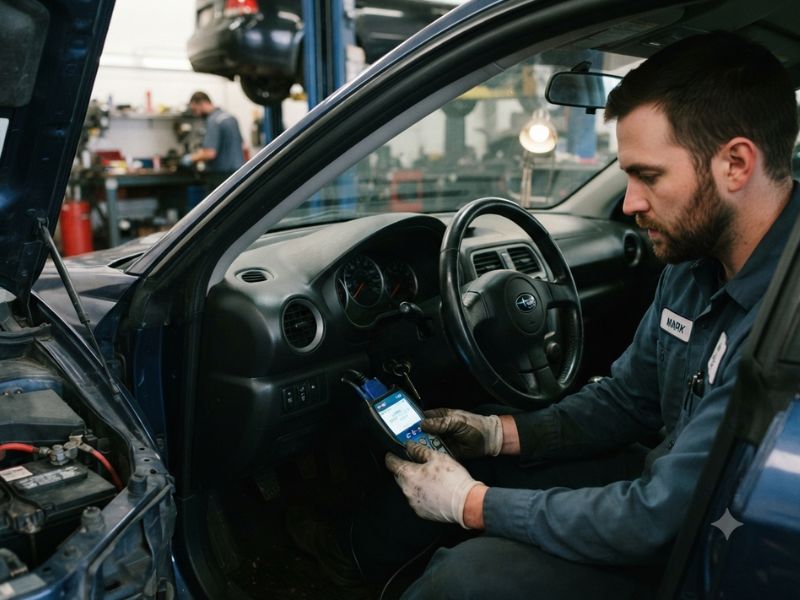
Yes, but only if the vehicle’s diagnostic electronics are powered.
An OBD2 code reader communicates with modules such as the engine control module or powertrain control module. Those modules do not require the engine to be running, but they do require electrical power.
That means a scanner can often work when:
- The engine cranks but does not start
- The starter clicks but the battery still powers the electronics
- The battery is weak but not completely discharged
- The car has an engine-management fault
- The vehicle has stored diagnostic trouble codes
A scanner is less likely to work when the vehicle has no electrical power at all.
If the battery is completely flat, the code reader may not power up, and the vehicle’s computer modules may remain offline.
Dead Car vs. Dead Battery: What’s the Difference?
A “dead car” does not always mean a dead battery.
There are several common no-start conditions.
A car may have enough battery power for the dashboard and electronics but not enough current to crank the starter. Another vehicle may crank normally but fail to start because of an engine-management problem. A third vehicle may have no lights, no chime, no starter response, and no electrical activity at all.
These conditions are diagnostically different.
If the electrical system still works, an OBD2 scanner may communicate normally.
If the electrical system is completely unpowered, diagnostic communication usually stops with it.
Does a Code Reader Need the Car to Be Running?
No. A code reader generally does not need the engine running to read stored fault codes.
For many scans, the ignition only needs to be switched to the position that powers the vehicle’s electronic control modules.
This is why a scanner can be useful on a crank-no-start vehicle.
The engine may never fire, yet the ECU can still report stored information about sensor circuits, ignition problems, timing-related faults, or other monitored conditions.
Why Ignition Power Matters
Modern vehicles contain multiple electronic control modules that stay mostly inactive when the vehicle is switched off.
Turning the ignition on wakes the relevant modules and allows them to communicate through the vehicle’s diagnostic network.
Depending on the vehicle, those modules may include:
- Engine control module
- Transmission control module
- Body control module
- ABS module
- Airbag module
- Immobilizer system
- Other manufacturer-specific controllers
A basic OBD2 reader usually focuses on standardized engine and emissions-related information.
A more advanced scan tool may access many additional systems.
The engine does not have to be running for many of those modules to respond.
Will an OBD2 Scanner Work With a Dead Battery?
Not if the battery is completely discharged and the vehicle has no usable electrical power.
Most plug-in OBD2 scanners depend on the vehicle for power.
If the battery voltage is too low, the scanner may fail to turn on or may turn on but lose communication.
This is an important difference.
A scanner that does not power up at all suggests that the OBD2 connector may not be supplying usable power.
A scanner that powers on but says “no communication” suggests that the tool is receiving power but cannot establish a data connection with the vehicle.
What If the Battery Is Only Weak?
A weak battery may still provide enough voltage for the scanner and ECU to operate.
In that situation, the scanner may work normally at first.
Problems can appear when the battery voltage drops further.
For example, communication may become unstable when:
- The starter is engaged
- The battery voltage falls sharply
- Several vehicle systems wake up at once
- The ECU resets because of low voltage
A scan tool may disconnect during cranking even though it worked perfectly with the ignition on and the engine off.
Low battery voltage can also create misleading trouble codes.
Where Does an OBD2 Code Reader Get Its Power?
Most handheld OBD2 readers receive power directly from the vehicle’s diagnostic connector.
The standardized OBD2 connector has 16 possible pin positions.
Battery power is normally supplied through pin 16, while ground connections are typically provided through pins 4 and 5.
That is why many basic scanners have no internal battery.
You plug them into the car, and they turn on immediately using vehicle power.
Why This Matters on a Dead Car
If the car battery is completely dead, the diagnostic connector may also be unpowered.
The scanner may appear broken even though it is functioning correctly.
The problem is simply that the vehicle is not supplying voltage.
This also explains why replacing the scanner is not the first conclusion to draw when a reader suddenly does nothing on a vehicle with a dead battery.
Can a Battery-Powered Scanner Read an Unpowered Car?
A self-powered scan tool can turn on without vehicle power, but that does not mean it can read an unpowered ECU.
This is an important distinction.
A professional scanner with its own battery may display menus, vehicle information, or diagnostic software even when the car itself is dead.
However, the vehicle’s control modules still need power to communicate.
Think of the scanner and ECU as two computers trying to talk to each other.
If one computer is switched off, the other can be fully powered and still receive no response.
What Can a Code Reader Tell You When a Car Won’t Start?
A code reader may provide useful diagnostic direction when a vehicle refuses to start.
It can show fault codes that the ECU has already detected.
Depending on the scanner and vehicle, useful information may include:
- Stored diagnostic trouble codes
- Pending codes
- Permanent codes
- Basic live sensor data
- Freeze-frame data
- System voltage
- Emissions-monitor information
The presence of a code does not automatically mean the named component has failed.
A code describes a condition the computer detected.
For example, a sensor-related code could result from the sensor itself, its wiring, a connector, voltage supply, or another related system.
Codes That May Be Relevant to a No-Start Condition
Certain types of faults can be especially relevant when an engine cranks but does not start.
Examples include faults involving:
- Crankshaft position sensor circuits
- Camshaft position sensor circuits
- Ignition control
- Fuel-system control
- Electronic throttle systems
- Engine timing correlation
- Immobilizer or security systems
- Communication between control modules
A basic reader may only show powertrain-related codes.
An advanced scan tool may reveal additional information from security, body, or network modules.
What Problems May Not Show Up on a Code Reader?
A code reader is useful, but it does not diagnose every reason a car fails to start.
Some no-start conditions may produce no useful fault code at all.
Examples include:
- Completely discharged battery
- Corroded battery terminals
- Loose battery connection
- Failed starter motor
- Mechanical engine damage
- Low compression
- Some fuel-delivery failures
- Certain wiring failures
- Blown power-supply fuses
A scanner can only report faults detected by electronic control modules.
It cannot directly identify every mechanical or electrical problem.
Why “No Codes” Does Not Mean Nothing Is Wrong
This is one of the most common misunderstandings in automotive diagnosis.
A vehicle can have a serious problem and still show no stored codes.
Diagnostic trouble codes are created only when the ECU sees a condition that meets its programmed fault criteria.
A failed starter, for example, may prevent the engine from cranking without creating a standard engine code.
Likewise, a mechanical compression problem may stop the engine from running even though the ECU sees normal electrical signals from many sensors.
“No codes” means the computer has not recorded a qualifying fault.
It does not mean the car is healthy.
Why Does the Code Reader Say “No Communication”?
A “no communication” message means the scanner is unable to establish a data connection with the vehicle.
That can happen for several reasons.
Possible causes include:
- Low battery voltage
- Ignition not switched on
- ECU not receiving power
- Blown fuse
- Wiring fault
- Damaged diagnostic connector
- Vehicle network problem
- Incompatible scan tool
- Module failure
The message itself does not identify which cause is responsible.
Code Reader Won’t Turn On vs. Won’t Connect
These two symptoms should be treated differently.
If the scanner does not turn on at all, the first concern is usually power at the diagnostic connector.
If the scanner turns on but cannot communicate, then the connector has at least enough power to operate the tool.
The problem may then involve the ignition state, ECU power, communication wiring, or network operation.
That distinction can prevent wasted time diagnosing the wrong part of the system.
Can Low Battery Voltage Cause Trouble Codes?
Yes. Low battery voltage can create multiple diagnostic trouble codes, especially in modern vehicles with many networked modules.
Electronic control units expect a stable supply voltage.
When system voltage becomes too low, modules may:
- Shut down temporarily
- Restart
- Stop communicating
- Report undervoltage
- Lose messages from other modules
- Generate network-related faults
This can make a scan result look worse than the actual problem.
For example, a weak battery might cause several modules to report lost communication even though none of those modules has permanently failed.
Why Voltage-Related Codes Need Context
If several unrelated electronic systems suddenly show faults after the battery has gone flat, the battery condition should be considered before assuming multiple components failed at the same time.
A cluster of communication and low-voltage codes may be a symptom of one electrical issue rather than several independent failures.
That is why scan data should always be interpreted alongside the vehicle’s actual electrical condition.
Can You Read Stored Codes After the Battery Dies?
Sometimes.
Many control modules store diagnostic information in memory that can survive normal key-off conditions and, in some cases, temporary loss of battery power.
However, not all information behaves the same way.
Battery disconnection or complete power loss may erase or reset certain temporary data.
Different Types of Diagnostic Information
A scan tool may show several categories of information.
Stored codes are faults that have met the criteria required to be recorded.
Pending codes are faults that have been detected but may not yet meet the conditions required to become confirmed.
Permanent codes are emissions-related codes designed to remain until the vehicle completes enough successful monitoring to confirm the problem has been corrected.
Freeze-frame data records operating conditions at or near the time a fault was detected.
Some of this information may remain available after a battery event, while other data may be reset depending on the vehicle.
Basic Code Reader vs. Advanced Scan Tool on a Dead Car
The type of scanner matters.
A cheap handheld code reader and a professional diagnostic tool do not provide the same level of access.
Basic OBD2 Code Reader
A basic reader normally focuses on standardized powertrain and emissions information.
It may provide:
- Check-engine-light codes
- Pending codes
- Basic code descriptions
- Readiness status
- Limited live data
This may be enough if the no-start problem is related to an engine-management fault that falls within generic OBD2 coverage.
Advanced Scan Tool
An advanced scanner may communicate with many more modules.
Depending on the vehicle, it may access:
- Transmission
- ABS
- Airbag system
- Body control module
- Immobilizer
- Instrument cluster
- Steering systems
- Manufacturer-specific modules
That extra access can matter on a no-start vehicle.
For example, a security-system fault may prevent the engine from starting without producing a useful generic powertrain code.
A basic reader may miss that problem entirely.
Can a Bluetooth OBD2 Scanner Work on a Dead Car?
A Bluetooth scanner has the same basic electrical limitation as a wired handheld reader.
The phone or tablet has its own battery, but the OBD2 adapter usually relies on the vehicle’s diagnostic port for power.
The vehicle’s control modules also need power.
So if the car is completely electrically dead, the smartphone can still run the app, but there may be no data available to read.
If the battery is only weak, the Bluetooth adapter may still connect normally.
Can a Code Reader Diagnose a Dead Battery?
A basic code reader should not be treated as a dedicated battery tester.
Some scanners can display system voltage, and some vehicles may store low-voltage-related codes.
That information can be useful.
However, battery health involves more than a single voltage reading.
A battery may show acceptable voltage with no load and still fail when the starter demands high current.
Battery condition may involve:
- State of charge
- Cranking performance
- Internal resistance
- Voltage under load
- Charging-system output
A dedicated battery or charging-system tester is better suited to evaluating those conditions.
The scanner can provide clues, but it does not replace proper battery testing.
When Is a Code Reader Most Useful on a No-Start Car?
A code reader is most useful when the vehicle still has electrical power and the problem may involve an electronically monitored system.
Good situations for scan-tool diagnosis include:
- Engine cranks but will not start
- Check-engine light is present
- Dashboard and electronics work normally
- Electronic sensor fault is suspected
- Immobilizer or communication issue may be involved
- Several warning lights appeared before the no-start condition
- The vehicle has stored trouble codes
The scanner becomes less useful when the problem is obviously a total loss of electrical power.
In that situation, restoring or evaluating the basic electrical supply is usually more relevant than looking for codes.
Frequently Asked Questions
Can you scan a car with a completely dead battery?
Usually not. A completely discharged battery may leave both the OBD2 connector and vehicle control modules without power, preventing normal scanner communication.
Does the engine have to start to read OBD2 codes?
No. Most stored trouble codes can be read with the engine off as long as the ignition and relevant electronic control modules are powered.
Will a code reader work if the battery is weak?
Possibly. A weak battery may still provide enough voltage for the scanner and ECU to communicate, but low voltage can cause unstable connections or misleading fault codes.
Why does my OBD2 scanner not turn on?
The scanner may not be receiving power from the diagnostic port. A dead battery, blown fuse, damaged connector, or wiring issue can prevent the reader from powering up.
Can low battery voltage create false or misleading codes?
Yes. Low voltage can cause communication faults, undervoltage codes, and temporary module errors. Those codes may be secondary effects of the weak battery rather than separate component failures.
Can a code reader tell if the starter is bad?
Not directly in most cases. A basic OBD2 reader may provide related information, but a failed starter often requires electrical testing rather than code reading.
Will a Bluetooth OBD2 scanner work with a dead battery?
Not if the vehicle has no electrical power. The phone may work, but the OBD2 adapter and vehicle computers still need power to communicate.
Can a car have no trouble codes and still not start?
Yes. Mechanical problems, starter faults, battery issues, wiring problems, and some fuel-delivery failures may prevent starting without producing a useful diagnostic trouble code.
Conclusion
Yes, you can use a code reader on a dead car when the vehicle still has enough electrical power for the OBD2 port and control modules to operate. The engine itself does not need to be running for most stored-code checks.
The key difference is between a car that will not start and a car that has no electrical power at all. A crank-no-start vehicle can often be scanned normally, while a completely discharged battery may leave both the scanner and ECU unable to communicate. A code reader can provide valuable diagnostic clues, but it should be viewed as one source of information rather than a complete explanation for every no-start condition.