Can You Rent a Car Code Reader? Rental and Loan Options Explained
Yes, you can sometimes rent or temporarily borrow a car code reader, but traditional paid rental is not the most common option in the United States. Auto-parts stores often provide free check-engine-light scanning, temporary scanner access, or separate deposit-based loaner-tool programs instead of renting a basic OBD2 reader by the day.
So, can you rent a car code reader if you only need to check a warning light once? Usually, you have several options before buying one. The best choice depends on whether you simply need an engine trouble code, want to take the scanner home, or need advanced access to systems such as ABS, airbags, transmission, or body-control modules.
The important point is that “code reader,” “scan tool,” “free code scan,” and “loaner tool” do not necessarily mean the same service.
Can You Rent a Car Code Reader?
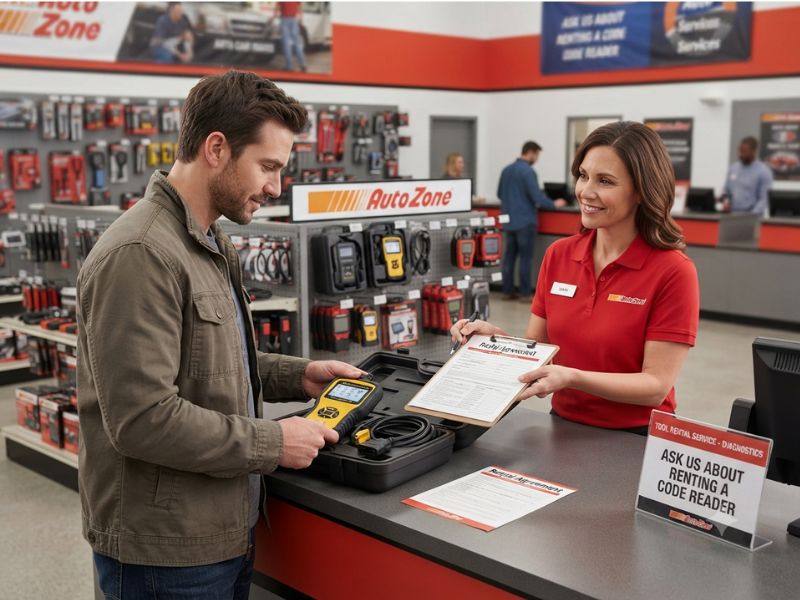
A car code reader can sometimes be obtained temporarily, but availability varies by retailer and location.
For a basic check-engine-light problem, many drivers do not need a conventional rental at all. Major auto-parts retailers currently advertise free engine-code scanning services. Advance Auto Parts lists check-engine-light scanning among its free store services, while O’Reilly Auto Parts offers its VeriScan check-engine-light code-reading service. AutoZone offers its Fix Finder service for free code reading.
AutoZone’s current Fix Finder information specifically says customers can borrow an OBD reader for a check-engine-light reading and return the scan tool to the store.
That is closer to temporary scanner use than a traditional tool rental.
Renting, Borrowing, and Free Scanning Are Different
There are three arrangements that people often describe as “renting a scanner.”
Traditional rental means paying a fee to keep a diagnostic tool for a specified period.
Loaner-tool programs generally involve temporarily obtaining a tool, often with a refundable deposit.
Free code scanning normally means using a store’s scanner or having a store employee perform a scan without taking the diagnostic tool home.
These distinctions matter because a store that advertises “loaner tools” does not necessarily include every code reader in that loaner inventory.
For example, Advance Auto Parts separately advertises free engine-code scanning and free-with-deposit loaner tools. That separation indicates that customers should not automatically assume the scanner itself is part of the general loaner-tool inventory.
What Is a Car Code Reader?
A car code reader is an electronic diagnostic tool that communicates with a vehicle’s onboard diagnostic system.
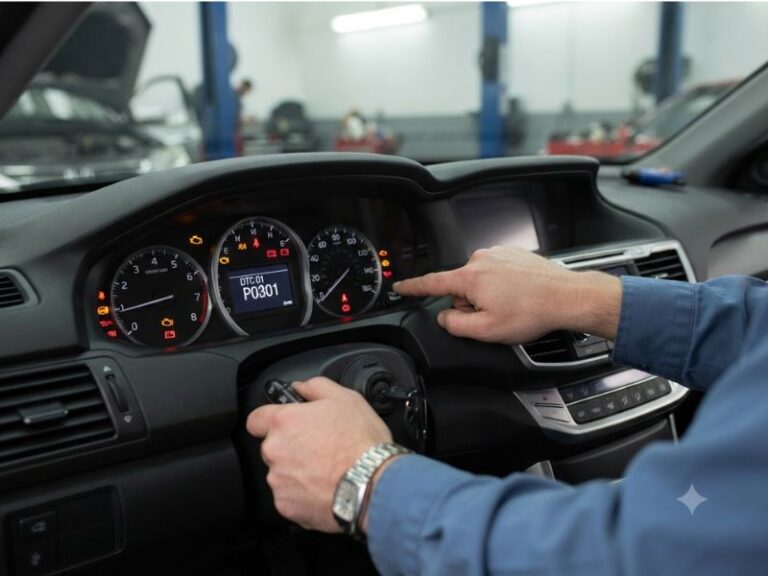
A basic OBD2 reader is primarily intended to retrieve diagnostic trouble codes, commonly called DTCs.
When the vehicle computer detects a monitored fault that meets its programmed criteria, it can store a trouble code. The reader retrieves that code so the problem can be investigated further.
A code reader may also provide information such as:
- Stored trouble codes
- Pending trouble codes
- Code descriptions
- Check-engine-light status
- Emissions readiness information
- Freeze-frame information on capable tools
- Basic live sensor data on more capable readers
The feature set depends heavily on the scanner.
A Trouble Code Is Not a Parts Recommendation
One of the most useful distinctions in automotive diagnostics is the difference between identifying a trouble code and identifying a failed component.
Suppose a reader reports a code associated with an oxygen-sensor circuit.
That does not automatically prove the oxygen sensor needs replacement. Possible causes can involve wiring, electrical connections, an exhaust problem, fuel mixture, or another condition that causes the sensor reading to fall outside the expected range.
Advance Auto Parts similarly notes that interpreting codes is not always as simple as replacing the sensor associated with the reported condition.
A scanner gives you diagnostic evidence. It does not eliminate the need to determine why the code was stored.
Where Can You Get a Car Code Reader Temporarily?
For most U.S. drivers, auto-parts stores are the most practical place to start.
The exact service varies among chains and individual locations.
AutoZone
AutoZone currently offers its free Fix Finder service for check-engine-light diagnostics. Its instructions describe borrowing an OBD reader, performing the reading, and returning the scan tool.
AutoZone also operates a separate Loan-A-Tool program for specialty repair tools. Under that program, customers leave or pay an amount covering the tool’s purchase price and can receive a full refund when an eligible tool is returned undamaged within the stated return window.
The distinction is worth noting: Fix Finder is the relevant service for code reading, while Loan-A-Tool covers a broader selection of automotive service tools.
Advance Auto Parts
Advance Auto Parts currently lists check-engine-light scanning as a free store service. It also operates a loaner-tool program that is free with a deposit. Advance notes that store services can vary by vehicle and location.
For someone who only wants to identify why the check-engine light is illuminated, the free scan may eliminate the need to rent a scanner.
O’Reilly Auto Parts
O’Reilly Auto Parts offers free check-engine-light code reading through its VeriScan service. Its current store information describes scanning the vehicle and reviewing the resulting report with the customer.
That is primarily a diagnostic service rather than a traditional take-home scanner rental.
Can You Borrow a Code Reader for Free?
Sometimes.
Free scanner access usually takes the form of a store code-reading service rather than unrestricted use of a scanner for several days.
AutoZone’s Fix Finder program is a clear example of temporary OBD-reader access for a free check-engine-light reading.
Other stores may perform the scan for you or use their own diagnostic equipment at the vehicle.
This can be enough when your goal is simply to answer questions such as:
- Why is my check-engine light on?
- What trouble code is stored?
- Is the code related to an emissions system?
- Did the same code return after a repair?
If you need hours or days to monitor live data, compare readings, or repeatedly scan the vehicle, borrowing or owning your own reader becomes more useful.
Do You Need a Deposit to Rent a Code Reader?
That depends on the service.
A free in-store code scan generally should not be confused with a deposit-based loaner program.
Advance Auto Parts currently states that its loaner-tool service is free with a deposit, while AutoZone’s Loan-A-Tool program requires an amount covering the tool’s purchase price and provides a refund when qualifying tools are returned according to the program terms.
Whether a particular diagnostic scanner is available through such a program is a separate question.
That is why it is better to ask a store specifically whether it:
- Performs a free code scan
- Lets you use the reader yourself
- Allows the scanner to leave the property
- Requires a refundable deposit
- Has the scanner capability your vehicle needs
A general statement such as “we rent tools” does not establish that an OBD2 scanner is included.
How Much Does It Cost to Rent a Car Code Reader?
There is no useful single nationwide rental price because stores use different service models.
For basic check-engine-light diagnostics, the cost may effectively be zero because major chains currently offer free code-scanning services.
A loaner arrangement may require money upfront even when the net cost becomes zero after the tool is returned.
A true professional scan-tool rental can be different because advanced automotive scanners can provide substantially more capability than a basic code reader.
The important comparison is therefore not simply “rental price versus purchase price.”
You should first establish what level of diagnostic access you need.
Basic Code Reader vs. Professional Scan Tool
The words “code reader” and “scan tool” are often used interchangeably, but their capabilities can be very different.
Basic OBD2 Code Reader
A basic reader is typically intended for engine and emissions-related diagnostics.
Depending on the model, it may read and erase generic powertrain codes and display a limited amount of vehicle data.
This is often enough for a normal check-engine-light investigation.
Advanced Scan Tool
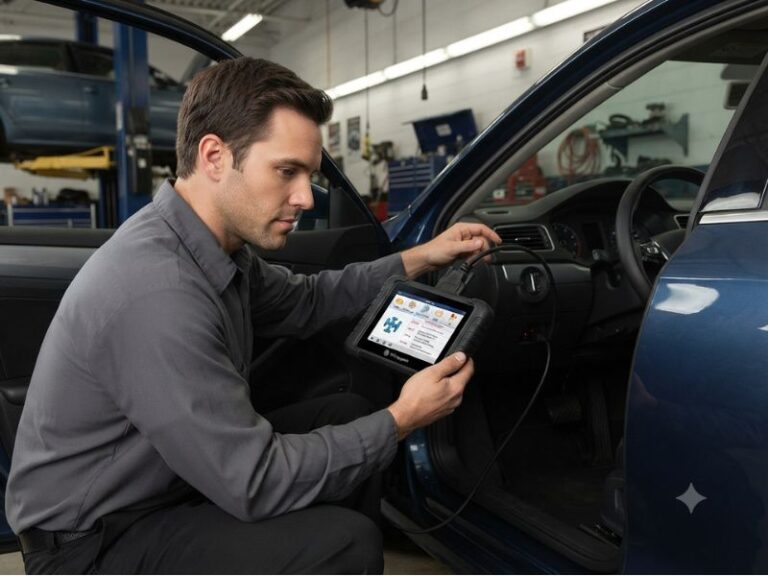
More capable scanners may communicate with systems beyond the engine computer.
Depending on the tool and vehicle, that can include:
- ABS
- Airbag/SRS
- Transmission
- Body control modules
- Electronic parking brake
- Steering systems
- Manufacturer-specific modules
- Service-reset systems
- Bidirectional controls
Retail diagnostic-tool catalogs illustrate how wide this capability range can be. Advance Auto Parts, for example, currently sells scanners ranging from basic OBD2 readers to units supporting ABS, SRS, network access, live data, and bidirectional functions.
Why Scanner Capability Matters More Than Rental Availability
Finding a scanner is not useful if it cannot access the system that triggered the warning light.
A generic OBD2 reader may be perfectly adequate for a check-engine light but unsuitable for diagnosing an ABS warning.
Likewise, a vehicle with a security-system or body-control problem may require a scanner with manufacturer-specific module coverage.
Before renting or borrowing anything, the useful question is:
Can this scanner communicate with the module I need to diagnose?
That is more important than the physical size or appearance of the tool.
Can You Rent a Scanner for an ABS or Airbag Light?
Possibly, but a basic engine code reader may not be sufficient.
ABS and SRS/airbag faults are stored in their respective control modules. Reading those modules requires a scanner with appropriate system coverage.
Some consumer-level scanners now support ABS and other systems, while more advanced diagnostic tools offer much broader access. Current retail listings show code readers with features ranging from basic OBD2 functionality to ABS, SRS, transmission, and other module coverage.
This is one situation where a free basic check-engine scan may not answer the actual question.
If the illuminated warning light is ABS, airbag, transmission, or another non-engine system, confirm scanner coverage first.
Can You Rent a Code Reader for a Check Engine Light?
A check-engine light is the situation where temporary access to a basic OBD2 reader makes the most sense.
In fact, because several major U.S. auto-parts stores currently provide free check-engine scanning, a conventional rental may be unnecessary.
The scan may reveal a generic powertrain code such as a sensor-circuit, emissions-system, misfire, or fuel-control fault.
The code should then be treated as the starting point for diagnosis.
Clearing the Code Is Not the Same as Fixing the Car
Many code readers can erase diagnostic trouble codes and switch off the check-engine light temporarily.
That does not repair the problem that caused the code.
If the underlying fault remains, the vehicle computer may detect it again and illuminate the warning light.
Advance Auto Parts specifically notes that erasing a code does not correct the malfunction that originally triggered it.
Clearing codes too early can also remove diagnostic information that might have helped identify the fault.
Can You Use a Rented Code Reader on Any Car?
Not necessarily.
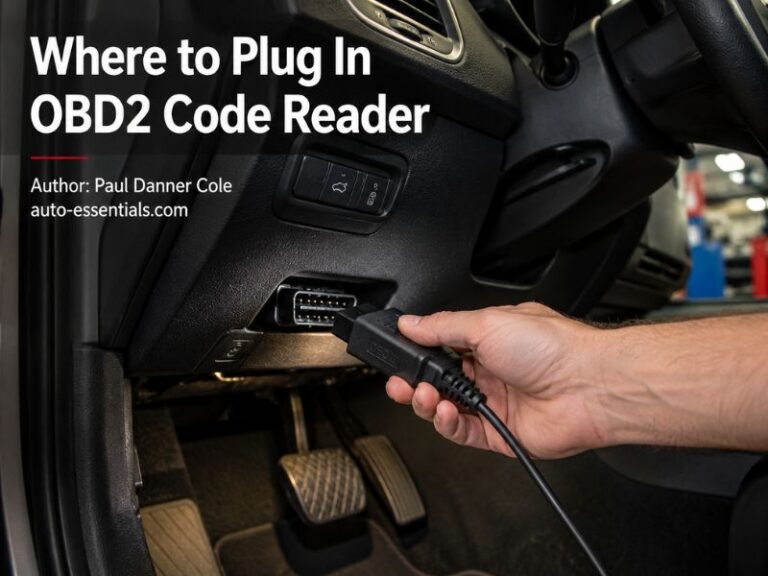
Scanner compatibility involves more than having the familiar 16-pin diagnostic connector.
For basic OBD2 engine diagnostics, standardized compatibility makes generic readers useful across many vehicles. Advanced functions are less universal.
Two scanners that both advertise OBD2 capability may differ considerably in their ability to access:
- ABS
- Airbags
- Transmission
- Body modules
- Hybrid systems
- Manufacturer-specific trouble codes
- Service functions
The exact vehicle year, make, model, engine, and scanner software coverage can matter.
Vehicle Compatibility Matters More With Advanced Functions
Generic engine codes are relatively standardized.
Manufacturer-specific module communication is not nearly as simple.
That means a scanner that provides extensive functions on one vehicle may offer more limited access on another.
For a one-time rental or borrowed scanner, checking compatibility before relying on it prevents a wasted trip.
Renting a Code Reader vs. Getting a Free Code Scan
These options solve slightly different problems.
| Option | Best Use | Main Limitation |
| Free store code scan | Quick check-engine-light diagnosis | Usually limited to the service offered by the store |
| Temporary borrowed reader | Checking a vehicle without buying a scanner | Availability and return terms vary |
| Advanced scanner rental | Specialized or deeper diagnostics | Harder to find and capability must match vehicle |
| Owning a scanner | Repeated DIY diagnostics | Requires an upfront purchase |
For a single check-engine-light event, free scanning is usually the simplest option.
For someone diagnosing an intermittent issue over several days, access to a personal or temporarily borrowed scanner can be more useful because the vehicle may need to be checked more than once.
Is It Better to Rent or Buy a Car Code Reader?
That depends mainly on how often you expect to use it and what functions you need.
Temporary Access Makes Sense When
Renting, borrowing, or using a free scan service can make sense when:
- You only need one trouble-code reading
- You rarely diagnose your own vehicles
- You want to identify a check-engine code before deciding what to do next
- You need an expensive specialized tool only once
There is little advantage in purchasing complex diagnostic equipment for a single basic code check if a suitable free service is available nearby.
Buying Makes More Sense When
Owning a reader becomes more useful when:
- You maintain multiple vehicles
- You regularly perform DIY repairs
- You want to check codes immediately
- You need repeated live-data readings
- You are diagnosing an intermittent fault
- You want to verify repairs yourself
Basic readers are widely sold by major auto-parts retailers, while more advanced models add features such as live data and access to additional vehicle systems.
The value of ownership increases with frequency of use.
Limitations of a Rented or Free Code Reader
Temporary scanner access can save money, but it does not provide unlimited diagnostic capability.
Common limitations include:
- Generic codes only
- Limited manufacturer-specific information
- No ABS or SRS access on basic readers
- Limited live data
- No bidirectional functions
- Limited time with the scanner
- Inability to monitor an intermittent problem over several days
There is also a knowledge limitation.
A professional-level scanner can display a large amount of data, but access to more information does not automatically make a diagnosis correct.
The useful skill is understanding which data matters and how the reported fault relates to the vehicle’s actual symptoms.
Frequently Asked Questions
Can you rent an OBD2 scanner?
Yes, temporary scanner access may be available, although conventional daily OBD2 rental is less common than free code scanning or loaner-style programs. Current services vary by retailer and location.
Do auto parts stores lend out code readers?
Some provide temporary access. AutoZone’s current Fix Finder instructions describe borrowing an OBD reader for a free check-engine-light scan and returning the tool. Other retailers may perform the scan as a store service instead.
Can you get car codes read for free?
Yes. AutoZone, Advance Auto Parts, and O’Reilly currently advertise free check-engine-light code-scanning services in the United States, although availability or service details can vary by location.
Do you need a deposit to borrow an OBD2 scanner?
It depends on the program. General auto-parts-store loaner programs may require a refundable deposit, while free code-scanning services may operate differently. Confirm the terms for the specific scanner and location.
Can a rented code reader scan ABS codes?
Only if the scanner specifically supports ABS diagnostics for the vehicle. Basic OBD2 readers may be limited to engine and emissions-related information, while enhanced scanners can access additional modules.
Is it better to rent or buy an OBD2 scanner?
Temporary access makes sense for a one-time code check. Buying becomes more practical when you diagnose vehicles regularly, need repeated live-data readings, or want the scanner available whenever a warning light appears.
Can one code reader work on different cars?
Yes, many OBD2 readers can work across multiple compatible vehicles for standardized engine diagnostics. Advanced module and manufacturer-specific functions vary more widely, so compatibility should be verified for the particular scanner.
Does a free code scan tell you exactly what is wrong?
No. A trouble code identifies a detected condition or circuit, but it does not necessarily prove which component has failed. Proper diagnosis may require inspecting wiring, testing components, reviewing live data, or checking related mechanical conditions.
Conclusion
Yes, you can rent a car code reader in some situations, but traditional rental is only one form of temporary scanner access. For a basic check-engine-light problem, free code scanning or short-term use of an OBD reader at an auto-parts store may be easier than finding a conventional rental. AutoZone, Advance Auto Parts, and O’Reilly currently offer forms of free check-engine-light scanning, while separate loaner-tool programs may use refundable deposits.
The deciding factor should be scanner capability rather than simply whether a tool is available. A basic code reader can be enough for many check-engine-light problems, but ABS, airbag, body-module, or manufacturer-specific diagnostics may require a more advanced scan tool. For occasional use, temporary access is practical; for repeated DIY diagnostics, owning a compatible reader is often more convenient.