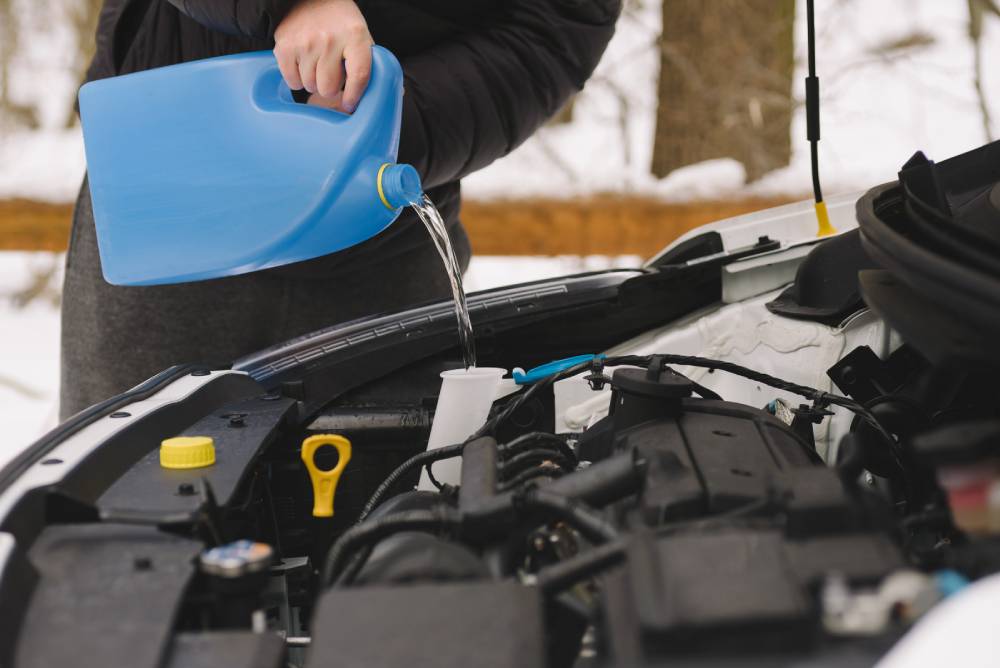
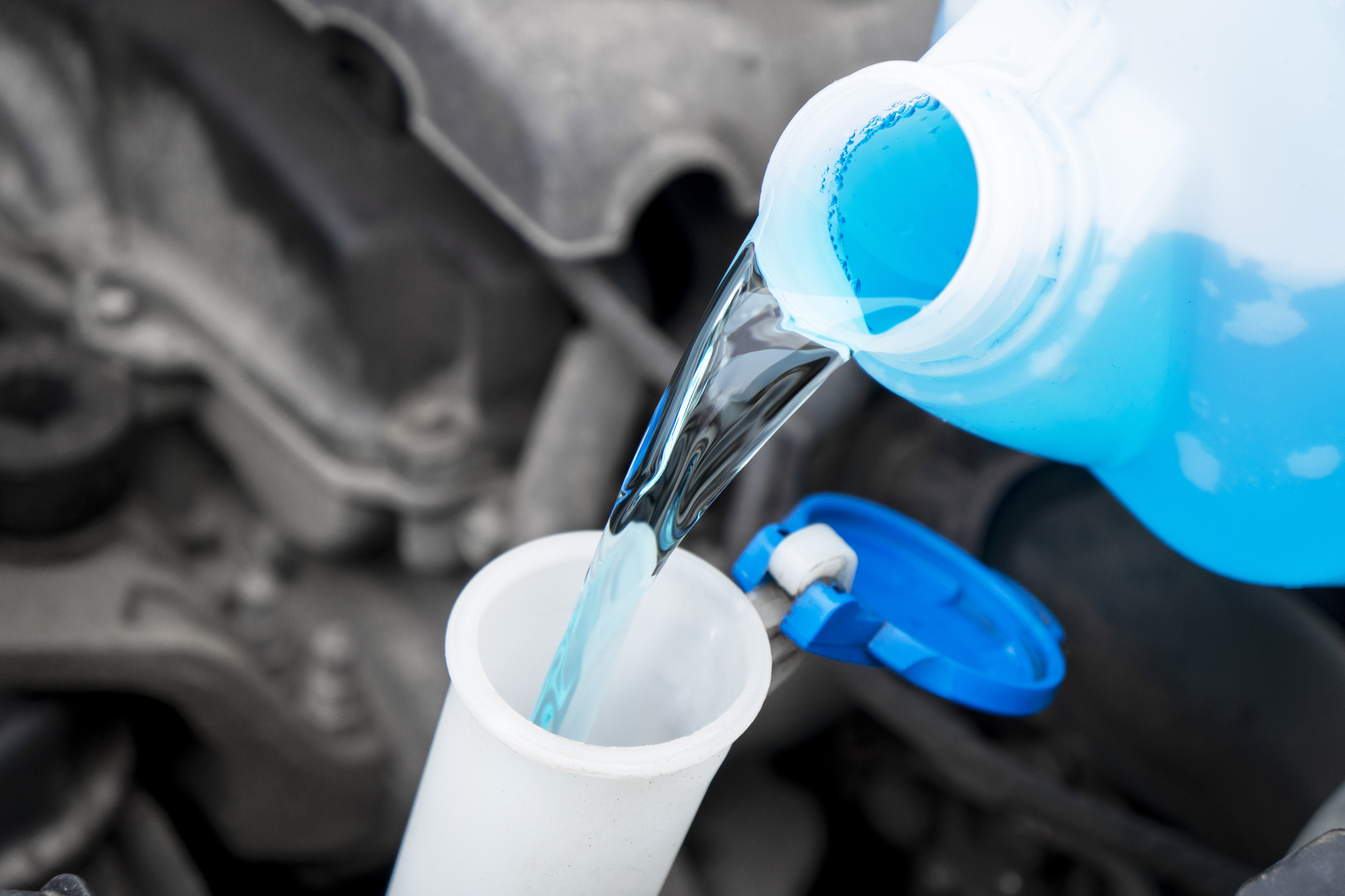
To make winter windshield washer fluid, combine distilled water with enough isopropyl alcohol to lower the freezing point, then add only a small amount of clear, low-sudsing dish soap for cleaning.
For drivers in the United States, winter windshield conditions vary enormously. A car in coastal Virginia may rarely see temperatures below 20°F, while vehicles in Minnesota, North Dakota, the Rockies, or northern New England can face prolonged subzero weather. That difference matters because a homemade washer-fluid mixture that works during a mild freeze may become slushy or solid during a severe cold snap. Road salt, brine, dirty snow, and highway spray also create a film that plain water cannot reliably handle.
The most practical homemade approach uses distilled water, isopropyl alcohol, and a very small quantity of clear dish soap. Isopropyl alcohol lowers the freezing point and helps dissolve oily road grime, while distilled water reduces the mineral deposits that can form when hard tap water evaporates. The important part is getting the alcohol concentration appropriate for your climate rather than following a one-size-fits-all recipe.
This guide explains how to make winter windshield washer fluid, how much alcohol to use, how to mix and test it, which ingredients to avoid, and when a commercially rated winter fluid is the safer choice. Because homemade mixtures are not laboratory-certified to a specific temperature, drivers expecting severe subzero conditions should use a commercially labeled fluid with a cold-weather rating below the lowest forecast temperature.
How to Make Winter Windshield Washer Fluid at Home
A straightforward winter recipe for relatively moderate cold uses approximately 40 percent pure isopropyl alcohol by volume. When starting with 99 percent isopropyl alcohol, making approximately one gallon requires about 6.5 cups of 99 percent isopropyl alcohol and 9.5 cups of distilled water. Add about 1 teaspoon of clear, low-sudsing dish soap after the liquids are combined.
That concentration has a theoretical freezing point close to -1°F based on published isopropyl-alcohol-and-water mixture data. It should not be treated as guaranteed protection to -1°F because measurement differences, ingredient strength, dilution already present in the vehicle, evaporation, and contamination can change actual performance. A sensible winter mixture should remain comfortably liquid below the lowest temperature you expect to encounter.
If your area commonly reaches temperatures near or below zero, consider a stronger mixture or switch to commercially rated winter washer fluid. Severe-winter commercial products are formulated and labeled for specific temperatures and may also contain detergents, corrosion-control ingredients, and other additives that are difficult to reproduce accurately at home.
Source: modernmississauga.com
Distilled water
Use about 9.5 cups when preparing the basic one-gallon recipe with 99 percent isopropyl alcohol.
99 percent isopropyl alcohol
Use about 6.5 cups to produce approximately a 40 percent actual-alcohol mixture.
Clear dish soap
Use approximately 1 teaspoon. More soap is not better and may leave streaks or excessive foam.
Clean mixing container
Choose a chemical-compatible container large enough to hold the entire batch without spilling.
Funnel
A clean funnel makes transferring the finished mixture into the washer reservoir easier and reduces spills.
Step-by-Step Mixing Instructions
Measure the distilled water and pour it into a clean container. Add the measured isopropyl alcohol slowly. Keep the container away from flames, cigarettes, sparks, heaters, and other ignition sources because isopropyl alcohol is flammable.
Add approximately 1 teaspoon of clear dish soap. Close the container and gently turn or swirl it several times. Avoid aggressive shaking because detergent can create a large amount of foam.
Label the container clearly as windshield washer fluid and identify that it contains isopropyl alcohol. Never store homemade washer fluid in a beverage bottle, food container, or anything that could be mistaken for a drink.
Before filling the vehicle, check the owner’s manual for any washer-fluid restrictions. Drain or use up incompatible summer fluid when practical so it does not substantially dilute your winter mixture.
Measure carefully
Changing the water-to-alcohol ratio changes the freezing behavior of the finished fluid.
Mix gently
Gentle mixing distributes the detergent without filling the container with foam.
Label immediately
Clear labeling reduces the risk of accidental ingestion or misuse.
Signs the Mixture Is Working
The fluid should remain completely liquid at the temperatures your vehicle encounters, spray normally through the nozzles, remove road film without excessive streaking, and wipe away cleanly after a few passes of the wiper blades.
If the solution becomes cloudy, develops ice crystals, turns slushy, sprays weakly only during cold weather, or freezes on the windshield immediately after spraying, it does not provide enough cold-weather protection for the conditions.
How Much Isopropyl Alcohol Should You Use for Winter Washer Fluid?
The deciding variable is the percentage of actual isopropyl alcohol in the finished mixture, not simply the number of bottles of rubbing alcohol added. This distinction matters because rubbing alcohol sold in U.S. stores commonly comes in different strengths, including 70 percent, 91 percent, and 99 percent.
For example, mixing equal volumes of 70 percent rubbing alcohol and water does not create a 50 percent isopropyl alcohol mixture. It produces approximately 35 percent actual isopropyl alcohol because nearly one-third of the rubbing alcohol itself is already water.
Published freezing-point data for isopropyl-alcohol-and-water mixtures illustrate why concentration matters. Approximately 20 percent alcohol freezes around 17°F, 30 percent around 6°F, 40 percent around -1°F, 50 percent around -5°F, 60 percent around -10°F, 70 percent around -16°F, and 75 percent around -26°F. These figures describe the alcohol-water mixture rather than a complete washer-fluid formulation and should be treated as guidance, not a guaranteed vehicle rating.
Source: storage.googleapis.com
Around 20 percent actual isopropyl alcohol
Published mixture data place the freezing point around 17°F.
Around 30 percent actual isopropyl alcohol
Published mixture data place the freezing point around 6°F.
Around 40 percent actual isopropyl alcohol
Published mixture data place the freezing point around -1°F.
Around 50 percent actual isopropyl alcohol
Published mixture data place the freezing point around -5°F.
Around 60 percent actual isopropyl alcohol
Published mixture data place the freezing point around -10°F.
Severe subzero weather
A commercially rated winter fluid is the more predictable choice when temperatures routinely fall far below zero.
Why 70 Percent Rubbing Alcohol Changes the Recipe
If you have 70 percent isopropyl alcohol instead of 99 percent, you must account for the water already in the bottle. For a 40 percent actual-alcohol mixture, roughly 57 percent of the finished liquid would need to be 70 percent rubbing alcohol. That is approximately 9.1 cups of 70 percent rubbing alcohol and 6.9 cups of distilled water for one gallon before adding the small amount of detergent.
Using a higher-strength alcohol makes concentration easier to control and leaves more room for distilled water. Whatever strength you purchase, read the percentage on the bottle instead of assuming all rubbing alcohol is equivalent.
Check the bottle percentage
70 percent, 91 percent, and 99 percent products produce different final concentrations when mixed with the same amount of water.
Allow a cold-weather margin
Do not design a mixture whose expected freezing point exactly matches the forecast low.
Why Each Ingredient Matters
Winter windshield washer fluid has two main jobs: it must stay liquid in cold weather and clean contaminants from the windshield. Water provides the bulk of the solution and carries away loosened dirt. Alcohol depresses the freezing point and helps dissolve some oily contaminants. A small amount of detergent helps break the surface tension of water and lift grime.
The ingredients should remain simple. Adding more household chemicals does not automatically improve cleaning and can introduce compatibility, residue, odor, or safety problems.
Source: storage.googleapis.com
Distilled water
Distilled water contains far fewer dissolved minerals than typical hard tap water, reducing the chance of mineral residue in small washer passages and nozzles.
Isopropyl alcohol
It lowers the freezing point of the water mixture and helps the solution evaporate from the windshield.
Low-sudsing detergent
A tiny amount improves removal of road film, salt residue, oily grime, and other contaminants.
Should You Add Vinegar?
Vinegar can help clean some mineral deposits on household glass, but it is not a substitute for the alcohol needed for dependable winter freeze protection. A winter washer-fluid recipe does not need vinegar to perform its primary job.
Leaving vinegar out also keeps the formulation simpler and avoids adding another variable when evaluating odor, streaking, seals, coatings, and vehicle-specific materials.
Should You Add Food Coloring?
Color is unnecessary for cleaning or freeze protection. A clearly labeled container is a better way to identify homemade washer fluid. Avoid adding unnecessary dyes that could potentially stain surfaces if concentrated fluid spills.
Winter Washer Fluid Safety and Ingredients to Avoid
Treat homemade washer fluid as an automotive chemical, not as ordinary soapy water. Isopropyl alcohol is flammable and should be mixed only in a ventilated area away from heat, flames, smoking materials, electrical sparks, and other ignition sources.
Wear eye protection when pouring larger quantities and wash exposed skin if you spill the mixture. Keep the finished fluid out of reach of children and pets. Store it in a sturdy, tightly closed, clearly labeled chemical container rather than a milk jug, soda bottle, sports-drink bottle, or drinking-water container.
Commercial windshield washer fluids may contain methanol, which can cause severe poisoning if swallowed. Do not attempt to make your own methanol-based formula. A DIY recipe using readily available isopropyl alcohol avoids the need to handle concentrated methanol, but isopropyl alcohol is still hazardous if swallowed and must be stored responsibly.
Source: hitchesguide.com
Do not use automotive engine antifreeze
Engine coolant is formulated for the cooling system, not the windshield washer system, and can smear the windshield while creating an unnecessary poisoning hazard.
Do not add bleach
Bleach is unnecessary, can damage materials, and creates dangerous reactions when mixed with certain household chemicals.
Do not experiment with ammonia mixtures
Ammonia is unnecessary for a basic winter formula and must never be combined with bleach-containing products.
Do not use excessive dish soap
Too much detergent can create foam, leave residue, and cause streaking.
Do not use plain water in freezing weather
Water can freeze in the reservoir, lines, pump area, or nozzles and leave the washer system unavailable when visibility is poor.
What to Do If Someone Swallows Washer Fluid
Treat accidental ingestion as a poisoning concern. In the United States, contact Poison Control promptly at 1-800-222-1222 for guidance. Do not induce vomiting unless a medical professional specifically tells you to do so.
If the person has severe symptoms, difficulty breathing, seizures, loss of consciousness, or another immediate medical emergency, call 911.
Keep Homemade Fluid Away From Flames
Increasing the percentage of isopropyl alcohol improves freeze resistance but also increases the amount of flammable solvent in the mixture. Keep both the raw alcohol and finished mixture away from ignition sources during preparation, storage, and transfer.
How to Test and Use Your Homemade Winter Washer Fluid
A homemade mixture does not come with the laboratory-certified freeze rating printed on commercial washer-fluid containers. Before relying on it during winter travel, test a small sample under colder conditions than you expect your car to experience.
A household freezer can reveal an obviously inadequate mixture, but it is not a precise certification test because household freezers differ in temperature and may be warmer than severe outdoor conditions. The goal is to identify obvious freezing or slush before you put the mixture into the vehicle.
After filling the reservoir, operate the washers long enough to move the winter mixture through the pump, hoses, and spray nozzles. Simply topping off a reservoir that still contains a large amount of summer fluid can substantially dilute the new formula.
Source: laundrytowear.com
Check a small sample first
Look for ice crystals, slush, separation, or unusual thickening.
Fill the correct reservoir
Confirm the windshield-washer reservoir symbol before pouring any fluid into the vehicle.
Prime the lines
Run the washers several times so the winter mixture replaces weaker fluid trapped in hoses and nozzles.
Inspect the spray pattern
Both or all washer jets should spray normally without weak flow or obvious blockage.
Watch for streaks
If the windshield develops a persistent film, reduce unnecessary detergent and make sure the wiper blades are clean and in good condition.
What If the Washer Fluid Freezes?
Do not repeatedly run the washer pump against a frozen system. Move the vehicle into a heated garage or another environment where the reservoir and lines can thaw gradually. Once thawed, remove or dilute the weak mixture appropriately and refill with fluid that provides adequate cold protection.
If the reservoir is liquid but nothing sprays, inspect the washer nozzles for ice, check whether the hoses are frozen, and listen for the washer pump. A system that still fails after fully thawing may have a clogged nozzle, damaged hose, blown fuse, failed pump, or another mechanical problem.
When Commercial Winter Washer Fluid Makes More Sense
Commercial winter fluid is the better choice when you routinely drive in severe subzero temperatures, park outside for long periods, travel through changing climates, or simply need a clearly stated freeze-protection rating.
For perspective, some commercially sold U.S. winter de-icer washer fluids are labeled for temperatures around -20°F to -34°F. Reproducing that level of performance consistently with household ingredients is much less straightforward than making a moderate-cold DIY solution.
Frequently Asked Questions
Q
Can I use rubbing alcohol in windshield washer fluid?
Yes. Isopropyl rubbing alcohol can lower the freezing point of a water-based washer mixture. Check whether the bottle contains 70 percent, 91 percent, or 99 percent isopropyl alcohol because the strength changes how much you need.
Keep alcohol-containing mixtures away from flames and other ignition sources, and check your vehicle owner’s manual if it specifies particular washer-fluid requirements.
Q
Can I make winter windshield washer fluid with 70 percent alcohol?
Yes, but remember that 70 percent rubbing alcohol is already about 30 percent water. To obtain approximately 40 percent actual isopropyl alcohol in a one-gallon finished mixture, you would use roughly 9.1 cups of 70 percent rubbing alcohol and 6.9 cups of distilled water, plus about 1 teaspoon of clear, low-sudsing dish soap.
For very cold climates, 70 percent rubbing alcohol becomes less convenient because even undiluted 70 percent rubbing alcohol cannot create a finished solution containing more than 70 percent actual isopropyl alcohol.
Q
Will homemade windshield washer fluid freeze?
It can. Every water-and-alcohol mixture has a temperature range at which freezing or crystallization can begin. The amount and strength of the alcohol, existing fluid in the reservoir, contamination, and actual outdoor temperature all affect performance.
That is why a homemade fluid should be tested before winter use and why commercially temperature-rated fluid is preferable when extreme cold is expected.
Q
Can I use vodka instead of rubbing alcohol for windshield washer fluid?
Typical 80-proof vodka contains about 40 percent ethanol and 60 percent water, so its alcohol concentration is relatively low for serious winter freeze protection. Using it would also be unnecessarily expensive compared with an appropriate automotive product or measured isopropyl-alcohol mixture.
For predictable winter preparation, use ingredients with clearly stated concentrations or buy winter washer fluid carrying an appropriate temperature rating.
Q
Can I use plain water in my windshield washer reservoir during winter?
Plain water is a poor winter choice wherever temperatures may reach freezing. It can freeze in the reservoir, lines, or nozzles and prevent the washer system from operating.
Even above freezing, hard tap water can leave mineral residue. Distilled water is a better base when making a homemade mixture.
Q
How much dish soap should I put in homemade windshield washer fluid?
About 1 teaspoon per gallon is sufficient for a basic formula. The detergent is there to help loosen road film, not to create suds.
If you add too much, the washer system may foam and the windshield can develop streaks or residue.
✦ Wrapping Up
Conclusion
Learning how to make winter windshield washer fluid is mainly about controlling the alcohol concentration rather than adding a long list of household ingredients. A simple mixture of distilled water, isopropyl alcohol, and about 1 teaspoon of clear dish soap per gallon can provide useful cleaning and moderate freeze resistance when the proportions are chosen for the expected temperature.
For a roughly 40 percent actual-isopropyl-alcohol mixture, approximately 6.5 cups of 99 percent isopropyl alcohol combined with 9.5 cups of distilled water makes about one gallon before the small detergent addition. Published mixture data put the freezing point near -1°F, so use a meaningful safety margin instead of assuming the mixture is dependable at its theoretical limit.
Drivers dealing with the harshest U.S. winter conditions should prioritize reliability over a homemade formula. When overnight temperatures routinely fall far below 0°F, use a commercially formulated winter washer fluid rated below the lowest temperature you expect to encounter.
💡 Key Takeaway
Check your local winter low, choose a mixture with a comfortable temperature margin, test a small sample before filling the vehicle, and switch to commercially rated winter fluid whenever severe subzero weather exceeds the practical limits of a homemade recipe.
Learn how to fold a windshield sun shade correctly with simple steps for pop-up, accordion, and umbrella styles, plus storage and troubleshooting tips.
Learn how to fold a pop up windshield sun shade safely and quickly. Follow simple steps, avoid common mistakes, and store your car sun shade without damaging its frame.