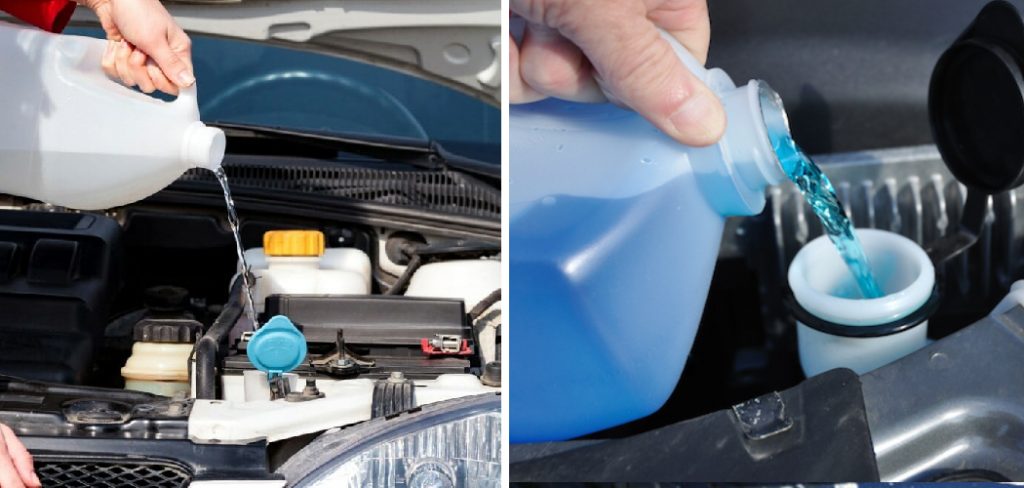
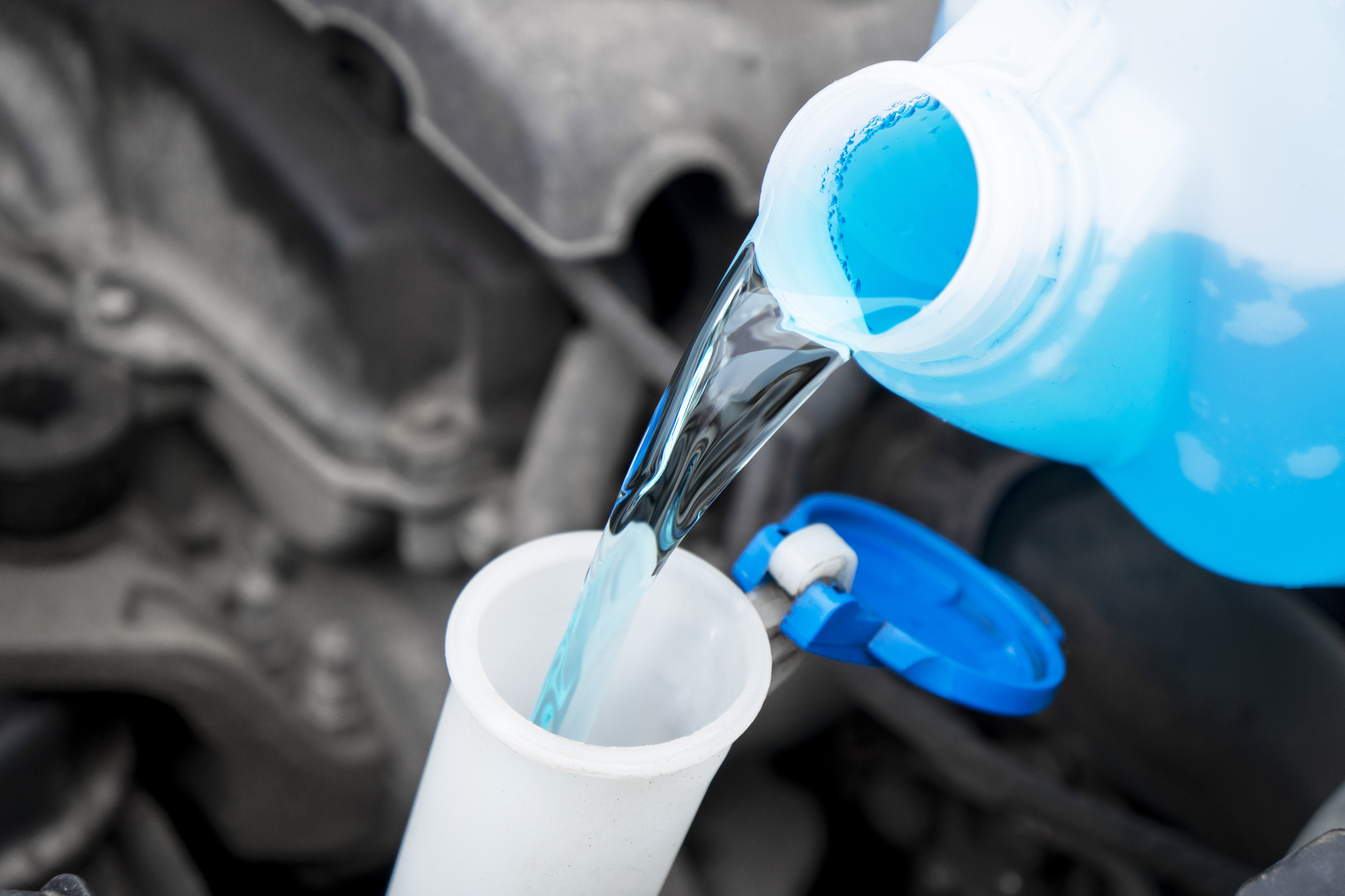
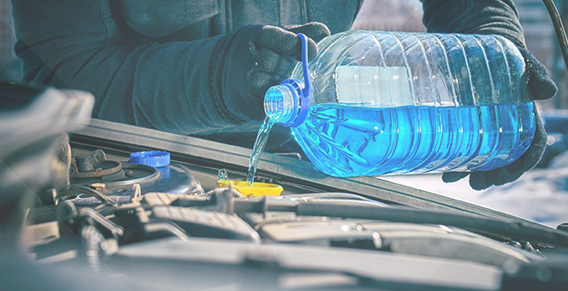
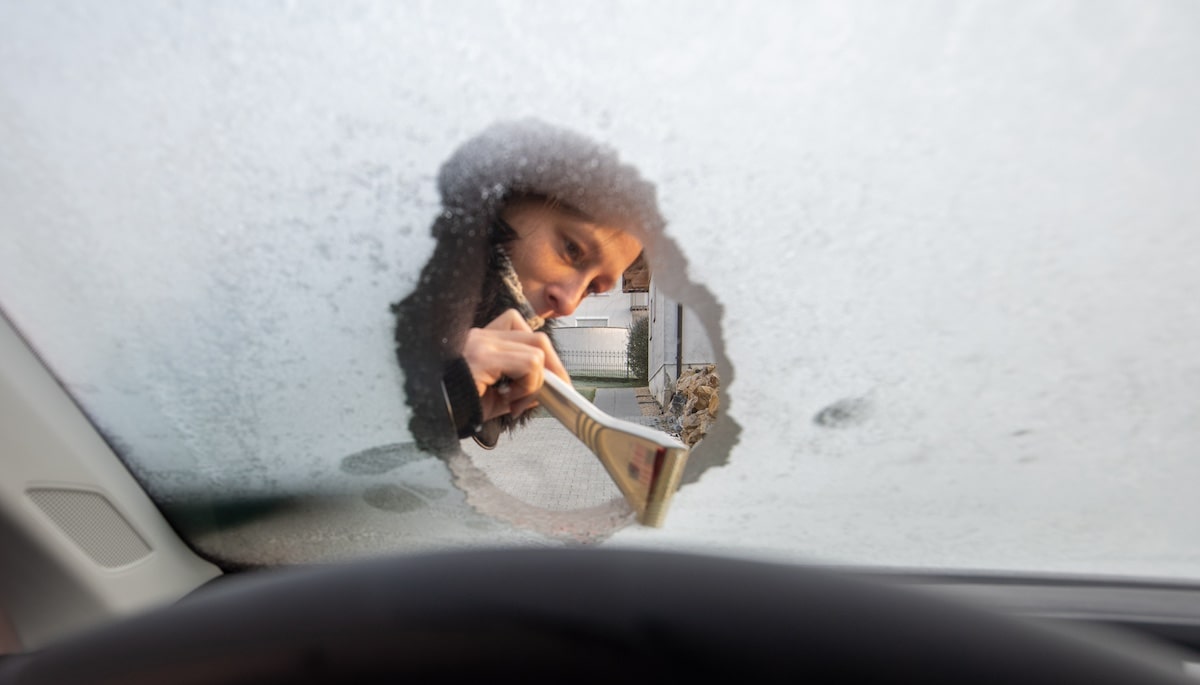
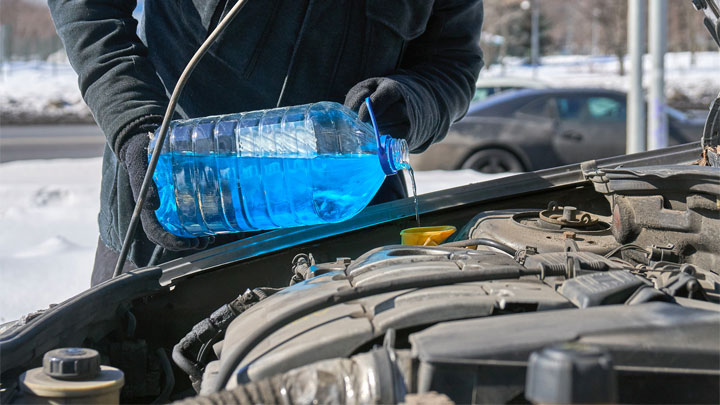
Yes, windshield washer fluid can freeze when temperatures fall below its rated freezing point. Summer formulas and diluted fluid are especially vulnerable, while winter formulas are designed to resist lower temperatures.
Across the United States, winter weather can change quickly. Drivers in Minnesota, Michigan, Colorado, and other cold regions may face subzero temperatures, while motorists in southern states can encounter unexpected freezes. When road salt, mud, snow, and ice cover a windshield, working washer fluid helps maintain a clear view of traffic.
The key is to match the washer fluid to the lowest temperatures your vehicle may face. A product labeled for freezing weather is not automatically suitable for every cold snap. Its stated temperature rating, the amount of water in the mixture, and the condition of the washer system all affect whether the fluid stays liquid.
If your windshield washer stops spraying on a cold morning, frozen fluid is one possible cause. An empty reservoir, clogged spray nozzles, a damaged hose, or a failed pump can cause similar symptoms. Knowing how to tell these problems apart can help you restore the system without damaging its parts.
Can Windshield Washer Fluid Freeze in Cold Weather?
Yes, windshield washer fluid can freeze when the temperature drops below the mixture’s freezing limit. The risk depends on the ingredients, the concentration of those ingredients, and the amount of water in the system. Not every washer fluid has the same cold-weather performance.
Many summer formulas focus on removing bugs, dust, and road grime in mild weather. They may contain enough water to freeze when temperatures fall. Winter formulas use suitable alcohol-based ingredients and other additives to lower the freezing point and help keep the washer system usable in cold conditions.
A fluid that remains liquid in a garage may freeze when a car sits outside overnight. Windshield washer reservoirs, exposed hoses, and spray nozzles can cool at different rates. The fluid near a nozzle may freeze before the contents of the larger reservoir do.
Source: rxmechanic.com
Summer washer fluid
Usually intended for warmer conditions. Check the label because some summer products have limited cold-weather protection.
Winter washer fluid
Formulated to resist freezing down to a stated temperature under the conditions specified by its manufacturer.
Water or diluted fluid
Has less protection against freezing and may turn to ice in cold weather.
Why Washer Fluid Freezes
A liquid freezes when its temperature reaches a point at which its molecules can form a solid structure. Adding suitable dissolved substances, such as alcohols used in washer fluid, can lower that point. The resulting mixture may remain liquid at temperatures where plain water would freeze.
This protection has limits. As temperatures fall further, even winter-rated washer fluid can freeze or form ice crystals. A mixture that contains more water than the product was designed for may lose much of its expected protection.
Temperature
The colder the environment, the greater the risk that a washer fluid mixture will freeze.
Formula
Different ingredients and concentrations provide different levels of freeze protection.
Dilution
Adding water can raise the mixture’s freezing point and reduce its effectiveness in winter.
At What Temperature Does Windshield Washer Fluid Freeze?
There is no single freezing temperature for all windshield washer fluids. Plain water freezes at 32 degrees Fahrenheit under normal atmospheric pressure, but washer fluid contains other ingredients that can lower its freezing point. The actual rating depends on the specific formula and mixture.
Some winter washer fluids are labeled for protection near 0 degrees Fahrenheit, while others are formulated for substantially colder conditions. These figures are examples of common label ratings, not universal specifications. Always check the container for the exact temperature rating and follow its directions.
A product’s advertised rating should not be treated as a guarantee that every part of a vehicle’s washer system will remain ice-free under every condition. The reservoir, tubing, and nozzles may have different exposure to cold, and residual water can weaken the protection of the fluid already in the system.
Source: minit-tune.com
32°F (0°C)
Plain water begins freezing under normal atmospheric conditions. Summer washer fluid may also be at risk, depending on its formula.
Around 0°F (-18°C)
A winter product with a suitable label rating may remain usable, but products with weaker protection may freeze.
Below 0°F (-18°C)
The product’s precise rating becomes especially important. Choose fluid rated for the expected local low temperatures.
How to Read a Washer Fluid Temperature Rating
Look for a statement such as protects to minus 20 degrees Fahrenheit or a similar temperature claim. Confirm that the rating applies to the product as supplied and whether the manufacturer gives any mixing instructions. Do not assume that a concentrated product and a ready-to-use product have the same rating.
If your region regularly experiences temperatures below the product’s stated limit, select a suitable formula with a lower rated temperature. Allow for local weather changes rather than choosing fluid only for the average daytime temperature.
Check the label
Find the stated freezing or protection temperature and the recommended use conditions.
Avoid guesswork
Do not estimate the freezing point from color, smell, or brand name.
Account for existing fluid
Residual summer fluid or water can change the performance of the mixture in the reservoir.
What Happens When Windshield Washer Fluid Freezes?
Frozen washer fluid can prevent the system from spraying fluid onto the windshield. Ice may block the small openings in the spray nozzles, restrict fluid movement through the hoses, or form in the reservoir. A frozen mixture may also become thick enough that the pump cannot move it as intended.
Water expands when it freezes. If enough water in a reservoir or enclosed passage turns to ice, the expansion can place stress on plastic parts, seals, connectors, and hoses. This does not mean every frozen system will suffer damage, but repeated freezing can increase the risk.
The pump may make a humming or buzzing sound without delivering fluid if the liquid path is blocked. Running the pump repeatedly in an attempt to force the fluid through can add unnecessary strain. Stop using the washer control until the system has thawed and you can check whether it works normally.
Source: img-s-msn-com.akamaized.net
Blocked spray nozzles
Ice or debris can prevent fluid from reaching the glass even when the reservoir contains liquid.
Restricted hoses
Frozen fluid in a narrow hose may block the flow from the reservoir to the nozzles.
Possible component damage
Freezing and expansion may damage a reservoir, hose, seal, or connector in some circumstances.
Reduced visibility
A nonworking washer system can leave salt and road grime on the windshield, making winter driving less safe.
Can Frozen Washer Fluid Damage the Pump?
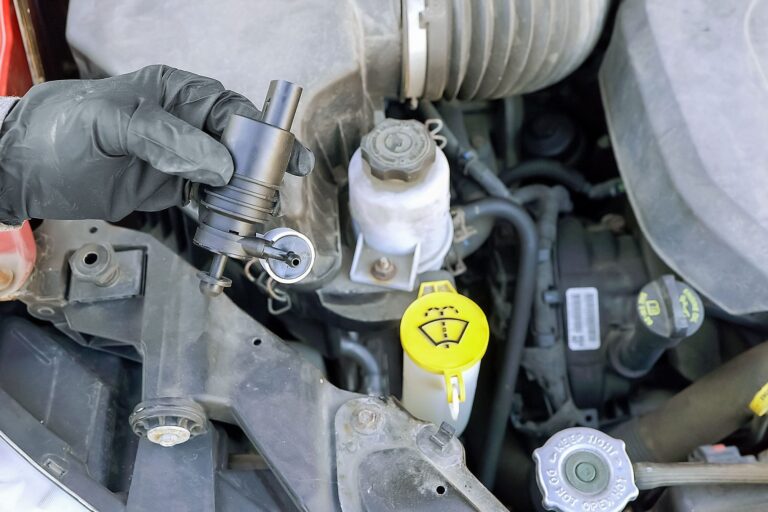
Yes, freezing can contribute to washer pump problems, especially when ice blocks the pump’s intake or outlet. The exact outcome depends on the pump design, the location of the ice, and how the driver uses the system while it is frozen.
A pump that makes noise but does not spray may be facing a blockage rather than an electrical failure. A silent pump may indicate a blown fuse, wiring issue, failed switch, or defective motor. These symptoms alone do not establish the cause, so diagnose the system after it has thawed.
Do not force the system
Avoid repeated or prolonged washer activation when the fluid may be frozen.
Allow full thawing
Warm the vehicle in a suitable place before testing the pump again.
How to Tell If Your Windshield Washer Fluid Is Frozen
A washer system that stops spraying during freezing weather may contain ice, but several other faults can produce the same result. Start with simple visual checks and avoid taking apart the system before confirming that the fluid has had time to thaw.
Park safely and inspect the reservoir if its location and level are visible without removing parts. Check for a low fluid level, signs of leakage, and ice around the accessible spray nozzles. Never reach near moving belts or fans, and keep hands clear of hot engine components.
If the temperature is below the product’s rated limit, freezing becomes more plausible. If the vehicle is warm and the fluid has fully thawed but the washer still fails, investigate other causes rather than assuming the system remains frozen.
Source: pitstoparabia.com
No fluid comes out in freezing weather
Possible causes include frozen fluid, blocked nozzles, a restricted hose, an empty reservoir, or a pump problem.
The pump runs but nothing sprays
Ice or another blockage may be preventing flow. A damaged hose or disconnected line is also possible.
The pump is silent
Check the vehicle manual for the correct fuse location and inspection procedure. A wiring, switch, or motor fault may be responsible.
Fluid leaks beneath the vehicle
A loose connection, damaged hose, cracked reservoir, or other leak may be present. Have the system inspected if the source is unclear.
Frozen Fluid or a Clogged Nozzle?
Frozen fluid often affects the system during a cold spell and may improve after the vehicle warms up. A clogged nozzle can remain blocked in warmer weather, too. Mineral deposits, dirt, and debris may restrict the tiny spray openings.
Do not push a metal pin deep into a nozzle unless the vehicle manufacturer specifically permits that method. Some vehicles use delicate or specially shaped spray jets that can be damaged by sharp tools. Follow the owner’s manual or have a technician clean the nozzle.
Check temperature and fluid rating
Compare the current conditions with the washer fluid’s stated protection limit.
Thaw before testing
Once the system is fully warm, make a brief test to see whether the spray returns.
Investigate persistent faults
If the system remains inoperative, inspect the fuse, hoses, nozzles, connections, and pump as appropriate for the vehicle.
How to Thaw Frozen Windshield Washer Fluid Safely
The safest way to thaw frozen windshield washer fluid is to move the vehicle to a warmer, sheltered location and let the system warm gradually. A heated garage is often suitable if it is safe to use and has adequate ventilation. The amount of time required depends on the outside temperature, the vehicle, and where ice has formed.
Do not rely on starting the engine outdoors and waiting for engine heat to reach the reservoir. On many vehicles, the washer reservoir sits away from the engine, and some parts may remain cold long after the engine warms. A vehicle should never be left running in an enclosed garage because exhaust gases can cause carbon monoxide poisoning.
Avoid boiling water, open flames, heat guns, and other intense heat sources. Sudden temperature changes can damage plastic components, and direct heat can harm wiring, paint, or nearby parts. Gentle warming and patience are safer than trying to force a quick thaw.
Source: motorbiscuit.com
Move the vehicle to a warmer place
Use a suitable garage or sheltered location where the vehicle can warm gradually.
Wait for the fluid to thaw
Give the reservoir, hoses, and nozzles time to warm. A liquid reservoir does not prove that every passage is clear.
Check for leaks
After thawing, inspect accessible areas for wet spots, cracked parts, or loose hoses.
Test briefly
Use the washer control for a short test only after the system is thawed and the reservoir contains suitable fluid.
What If the Fluid Will Not Thaw?
A deeply chilled vehicle may need several hours in a warmer space before all the fluid and narrow passages thaw. Do not keep activating the pump while waiting. If you cannot move the vehicle to a warmer location, arrange professional help or wait for safer temperatures.
After thawing, replace an unsuitable summer mixture with the correct winter-rated product. If the reservoir contains a large amount of water or a mixture of unknown strength, draining and refilling may be more reliable than simply adding a small amount of winter fluid.
Do not add boiling water
It can cause thermal shock and may damage the reservoir or surrounding components.
Do not use household antifreeze
Engine coolant and other automotive chemicals are not substitutes for windshield washer fluid.
Seek repair if needed
Persistent leaks, electrical faults, or a pump that remains inoperative after thawing require further diagnosis.
How to Prevent Windshield Washer Fluid From Freezing
Preventing frozen washer fluid starts with choosing a product rated for the coldest conditions your vehicle is likely to encounter. Before winter arrives, check the fluid already in the reservoir and confirm that it is appropriate for the local forecast. A warm autumn day is a useful time to prepare before temperatures fall.
Use a ready-to-use winter product as directed or dilute a concentrate only according to its instructions. Adding water to a winter formula without checking the label can weaken its freeze protection. If summer fluid remains in the system, a partial top-up may not produce the cold-weather rating printed on the new container.
Keep enough suitable fluid in the reservoir for normal use, but do not overfill it beyond the manufacturer’s guidance. Check the system before a long winter trip, especially if the route crosses higher elevations or colder regions. The temperature where you start is not always the temperature you will face later.
Source: askmyauto.com
Choose the right winter rating
Select washer fluid that covers the lowest temperatures expected during your driving season.
Avoid unapproved dilution
Follow the product label. Extra water can reduce the mixture’s resistance to freezing.
Prepare before the first freeze
Replace unsuitable summer fluid before a cold snap rather than waiting until the system stops working.
Inspect the system
Repair leaks, damaged hoses, and faulty caps so the washer system remains ready for use.
Should You Mix Summer and Winter Washer Fluid?
Mixing summer and winter washer fluid can change the final freezing point. The result depends on the ingredients, the proportions, and the concentration of each product. Without reliable specifications for both mixtures, the final protection level cannot be calculated accurately.
If the reservoir contains a significant amount of summer fluid, do not assume that topping it off with winter fluid immediately gives the entire system the winter product’s full rating. Use the vehicle and product instructions to decide whether the old mixture should be removed before refilling.
Check compatibility
Follow the manufacturer’s guidance on whether the products can be mixed.
Do not guess the rating
A blend of two products may not retain the freezing protection claimed for either one individually.
Replace unknown mixtures
If the existing fluid’s composition is unclear and severe cold is expected, use a suitable method to remove it and refill the system.
Can You Use Water Instead of Windshield Washer Fluid in Winter?
Plain water is not a good substitute for winter windshield washer fluid. It freezes at about 32 degrees Fahrenheit under normal atmospheric pressure, which makes it unsuitable when temperatures reach or fall below freezing. Ice can block the system and leave the windshield without a reliable way to remove road grime.
Water also lacks the cleaning ingredients found in purpose-made washer fluid. It may remove some loose dirt, but it is less effective against oily road film, insects, and other residues. In winter, road salt and slush can quickly coat a windshield and reduce visibility.
Automotive washer fluid is designed for use on vehicle glass and through the washer system. Select a product that suits the weather and your vehicle’s requirements. If the reservoir currently contains water, replace it with an appropriate formula before freezing conditions arrive.
Source: cartreatments.com
Freezing risk
Water can freeze in the reservoir, hoses, and spray nozzles during cold weather.
Cleaning limits
Water may not remove road film or oily grime as well as a suitable washer fluid.
Wrong chemical substitutes
Do not use engine coolant, household detergents, or unapproved mixtures in the washer system.
Can You Add Rubbing Alcohol to Prevent Freezing?
Adding rubbing alcohol by guesswork is not a reliable way to make windshield washer fluid winter-ready. The alcohol concentration, other ingredients, and compatibility with the vehicle’s materials may be uncertain. Some mixtures may also damage components or leave unwanted residue on the glass.
Use a commercially formulated automotive washer fluid with a stated temperature rating. If you have already added an unapproved chemical, consult the vehicle manufacturer or a qualified technician about the appropriate way to drain and clean the system.
Use a formulated product
Choose automotive washer fluid intended for the expected temperatures.
Follow label directions
Do not add solvents or chemicals unless the product and vehicle manufacturers permit them.
Winter Washer Fluid Safety and Common Mistakes
A working washer system supports safe driving, but washer fluid itself must be handled with care. Many products contain alcohols or other ingredients that can be harmful if swallowed or mishandled. Read the label, keep the container closed, and store it away from children and pets.
Never assume that a fluid is safe to ingest because it resembles water or has a bright color. If a person or animal swallows washer fluid, contact the appropriate poison-control service or emergency veterinary service promptly and follow professional guidance. Do not induce vomiting unless a qualified professional directs you to do so.
Washer fluid should not replace safe winter driving practices. If the windshield becomes too dirty or icy to see through, slow down safely and stop in a suitable location. Do not continue driving with impaired visibility while hoping that the wipers or washer system will clear the glass.
Source: vautobasics.com
Never mix unknown chemicals
Mixing products can change performance and create unnecessary exposure risks.
Avoid direct heat
Do not use an open flame or high-temperature tool to thaw a frozen reservoir.
Use suitable ice-removal tools and approved deicing products when needed, following their labels.
Do not drive with poor visibility
Stop safely when the windshield cannot be kept clear.
What to Check Before a Winter Road Trip
Before a long trip, verify that the washer reservoir contains enough winter-rated fluid for the forecast conditions. Check that the front and rear washer systems work if your vehicle has both, and confirm that the wiper blades clear the glass without leaving broad streaks.
Review the weather along the full route, not just at your departure point. If severe cold is expected and the washer system is unreliable, repair it before traveling. A clear windshield is essential when spray from other vehicles, road salt, and melting snow can quickly obstruct the driver’s view.
Confirm fluid protection
Check the product rating against the forecast low temperature.
Test washer operation
Verify that fluid sprays evenly after the system has reached a suitable temperature.
Inspect wiper blades
Replace worn or damaged blades that cannot clear the windshield effectively.
Plan for changing weather
Carry appropriate winter supplies and allow time to stop safely if visibility deteriorates.
Frequently Asked Questions
Q
Can windshield washer fluid freeze overnight?
Yes. Washer fluid can freeze overnight if the temperature falls below the mixture’s freezing limit. Summer formulas, water-heavy mixtures, and fluid diluted with water are more vulnerable than a suitable winter formula. Check the product label and the overnight forecast to assess the risk.
Q
Will winter windshield washer fluid freeze at 0 degrees Fahrenheit?
It depends on the product. Some winter formulas are rated for temperatures around 0 degrees Fahrenheit, while others are designed for colder conditions. If the forecast may reach or fall below the stated limit, select a product with a lower temperature rating and follow its instructions.
Q
Can I drive with frozen windshield washer fluid?
A frozen washer system may leave road salt, slush, and grime on the windshield. If you cannot maintain a clear view, do not continue driving. Stop in a safe place and arrange for the system to thaw or be repaired before driving again.
Q
How long does it take for frozen washer fluid to thaw?
Thawing time varies with the outside temperature, the amount of ice, the vehicle design, and the location of the frozen passages. A vehicle may need several hours in a warm space, and narrow hoses or nozzles may take longer than the reservoir. Do not use boiling water or intense direct heat to speed up the process.
Q
Can I mix winter washer fluid with summer washer fluid?
Some products may be compatible, but mixing them can reduce or change the final freezing protection. The outcome depends on both formulas and their proportions. Follow the manufacturers’ directions, and do not assume that adding winter fluid to a partly full reservoir immediately provides the full temperature rating.
Q
Why does my washer pump run but no fluid comes out?
A running pump with no spray may indicate frozen fluid, a blocked nozzle, a restricted hose, a disconnected line, or another flow problem. Let the system thaw completely before testing it again. If fluid still does not spray, inspect the system or ask a qualified technician to diagnose the fault.
Q
Does windshield washer fluid expire or lose freeze protection?
Storage conditions and product formulation affect how well a washer fluid remains suitable for use. Follow the manufacturer’s shelf-life and storage instructions, and keep the container sealed. If the fluid’s identity or condition is uncertain, use a fresh product with a clear temperature rating rather than relying on an unknown mixture.
✦ Wrapping Up
Conclusion
Windshield washer fluid can freeze when the temperature drops below the mixture’s freezing point. Summer formulas and diluted mixtures are especially vulnerable, while winter-rated products are designed to protect the washer system in colder conditions. The exact temperature limit depends on the product, so the label matters more than the fluid’s color or brand name.
If your washer system freezes, move the vehicle to a suitable warm location and let the reservoir, hoses, and nozzles thaw gradually. Avoid boiling water, open flames, unapproved chemical additives, and repeated pump operation while the system may be blocked. Once thawed, check for leaks and test the system briefly.
Preparing before the first freeze is usually easier than dealing with a blocked washer system during a winter trip. Choose fluid rated for the expected low temperatures, avoid unapproved dilution, and inspect the wipers and washer system before driving in snow or on salt-treated roads.
💡 Key Takeaway
Check the temperature rating on your windshield washer fluid today. If it does not cover the coldest temperatures expected where you drive, replace it with a suitable winter formula before the next freeze.
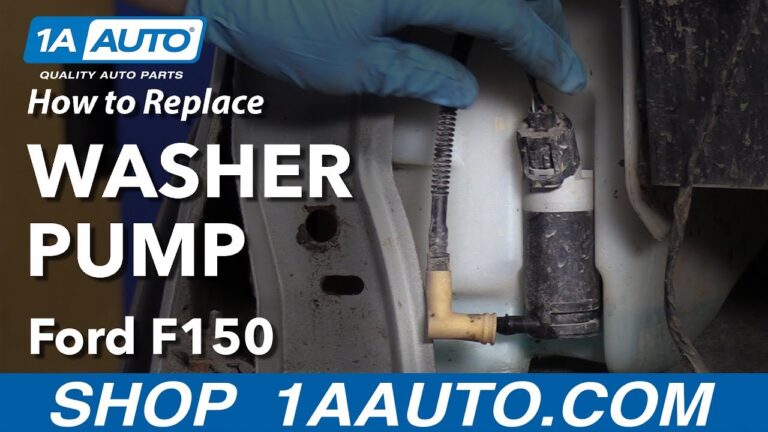
Learn how to replace a windshield washer pump on a Ford F-150, including diagnostic checks, tools, removal steps, installation tips, and troubleshooting.
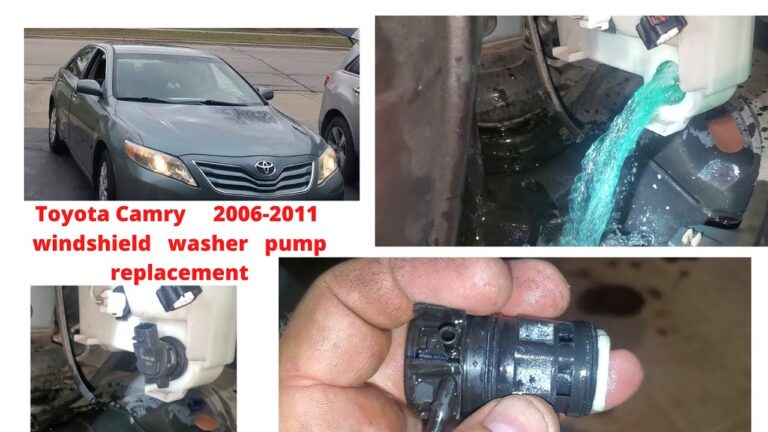
Learn how to replace a Toyota Camry windshield washer pump, diagnose pump failure, access the reservoir, install a new pump, and test the washer system.